Ebook Info
- Published: 2002
- Number of pages: 330 pages
- Format: PDF
- File Size: 5.16 MB
- Authors: E. Roy Weintraub
Description
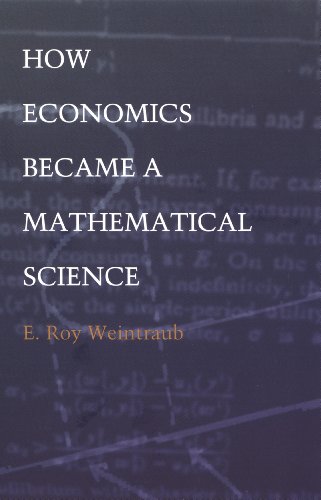
In How Economics Became a Mathematical Science E. Roy Weintraub traces the history of economics through the prism of the history of mathematics in the twentieth century. As mathematics has evolved, so has the image of mathematics, explains Weintraub, such as ideas about the standards for accepting proof, the meaning of rigor, and the nature of the mathematical enterprise itself. He also shows how economics itself has been shaped by economists’ changing images of mathematics.Whereas others have viewed economics as autonomous, Weintraub presents a different picture, one in which changes in mathematics—both within the body of knowledge that constitutes mathematics and in how it is thought of as a discipline and as a type of knowledge—have been intertwined with the evolution of economic thought. Weintraub begins his account with Cambridge University, the intellectual birthplace of modern economics, and examines specifically Alfred Marshall and the Mathematical Tripos examinations—tests in mathematics that were required of all who wished to study economics at Cambridge. He proceeds to interrogate the idea of a rigorous mathematical economics through the connections between particular mathematical economists and mathematicians in each of the decades of the first half of the twentieth century, and thus describes how the mathematical issues of formalism and axiomatization have shaped economics. Finally, How Economics Became a Mathematical Science reconstructs the career of the economist Sidney Weintraub, whose relationship to mathematics is viewed through his relationships with his mathematician brother, Hal, and his mathematician-economist son, the book’s author.
User’s Reviews
Reviews from Amazon users which were colected at the time this book was published on the website:
⭐This book is a good introduction to how economics forgot the life-world as horizon of experience for humane sciences.
⭐Excellent background for understanding contemporary economics. Incisive but not judgmental.
⭐Delivery conform to expectations
⭐E. Roy Weintraub investigates the relationship between the development of mathematics and economics. He argues that by ignoring that mathematics too is a changing field, historians of economic thought have missed important distinctions. In clarifying the strange relationship between Marshall and mathematical methods in economics he shows how this distinctions give new, important insights. He traces the story of the mathematician Griffith C. Evans and his attempt to do mathematical economics like physics with quantifyable data (influenced by Volterra). In his next chapter he looks at Hilberts influence in mathematics, which is distinct from his impact on metamathematics. Having set the stage for abstract formalisms, he investigates how Gerard Debreu has brought the views of Nicolas Bourbaki, a important abstractionist movement, into economics.The following two chapters aim to clarify the differences between mathematical and economic culture. As an illustration, he gives a account of a unfruitful correspondence between Don Patinkin and the eccentric mathematician, Cecil Phipps, who also was influencial in the puplication of the famous existence proof of Arrow and Debreu.After this, Weintraub get’s personal and tells the story of his economist father and mathematician uncle and how economics become a topic for well trained mathematicians. Weintraub also tells his own story of a economist turned mathematician as a example of a large inflow of mathematicians into economics.The last chapter is dedicated to methodological issues.
⭐Dr. Weintraub possesses an understanding of the progression of economic thought–and the sciences in general for that matter–that is incredibly sophisticated and, simultaneously, surprisingly accessible. Weintraub illustrates the importance of CONTEXT–each chapter masterfully contextualizes the concepts of mathematics and economics in living history as they were perceived by the protagonists, reminding us that meanings and objectives change, get tangled with each other, cause myriad misunderstandings and misinterpretations, but also inspire the creation of novel methods. It becomes clear that overly linear and logically atomized constructions of the sciences lead to spurious problems and unanswerable questions (wait until you meet Debreau).Marshall’s nineteenth-century mathematics is practically inseparable from its numerous physical applications, and he gradually becomes out of touch with the field as the Hilbertian axiomatization program takes form and math becomes its OWN (ideally) pristine entity. A stubborn mathematics professor from the University of Florida tries desperately to reject the Arrow-Debreau paper because he badly misinterprets certain economic assumptions. Weintraub’s subjects are woven effortlessly throughout and through each episode. We ultimately arrive at Weintraub’s personal narrative and watch as the massive moves in economics hit home and affect the professional lives of his father, uncle, and years later, the author himself–creating another stimulating and rich narrative layer for the reader to consider.A basic history usually provides two dimensions, a linear progression of A begetting B begetting C. A better history considers complex, multi-directional factors that zip around in three dimensions colliding, reinforcing, negating, colluding. Weintraub’s account, alas, gives us the rare privilege of four dimensions.Provocative, unique, sophisticated, and accessible, I recommend this work to anybody remotely curious about the history of economic thought.
⭐I do not know who Michael Brady is, nor what his difficulties are. His comments on this book however are bizarre. Not one element of his “note” is connected to anything I wrote in this book, which is a history, not a presentation of Keynes. He seems to have a personal interpretation of Keynes, sort of like a personal relationship with God, and it seems to lead him to think anyone else cares, or is presenting counter-interpretations. This is wild stuff. Read the book for yourself, or any of the more than a dozen published reviews in several languages, or the award citations from the History of Economics Society or The Society for the History of Economics (each of which presented this book with its best book award), to check my veracity.
⭐I don’t like history all that much, but this book convinced me otherwise. If you like the reading about the history of mathematics and the axiomatic foundations out economic theory, this book is for you.
⭐This book certainly ranks as one of the more interesting that I have read of late. It makes a great point that the history of economics is, to a degree, linked with the history of mathematics. Economists, in other words, aren’t just hostage to their own upbringing and life experiences when it comes to significant views they espouse (Irving Fisher is a great example of this), but they are also hostage to their understanding and even upbringing in mathematics.You might not know it, but a number of people that economists like me think of as being economists (Gerard Debreu is a good example) are really mathematicians who turned their hand to economics later in life. Little wonder, then, that their contributions to economics are so math-heavy.So much for the good things about this book. On the other hand, it is a challenging read for non-specialists. I reckon I only understood about 20% of what was written.But it is a real eye-opener nonetheless (if it wasn’t, I’d easily only have given it two or three stars in my review).
Keywords
Free Download How Economics Became a Mathematical Science (Science and Cultural Theory) in PDF format
How Economics Became a Mathematical Science (Science and Cultural Theory) PDF Free Download
Download How Economics Became a Mathematical Science (Science and Cultural Theory) 2002 PDF Free
How Economics Became a Mathematical Science (Science and Cultural Theory) 2002 PDF Free Download
Download How Economics Became a Mathematical Science (Science and Cultural Theory) PDF
Free Download Ebook How Economics Became a Mathematical Science (Science and Cultural Theory)