Ebook Info
- Published: 1991
- Number of pages: 189 pages
- Format: PDF
- File Size: 2.23 MB
- Authors: E. Roy Weintraub
Description
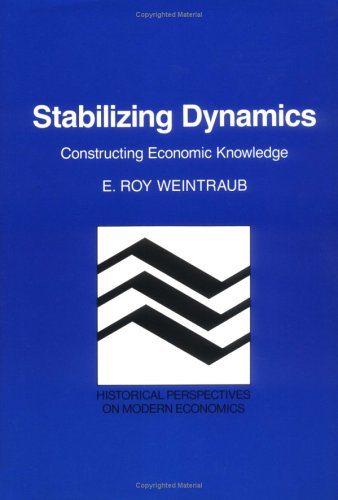
Today, economic theory is a mathematical theory, but that was not always the case. Major changes in the ways economists presented their arguments to one another occurred between the late 1930s and the early 1950s; over that period the discipline became mathematized. Professor Weintraub, a noted scholar of the modern history of economic thought, argues that those changes were not merely cosmetic: The mathematical forms of the arguments significantly altered the substance of the arguments. Stabilizing Dynamics is particularly concerned with the ways in which the rich and confusing talk of the 1930s evolved, over a fifteen-year period, into technical analysis of some mathematical structures. The author describes the context for the history of that change, locating it in the broader intellectual currents, and shows how the history of modern economics can be seen as a confluence of several disparate traditions. Historiographically, this book offers one of the first constructivist accounts of modern economic analysis.
User’s Reviews
Editorial Reviews: Review “The title of Roy Weintraub’s pioneering, thought-provoking book has an intentional double meaning, describing both his subject and thesis…Weintraub’s demonstration that there is no single ‘true’ interpretation of this episode in the history of economic thought also raises a question: Why should we care more about his interpretation than any other? It is precisely because he does not answer this question that his case for alternative socially constructed interpretations is convincing….challenging and persuasive.” Journal of Economic History”Stabilizing Dynamics is clearly a very important contribution to the literature [not only] in the purely historical sense…[but because it] is the first major constructive study in the history of economic thought.” Economic Journal”The virtues of this book are at least three. It is very well-written; it offers a reasonably comprehensive and very interpretive history of dynamic analysis…and it offers quite a persuasive example of studying economic ideas in their original time and place. It is worth buying, reading, and recommending.” The Philosophy of Science”An important contribution to our understanding of the history of general equilibrium analysis…and a manifesto for a particular way of doing history.” Journal of the History of Economic Thought”Weintraub’s analysis of economics as discourse–of economics not as truth but as the imposition of discursive order– is brilliant.” Warren Samuels
Reviews from Amazon users which were colected at the time this book was published on the website:
⭐Weintraub has written a book on the creation and growth of macroscopic economic knowledge over time.The story starts with the publication of Keynes’s General Theory(GT).Unfortunately,Weintraub is ignorant of the basic mathematical model specified by Keynes in the GT in chapters 20 and 21.Throughout the book,Weintraub is constantly talking about questions of stability and equilibrium and how these terms are supposed to be interpreted and understood relative to a particular economist.On pp.28-29,these questions are related to Keynes’s GT,especially Keynes’s discussion of these topics within a macro framework of business cycle fluctuations.He provides the reader with Patinkin’s conclusion that Keynes’s claim of having demonstated the possibility of having a less than full employment equilibrium(a stable unemployment equilibrium at less than full employment)was impossible.Therefore,Keynes must have meant that there was a dynamic long run underemployment disequilibrium or this is the way he must be interpreted.Weintraub then states the following:”I am not suggesting that this reading of Keynes is wrong or right.I am suggesting that this reading interprets and reconstructs in the same way that every reading of a text is an interpretation,a reconstruction”(Weintraub,p.29).Nowhere in any of these discussions is any attempt made to examine the formal mathematical model that Keynes provided the reader of the GT.Keynes called his model the D-Z theory of effective demand.Assuming that a reader of the GT is able to integrate derivatives(TAKE THE ANTIDERIVATIVE),the expected aggregate supply function is Z=g(N)=P+wN,where P equals expected economic profit,w is a constant money wage,and N is aggregate employment.The expected aggregate demand function is D=f(N)=pO,where p is an expected price and O=F(N)is real output.The actual or current aggregate demand function is Y=C+I,where C=a+bY(or C=bY).Keynes’s technical result is that w/p=MPL/(MPC+MPI).w/p is the expected real wage,MPL is the marginal product of labor,MPC is the marginal propensity to spend on consumption goods, and MPI is the marginal propensity to spend on investment goods.Patinkin’s static,stable equilibrium result is only specified if w/p=MPL.According to Patinkin,this is the only equilibrium possible.Of course,Patinkin,like Pigou and a host of other classical and neoclassical economists,is thinking of the special case where MPC+MPI=1.Keynes generalized this result,showing that if MPC+MPI<1,unemployment equilibria are possible within a static framework.These multiple equilibria are stable,given that the MPC<1.Weintraub needs to completely rewrite this book and incorporate into it a discussion of Keynes's mathematical model.There is no need for any reinterpretation and/or reconstruction.
Keywords
Free Download Stabilizing Dynamics: Constructing Economic Knowledge (Historical Perspectives on Modern Economics) in PDF format
Stabilizing Dynamics: Constructing Economic Knowledge (Historical Perspectives on Modern Economics) PDF Free Download
Download Stabilizing Dynamics: Constructing Economic Knowledge (Historical Perspectives on Modern Economics) 1991 PDF Free
Stabilizing Dynamics: Constructing Economic Knowledge (Historical Perspectives on Modern Economics) 1991 PDF Free Download
Download Stabilizing Dynamics: Constructing Economic Knowledge (Historical Perspectives on Modern Economics) PDF
Free Download Ebook Stabilizing Dynamics: Constructing Economic Knowledge (Historical Perspectives on Modern Economics)