

Ebook Info
- Published: 1950
- Number of pages: 288 pages
- Format: PDF
- File Size: 11.49 MB
- Authors: David Chandler
Description
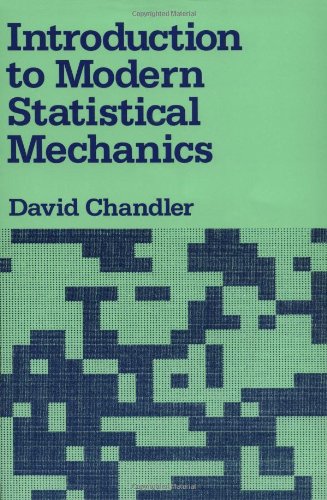
Leading physical chemist David Chandler takes a new approach to statistical mechanics to provide the only introductory-level work on the modern topics of renormalization group theory, Monte Carlo simulations, time correlation functions, and liquid structure. The author provides compact summaries of the fundamentals of this branch of physics and discussions of many of its traditional elementary applications, interspersed with over 150 exercises and microcomputer programs.A solutions manual for this text is available with ISBN: 9780195058895.
User’s Reviews
Editorial Reviews: Review “The exposition is very clear, and although elementary, this book is an example of a text which requires a large degree of reader participation. . . . People teaching modern statistical physics will like the book and those who prefer a more traditional approach will be pleasantly surprised to see a new way in which all traditional subjects can be included in a textbook, so it can be a valuable tool in teaching any course of statistical physics.” ―Mathematical Reviews”There is clearly a strong case for any textbook which seeks to provide a continuous thread from tradition to modernity. Chandler’s book seems to be the first attempt at such a task….Suitable for undergraduates and first-year graduate students, [it] aims to provide an introduction to modern concepts and techniques in statistical mechanics without presupposing an undue degree of previous exposure to the subject. I strongly suspect that this book will prove popular with students and teachers alike.”―The Times Higher Education Supplement”Exactly what I was looking for. I will also use this in my graduate course.”―Greg H. Zimmerman, Tennessee State University”An excellent introduction emphasizing major modern topics such as Monte Carlo sampling, renormalization groups. and the fluctuation-dissipation theorem.” ―American Mathematical Monthly”The text is clear and spare and addresses the latest developments in statistical mechanics in a manner an undergraduate could readily understand.” ―New Scientist”A refreshing, lucid and much-needed textbook in an area which remains inaccessible to many students.”―G. P. Matthews, Plymouth Polytechnic, England”Chandler’s book gives an excellent introduction to statistical mechanics, and is highly recommended to any student majoring in physics or chemistry.” ―SIAM Review”The book is highly recommended for the excellent discussions that it contains.” ―American Scientist”A breezy and enthusiastic guide with quite solid content. All in all this is an outstanding job.” ―Physics Today”This is a book which pleases in many ways. The author’s style is engaging, the questions sprinkled throughout the whole book are both entertaining and interesting.” ―Education in Chemistry About the Author David Chandler is at University of California, Berkeley.
Reviews from Amazon users which were colected at the time this book was published on the website:
⭐This is a beautifully written book, very short which leaves a lot more time for thinking. The way the concepts are ordered and presented makes it very easy to keep in mind the bigger picture of the theory you’re trying to develop (statistical mechanics), and probably the fact that it leaves out many extraneous topics helps with that too.I disagree with those who say it’s not a good introduction. I was a sophomore when I first took thermodynamics and retained none of it. Two years later I was able to tackle this book, though with a lot of hard work. It’s graduate statmech, it’s not going to be easy, but once you start to understand some things you’ll come away feeling very satisfied with what you know. The book is pretty modern and includes a chapter on Monte Carlo methods, which are ubiquitous in the field. Ising-type models are also motivated even before the chapter on systems with interacting particles, which is great because it is a really good model to help frame statmech problems, and are used in many research fields.I would highly recommend this book to anyone with sufficient knowledge of general math and physics. I think ultimately it’s about how mature you are as a student that will determine how well you can get through this book. If it’s helpful, it’s probably on the same level as Sakurai for QM, although Chandler is more terse.
⭐I first bought this textbook when taking a graduate level stat mech course. This book was recommended together with the textbook by Hill, I found this textbook to be, by far, the most useful. It is very concise and easy to follow, I found myself reading entire chapters which is not something I typically do. The book is also excellent as a reference, and I have used it as such when acting as a TA for undergraduate stat mech. Information is easy to find, due to the concise nature of this textbook you wont have to dig through pages of filler text to find what you are looking for.There are only two minor disadvantages with this book in my opinion; most of the practice problems are not that useful, and the book is a bit pricy. Despite these minor disadvantages I definitely recommend this book to anyone who wants to learn about statistical mechanics.
⭐This book is a model for graduate textbooks. It is clear, concise and interesting to read. The portions of the class I took that were covered by this book were made so much easier by Chandler’s ability to say what needs to be said and give you enough information that a serious student can fill in the details and learn the material.The only minor fault is that it has no answers the to exercises, not even numerical ones where you could check your answer without giving anything away.Also, the book is rarely used (why I don’t know) so don’t expect to find tons of solutions to the problems on the web.I am about to start studying Monte Carlo methods on my own and I intend to start with the relevant material in this book.
⭐My statistical mechanics class for my Physics PhD used about 4-5 books and the professor lectured from none of them but instead used his own notes. This little book basically taught me all I needed to get an A in his class. It is spectacular. Nice and short, but it cuts out what you don’t need. The derivation of PV=nRT is one of the nicest results in stat mech, and following Prof Chandlers’ proof will aid you in almost ANY homework assignment that your professor might throw at you.
⭐not a good intro level book even at the graduate level as it often skips steps and assumes a pretty high base knowledge of the subject, but there are not many better options out there and it’s probably the required text anyway
⭐Very densely written book that assumes you already have a deep familiarity with the subject. He doesn’t begin with a definition and provide examples to stimulate further development, instead he often jumps into a discussion of properties and consequences of thermodynamic principles without clearly stating them first. When he does attempt a definition of a principle, it reads something like this: “There is an extensive function of state,S(E,X) which is monotonically increasing function of E, and if state B is adiabatically accessible from state A, then S_a Free Download Introduction to Modern Statistical Mechanics 1st Edition in PDF formatKeywords
Introduction to Modern Statistical Mechanics 1st Edition PDF Free Download
Download Introduction to Modern Statistical Mechanics 1st Edition 1950 PDF Free
Introduction to Modern Statistical Mechanics 1st Edition 1950 PDF Free Download
Download Introduction to Modern Statistical Mechanics 1st Edition PDF
Free Download Ebook Introduction to Modern Statistical Mechanics 1st Edition