

Ebook Info
- Published: 1985
- Number of pages: 276 pages
- Format: PDF
- File Size: 10.42 MB
- Authors: P.G. Harper
Description
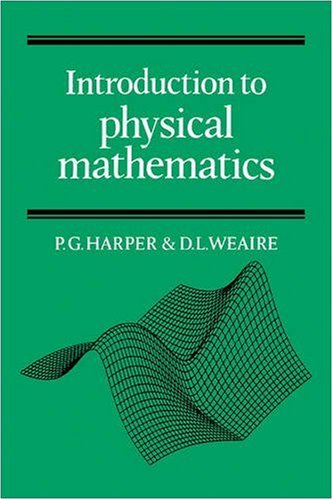
Directed primarily at college and university undergraduates, this book covers at basic level the essential applications of mathematics to the physical sciences. It contains all the usual topics covered in a first-year course such as vectors, matrices, differential equations, basic mathematical functions and their analysis, and power series. There is a strong emphasis on qualitative understanding (such as curve sketching) and practical methods of solution. The latter take due account of the impact of computers on the subject. The principles of mathematical expression are illustrated by copious examples taken from a wide range of topics in physics and chemistry. Each of the short chapters concludes with a summary and a large number of problems.
User’s Reviews
Editorial Reviews: Book Description Directed primarily at college and university undergraduates, this book covers at basic level the essential applications of mathematics to the physical sciences.
Reviews from Amazon users which were colected at the time this book was published on the website:
⭐This is an excellent book for giving a clear understanding of the conceptual forest of first year math for physicists, chemists and engineers. Chapters are short, concentrating on the essentials, up to and including the level of vector fields and differential equations (ordinary and partial). Focus is on uses of math as a tool in various physics contexts, not on definitions, theorems and proofs appropriate to math majors (though they could benefit by seeing this approach in addition).My only reason for not giving the 5th star is that, while the exercises are extensive, expand on the text and are therefore essential, some would be very difficult if you were relying purely on the chapter material to answer them. Additionally, although it is not completely necessary to be familiar with the physics to answer the math questions, it would provide helpful context for the problem and how the math aids the physics. Hence, to get the most out of the book, it is not completely self contained.That said, I highly recommend this to a freshman physicist in a challenging course at the beginning, or at the end to appreciate the essentials.
⭐
Keywords
Free Download Introduction to Physical Mathematics in PDF format
Introduction to Physical Mathematics PDF Free Download
Download Introduction to Physical Mathematics 1985 PDF Free
Introduction to Physical Mathematics 1985 PDF Free Download
Download Introduction to Physical Mathematics PDF
Free Download Ebook Introduction to Physical Mathematics