Ebook Info
- Published: 2004
- Number of pages: 172 pages
- Format: PDF
- File Size: 11.06 MB
- Authors: Vladimir I. Arnold
Description
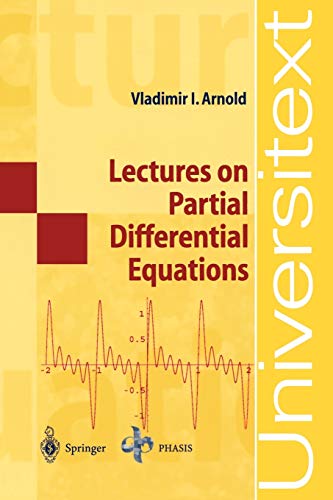
Choice Outstanding Title! (January 2006)This richly illustrated text covers the Cauchy and Neumann problems for the classical linear equations of mathematical physics. A large number of problems are sprinkled throughout the book, and a full set of problems from examinations given in Moscow are included at the end. Some of these problems are quite challenging! What makes the book unique is Arnold’s particular talent at holding a topic up for examination from a new and fresh perspective. He likes to blow away the fog of generality that obscures so much mathematical writing and reveal the essentially simple intuitive ideas underlying the subject. No other mathematical writer does this quite so well as Arnold.
User’s Reviews
Editorial Reviews: Review From the reviews of the German edition:”This book provides an introductory text (in German) to basic partial differential equations, based on the author’s lectures at Moscow University. […] Most of the standard themes are treated (see list below), but some unusual topics are covered as well. For instance, in chapter 10 double layer potentials are considered, and chapters 11 and 13 deal (among others) with Maxwell’s theorem on the multipole expansion of spherical functions. The style of the book is quite non-technical (it contains almost no estimates), taking a mainly geometric viewpoint. […]”Markus Kunze, Zentralblatt für Mathematik 1076.35001From the reviews:”[…] This excellent and stimulating textbook gives a beautiful first view on some basic aspects of the theory of partial differential equations and can be warmly recommended to any graduate student in mathematics and physics.”M.Günther, Zeitschrift für Angewandte Analysis und Ihre Anwendungen, Vol. 24, Issue 4, 2005″…..Arnold .. has long held a reputation as one of the world’s leaders in dynamics and geometry. His Lectures survey big ideas; accordingly, he largely suppresses both the functional analytic formalism and the delicate estimates so characteristic of the subject. He takes the viewpoint that the most important PDEs arise in physics and the most important mathematical ideas contributing to their solution derive from physical principles. Amold concentrates on the simplest equations of a given type and shows how the key ideas play out. For example, he attacks the general theory of one first-order equation, first via wave-particle duality, then via Hamiltonian dynamics. …. The author’s stature and the book’s lucidity make this an essential acquisition for all College libraries. ….”D.V.Feldman, CHOICE, January 2005 Vol. 42 No. 05″… Professor Arnold’s Lectures on Partial Differential Equations is an ambitious, intensely personal effort to reconnect the subject with some of its roots in modeling physical processes. He does so in a lively lecture-style format, resulting in a book that would complement almost any course in PDEs. …As can be gleaned from the previous paragraph, we bouth found the book by V.I.Arnold most stimulating and thought provoking, leading to statements such as, “It has been years since I enjoyed a book so much” by RBG and “I cannot point to any other book in mathematics written with the same intensity” by EAT. …… what follows […] is a beautiful book on PDEs, interwoven with the exposition of deep physical, geometrical, and topological insights that contribute to both the understanding and history of PDEs. Prof. Arnold’s book … connects with the roots of the field and brings in concepts from geometry, continuum mechanics, and analysis. It can be used together with any book on PDEs and students will welcome its directness and freshness. We know of no other book like it on the market and highly recommend it for individual reading and as an accompaniment to any course in PDEs. …”R.B. Guenther, E.A.Thomann, SIAM Review, Vol. 47, No. 1, 2005″This book contains the transcripts of twelve lectures on partial differential equations … . The presentation gives a vivid sense of what was actually said and discussed in the lecture course, and in this fashion the book differs markedly from many text books with similar titles. … The author uses physical intuition to derive the various mathematical theories, and is thus able to explain the ideas … in a fashion which is clear and helpful to both novice and expert.” M. Groves, ZAMM-Zeitschrift für Angewandte Mathematik und Mechanik, Vol. 85 (4), 2005″[…] In brief, this book contains beautifully structured lectures on classical theory of linear partial differential equations of mathematical physics. Professor Arnold stresses the importance of physical intuitions and offers in his lecture a deep geometric insight into these equations. The book is highly recommended to anybody interested in partial differential equations as well as those involved in lecturing on these topics. I encourage readers of this book to take note of the Preface which contains very interesting comments on the role of Bourbaki’s group in mathematics, a theme which resurfaces many times in these lectures.”J.Chabrowski, Gazette, Australian Mathematical Society, Vol. 31, Issue 5, 2004″… As a result the author has aimed to impart to students with pre-knowledge of only a basic kind (linear algebra, basic analysis, ordinary differential equations, …) the essence of the theory and applications of the subject of partial differential equations. Of course the subject is fundamental in mathematics and in physics and the author is an evangelist for keeping the subject mainstream for mathematicians and for physicists. He has attempted, he writes, to adhere to the principle of minimal generality, according to which every idea should first be clearly understood in the simplest situation! This is successfully done, so that this book should prove attractive in length and in scope to its target readership. … In this new excellent text are included a large number of interesting problems; at the end of the book there is a full set of problems from examinations given in Moscow. …”F.H.Berkshire, Imperial College London, Contemporary Physics 2004, Vol. 45, Issue 6″Like all Vladimir Arnold’s books, this one is full of geometric insight. Arnold illustrates every principle with a figure. This book aims to cover the most basic parts of the subject … . A large number of problems are sprinkled throughout the book, and a full set of problems from examinations given in Moscow are included at the end. Some of these problems are quite challenging!” L’Enseignement Mathematique, Vol. 50 (1-2), 2004″Dieses Buch betont geometrische Einsicht und physikalische Intuition. Die Prinzipien werden an Bildern erläutert, und das Buch enthält mehr Text als Formeln und Sätze. […]. Neben einer großen Anzahl von Übungsaufgaben, die im Buch verstreut sind, finden sich interessante Prüfungsbeispiele der Moskauer Universität.”J. Hertling, Internationale Mathematische Nachrichten, 2004, Issue 197, p. 47-48″The book is based on a short course of lectures delivered to the third year mathematics students of the Independent University of Moscow … . The book can serve as a nonstandard, geometrically motivated introduction to PDEs for students … . It is, probably, worth mentioning that the introduction contains some general philosophical views of the author on the subject of PDEs and modern mathematics as a whole and will be of interest to a broad mathematical audience.” (Victor Shubov, MathDL, January, 2001)”Like other books of Arnold, this is a very original introduction to the subject. It is … based on a course delivered to third-year students of mathematics. The aim of this book is to teach the fundamental ideas of partial differential equations and mathematical physics. … Not only students but also professional mathematicians from other fields of mathematics can learn the basic and simple ideas of partial differential equations from this unique book.” (Tibor Krisztin, Acta Scientiarum Mathematicarum, Vol. 74, 2008)
Reviews from Amazon users which were colected at the time this book was published on the website:
⭐OK, I did not read the book, just browsed through the pages. My first impression is that this is an excellent book, like most of Arnold’s books. It is not trying to cover the theory of Partial Differential Equations, and this cannot be done in a single book anyway – just selected topics on a very accessible level. The geometric insight is excellent and even a specialist can benefit from that. I highly recommend this book to undergraduates (and higher) that are passionate about analysis.I will update my review after I actually buy the book, I understand that I am not very helpful at the moment.Update: I read parts of the book and I still like it a lot. I however found to be aimed at more advanced readers. It is an excellent book to complement any of the standard PDE texts.
⭐Arnold’s geometric point of view of differential equations is really intriguing. These lectures treat the subject of PDEs by considering specific examples and studying them thoroughly. By this approach the author aims at presenting fundamental ideas in a clear way. However, the interetested reader should be acquainted with some geometric ideas of differential equations.
⭐On August 1, 2011, Congress amended the CPSIA to exclude ordinary books and ordinary paper-based printed materials from the third party testing and certification requirements of the CPSIA. An “ordinary book” as defined by the amendment, means: “a book printed on paper or cardboard, printed with inks or toners, and bound and finished using a conventional method, and that is intended to be read or has educational value.” H.R.2715.The manufacturer of the book containing this web address only manufactures ordinary books bound and finished in a conventional manner; thus, the books produced by this manufacturer are not subject to the testing and certification requirements of the CPSIA.The book is short, but insightful. Like his other books you will certainly encounter lots of geometric flavour.
Keywords
Free Download Lectures on Partial Differential Equations (Universitext) 2004th Edition in PDF format
Lectures on Partial Differential Equations (Universitext) 2004th Edition PDF Free Download
Download Lectures on Partial Differential Equations (Universitext) 2004th Edition 2004 PDF Free
Lectures on Partial Differential Equations (Universitext) 2004th Edition 2004 PDF Free Download
Download Lectures on Partial Differential Equations (Universitext) 2004th Edition PDF
Free Download Ebook Lectures on Partial Differential Equations (Universitext) 2004th Edition