

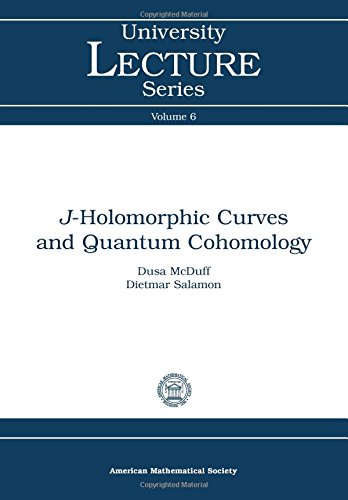
Ebook Info
- Published: 1994
- Number of pages: 209 pages
- Format: PDF
- File Size: 7.26 MB
- Authors: Dusa McDuff and Dietmar Salamon
Description
$J$-holomorphic curves revolutionized the study of symplectic geometry when Gromov first introduced them in 1985. Through quantum cohomology, these curves are now linked to many of the most exciting new ideas in mathematical physics. This book presents the first coherent and full account of the theory of $J$-holomorphic curves, the details of which are presently scattered in various research papers. The first half of the book is an expository account of the field, explaining the main technical aspects. McDuff and Salamon give complete proofs of Gromov’s compactness theorem for spheres and of the existence of the Gromov-Witten invariants. The second half of the book focuses on the definition of quantum cohomology. The authors establish that this multiplication exists, and give a new proof of the Ruan-Tian result that is associative on appropriate manifolds. They then describe the Givental-Kim calculation of the quantum cohomology of flag manifolds, leading to quantum Chern classes and Witten’s calculation for Grassmannians, which relates to the Verlinde algebra. The Dubrovin connection, Gromov-Witten potential on quantum cohomology, and curve counting formulas are also discussed. The book closes with an outline of connections to Floer theory.
User’s Reviews
Reviews from Amazon users which were colected at the time this book was published on the website:
⭐As the authors of this book explain, J-holomorphic curves are a generalization of holomorphic curves the latter of which solve the Cauchy-Riemann equations. The Cauchy-Riemann equations are replaced by an expression involving the differentials of a map of a Riemann surface into a closed symplectic manifold M and what is called an `almost complex structure’ J on M, which has the property that J^2 = -1. If J is chosen to be `compatible’ with the symplectic structure w on M, then this allows the use of hermitian geometry and then one can show that the area of a J-holomorphic curve is a symplectic invariant for M. Such a strategy for finding an invariant of a symplectic manifold follows upon that of using ordinary holomorphic curves to study symplectic topology in four dimensions. If one can find a single holomorphic curve with the right local properties, then the manifold in which it is embedded can in a sense be determined by the holomorphic curve.But the applications of J-holomorphic curves to symplectic geometry is much more involved than some of these relatively elementary constructions, but in order to appreciate these applications readers of this book will have to pay close attention to the details in these constructions. The authors do not always give the necessary insight to understand them, and so some outside reading will be required in order to gain this insight. For example, it is advantageous when reading this book to stand back from the formalism from time to time and think clearly about what kind of geometric consequences come from some of stated conditions. One example is to think of the closure condition on a symplectic form as representing the fact that the symplectic area of a surface with boundary does not change as the surface moves, as long as the boundary is held fixed. Another example is to view a J-holomorphic curve as giving a method by which one can cut a cylinder into 2-dimensional slices of area pi r^2. Still another example would be to view J as essentially being a rotation by a quarter turn, and that an almost complex structure is a collection of such rotations, one for each point, that varies smoothly as a function of the points. And, as contrasted with the case of complex structures, almost complex structures have no local symmetries. Locally though, J-holomorphic curves behave like holomorphic curves, but J is not integrable in general.Also important for readers is to have an understanding of the images of J-holomorphic maps in the target manifold, and so for this purpose it might be necessary to review the connection between embeddings and compactness. Along these lines, it is helpful to note that the image of a J-holomorphic map is not necessarily an embedding, and in addition J-holomorphic curves are parametrized and are only “approximately holomorphic” in the sense that they are not obtained from zero sets of sections of line bundles. In the book it is shown a J-holomorphic map is simple (not a multiple cover of any other curve) and has at most finitely many self-intersections and critical points.One of the most important discussions in this book though has to be on the topic of the compactification of the moduli space of J-holomorphic curves and its relation to the interesting phenomenon of “bubbling”. It might be a struggle for the reader to visualize what is going on with bubbling, since examples in the book are lacking. But since the energy of a non-constant J-holomorphic curve cannot be arbitrarily small, bubbling can only occur near finitely many points, and the “energy density” is concentrated at isolated points. Readers can find other examples of bubbling in the mathematical literature, such as in the Yamabe equation and the Yang-Mills equation, which are elliptic equations that have nonlinear terms that do not satisfy the Sobelev inequalities. If readers are willing to consult outside sources, they will find that many of the examples of bubbling take place in the context of maps between 1-dimensional and n-dimensional complex projective space. These examples are fairly clear if readers are familiar with the Fubini-Study metric on n-dimensional complex projective space. The most important thing to learn from these examples is that there can be several different bubbles for a curve, depending on the scaling and the parametrization, but the genus of the curve is to be unchanged in the limiting process. The preservation of the genus is the origin of the interest in the study of `stable maps’.The compactification of the moduli space makes use of what are called `cusp curves’ in the book, which are essentially unions of J-holomorphic spheres, the latter of which can be parametrized by a smooth non-constant J-holomorphic map from one-dimensional complex projective space into the symplectic manifold of interest. Cusp curves can represent a homology class A, and along with an `evaluation map’, are used to construct “strata” which are essentially images of evaluation maps on space spaces of simple cusp curves. If W is the moduli space of evaluation maps, its closure will be described by a stratified space. An evaluation map is used to obtain a `pseudo-cycle’ for a generic almost complex structure. The image of this map can be compactified by adding pieces of codimension greater than or equal to 2, and it carries a `fundamental class’ that is independent of J. The strategy of the proof of compactification is to choose a regular path of almost complex structures, to arrive at a cobordism between the endpoints of these almost complex structures. The proof of compactification and its use of evaluation maps motivated the construction of the famous Gromov-Witten invariants for symplectic manifolds, which are defined as the number of isolated curves which intersect specified homology cycles in the symplectic manifold. The authors show that there are two different special of looking at these invariants, one where the curve can intersect cycles anywhere, and one where the intersection points are fixed.Of course the most important part of the book is the discussion on quantum cohomology, and readers with a background in quantum physics/quantum field theory will no doubt immediately raise the question as to why the adjective “quantum” is used to describe this cohomology theory. In the opinion of the reviewer, the closest justification is in the context of the Floer theory wherein two curves are said to intersect if there is a J-holomorphic curve connecting them, thus making the intersection “uncertain” in some sense. Or, one could view the intersection from the standpoint of how the ordinary cup products in cohomology are “deformed” by “quantum” corrections. These corrections however are merely the result of taking the tensor product of the ordinary cohomology groups with a coefficient ring, the latter of which in the book is taken to be the collection of Laurent polynomials in variables of a chosen degree. There is nothing really “quantum” about this. The best way to view quantum cohomology however is to forget about any “quantum” interpretation and view it as a method of doing intersection theory, as of course it was designed to do. If one consults the research literature not referenced in this book, one will find that the variable q in the coefficient ring raised to a power d has a natural interpretation in terms of complex projective spaces, wherein one is interested in the intersection of hyperplanes. A projective hyperplane can be represented by a generator “p” in the second (ordinary) cohomology group of CP(n), whereas the intersection of two hyperplanes can be represented by squaring p, which is an element of the fourth (ordinary) cohomology group. If one continues to do this, namely if one takes the intersection of n generic hyperplanes, then this can be represented by p^n, which is an element of the 2n (ordinary) cohomology group of CP(n). If another intersection is attempted, then the empty set will result, and so one could view the ordinary cohomology of CP(n) as represented by Q[p]/p^(n+1). The “quantum” cup product will come into play when taking ordinary cup products of the generators p raised to some powers. Defining p^(n+1) = q, if one cups p^k with p^l and takes the quantum cup product with p^m, then one will obtain various powers of q depending on how k, l, m are related to n. For example, if k + l + m = n, then one will obtain q^0, which is viewed as degree 0 holomorphic spheres passing through the cycles p^k, p^l, and p^m. If k + l + m = 2n + 1, then the quantum cup product gives q^1, which because of the exponent being equal to 1 is viewed as all lines connecting p^k and p^m. These lines form a projective subspace of dimension l which meets p^l in one point. In general then the element q^d represents the contributions of the holomorphic spheres of degree d.All of these considerations about the element q^d are formalized when the the authors show how to prove associativity of the quantum cup product and the connection to the famous Novikov ring, which is taken to be the coefficient ring for the case of a closed symplectic manifold. The Novikov ring is the completion of the group ring of the second homology group of the symplectic manifold, and as such it allows the interpretation of quantum cohomology as being the encoding of information about the second homology of the symplectic manifold. This reflects the strategy of counting J-holomorphic curves in a given homology class. When the group ring has dimension 1 and the symplectic manifold is monotone, the Novikov ring will be the Laurent power series ring in q and q^(-1).
⭐
Keywords
Free Download J-Holomorphic Curves and Quantum Cohomology (University Lecture) in PDF format
J-Holomorphic Curves and Quantum Cohomology (University Lecture) PDF Free Download
Download J-Holomorphic Curves and Quantum Cohomology (University Lecture) 1994 PDF Free
J-Holomorphic Curves and Quantum Cohomology (University Lecture) 1994 PDF Free Download
Download J-Holomorphic Curves and Quantum Cohomology (University Lecture) PDF
Free Download Ebook J-Holomorphic Curves and Quantum Cohomology (University Lecture)