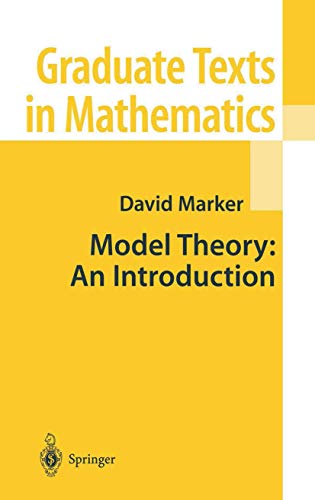
Ebook Info
- Published: 2002
- Number of pages: 345 pages
- Format: PDF
- File Size: 1.58 MB
- Authors: David Marker
Description
Assumes only a familiarity with algebra at the beginning graduate level; Stresses applications to algebra; Illustrates several of the ways Model Theory can be a useful tool in analyzing classical mathematical structures
User’s Reviews
Editorial Reviews: Review From the reviews:MATHEMATICAL REVIEWS”This is an extremely fine graduate level textbook on model theory. There is a careful selection of topics…There is a strong focus on the meaning of model-theoretic concepts in mathematically interesting examples. The exercises touch on a wealth of beautiful topics.””This is an extremely fine graduate level textbook on model theory. There is a careful selection of topics, with a route leading to a substantial treatment of Hrushovski’s proof of the Mordell-Lang conjecture for function fields. … The exercises touch on a wealth of beautiful topics. … There is additional basic background in two appendices (on set theory and on real algebra).” (Dugald Macpherson, Mathematical Reviews, 2003 e)”Model theory is the branch of mathematical logic that examines what it means for a first-order sentence … to be true in a particular structure … . This is a text for graduate students, mainly aimed at those specializing in logic, but also of interest for mathematicians outside logic who want to know what model theory can offer them in their own disciplines. … it is one which makes a good case for model theory as much more than a tool for specialist logicians.” (Gerry Leversha, The Mathematical Gazette, Vol. 88 (513), 2004)”The author’s intended audience for this high level introduction to model theory is graduate students contemplating research in model theory, graduate students in logic, and mathematicians who are not logicians but who are in areas where model theory has interesting applications. … The text is noteworthy for its wealth of examples and its desire to bring the student to the point where the frontiers of research are visible. … this book should be on the shelf of anybody with an interest in model theory.” (J. M. Plotkin, Zentralblatt Math, Vol. 1003 (03), 2003) From the Back Cover This book is a modern introduction to model theory which stresses applications to algebra throughout the text. The first half of the book includes classical material on model construction techniques, type spaces, prime models, saturated models, countable models, and indiscernibles and their applications. The author also includes an introduction to stability theory beginning with Morley’s Categoricity Theorem and concentrating on omega-stable theories. One significant aspect of this text is the inclusion of chapters on important topics not covered in other introductory texts, such as omega-stable groups and the geometry of strongly minimal sets. The author then goes on to illustrate how these ingredients are used in Hrushovski’s applications to diophantine geometry.David Marker is Professor of Mathematics at the University of Illinois at Chicago. His main area of research involves mathematical logic and model theory, and their applications to algebra and geometry. This book was developed from a series of lectures given by the author at the Mathematical Sciences Research Institute in 1998.
Reviews from Amazon users which were colected at the time this book was published on the website:
⭐This is really a 4.5 star rating, if possible, and despite its occasional hiccups, it is probably the best math book I’ve read (for context: as of this writing, I’m in my third year of grad school, focusing in Model Theory).Scope:This is really an introduction to model theory, as the field stands. The very, very basics are treated very quickly; he assumes that if you’re interested enough to buy a book on the topic, you know enough to get started. This is fine for me (and I assume most readers), but as one reviewer pointed out, this may not suit you if you have absolutely no background. It goes fairly deep into the subject (the table of contents is honest, check it if you like) and each chapter motivates the next fairly well, so you won’t find yourself looking for supplementary books to get through this one.The Good:The prose and the substance of the proofs are very well-written, and with a few exceptions, are easy to follow and feel quite natural. The proof techniques, instead of being overly slick, are easy to generalize, and you’ll often find yourself making new connections between concepts because of this.The exercises, in particular, are wonderful, ranging from quite easy to extremely difficult in roughly linear order, which gives a reader plenty of practice.The algebraic applications are plentiful and usually feel quite natural, and if you’re not interested in algebra, they are nonessential, and you can go back and read them later (or not at all) if you want to push on and learn more model theory instead.The Bad:The first (introductory) chapter has a very “I assume you’ve heard this before” feel to it, and if you haven’t, it’s quite rough. Most of it is very basic, but this is the only place he defines M^eq, which is a difficult and unfamiliar topic to most, and he really doesn’t explain it at all (or even define it very precisely).The fifth chapter (indiscernibles) feels rushed in a different way; the concepts are blasted at you like a cannon, unmotivated, and the theorems you prove with them are typically the easy cases of very hard theorems, with the proofs involved quite technical. It’s possible this is just the nature of the topic, but I think it’s more just that he has distaste for the subject and wanted to just get through it and past it.There are some typos. Serious typos. This is a bigger problem than it originally seems. Most of the time it’s clear what was meant, but sometimes it isn’t. There is a list of published errata, which gets about half of them, and most of the serious ones, but it’s frustrating.His assumption of your algebra skills is a little inconsistent and strange. I took a year of graduate algebra and he proved a lot of the basic things I’d seen before, but skipped the proofs of things I’ve never heard of and are rarely discussed outside of logic courses (i.e. real closed fields, differential fields).Summary:The book really is quite good. Assuming this is not your first exposure to the subject (perhaps taking a semester course in graduate logic beforehand) you will learn a tremendous amount. However, like all textbooks, not all subjects are covered perfectly, and it will help you to have an adviser (or just a colleague who knows model theory) to whom you can ask questions occasionally.
⭐This is a graduate level text–you will need mathematical maturity as well as a decent background in both logic and abstract algebra (the deeper your background the more you can gain). When I first purchased this book I had a difficult time appreciating the subtleties of the model theoretic approach to logic. Having had some time to ponder them, I have developed a deep appreciation of its power. Model theory is to predicate logic what analysis is to engineering calculus, it is enlightening, it is logic for grown-ups. Marker’s presentation is terse, for the most part he gives his definitions and theorems with very little comment. This is unfortunate because the essence of these definitions and theorems can usually be explained intuitively with just a sentence or two of plain English, much to the benefit of the learner. Also, there are a fair amount of typos, some of them damaging. For these two reasons, this book is not friendly to the beginner, and I myself did not like it at all when I first purchased it. With that said, I have since grown very fond of this text. Marker knows his subject well and this is reflected in the logical development. The theorems, their applications, and the many examples he gives are actually quite interesting, once you are with the program. I suspect that someone who has already had some model theory will find this book especially enjoyable. I also think this text can be put to very profitable use in the classroom–there is a great deal of power lying dormant here that can be unlocked by a professor with a good intuitive grasp of the subject. Briefly, Marker’s text is difficult for the beginner but well worth the reward if you perservere. Remove the typos and this is a five star book in my opinion.
⭐This is intended to be an introduction to abstract and applied model theory. It assumes a mathematical logic course and a year of graduate algebra, preferably with Shoenfield and Lang. Since it is recent and has selective coverage, it is probably a good guide to what is currently rated important. Delivery is sometimes very terse, using heavy notation. Proofs are not remarkably good or bad. References to the literature are there but not extensive. I thought the application to other fields was weak.My main complaint is that it didn’t make me feel that it was introducing a coherent field of study or illustrate why it should be interesting. The author doesn’t develop a context or explain where he is going. It feels like just a march of one detail after another, sometimes decending into a jumble.The strength of the text is that it is very explicit in what points it is making and what exterior ideas it is resting on. I expect most instructors would choose it for that reason. They should just be prepared to spend a lot of lecture time building context for the material.
Keywords
Free Download Model Theory: An Introduction (Graduate Texts in Mathematics, Vol. 217) 2002nd Edition in PDF format
Model Theory: An Introduction (Graduate Texts in Mathematics, Vol. 217) 2002nd Edition PDF Free Download
Download Model Theory: An Introduction (Graduate Texts in Mathematics, Vol. 217) 2002nd Edition 2002 PDF Free
Model Theory: An Introduction (Graduate Texts in Mathematics, Vol. 217) 2002nd Edition 2002 PDF Free Download
Download Model Theory: An Introduction (Graduate Texts in Mathematics, Vol. 217) 2002nd Edition PDF
Free Download Ebook Model Theory: An Introduction (Graduate Texts in Mathematics, Vol. 217) 2002nd Edition