

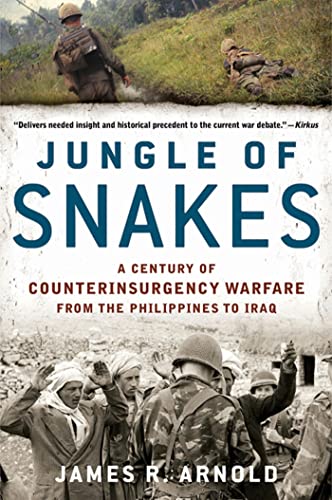
Ebook Info
- Published: 2010
- Number of pages: 304 pages
- Format: PDF
- File Size: 1.91 MB
- Authors: James R. Arnold
Description
The end of the cold war promised a new era of international peace. Instead, violence has proliferated across the globe. What does history tell us about how this conflict will play out? Noted military historian James R. Arnold delivers an engrossing narrative history of a century of counterinsurgent warfare. Analyzing past campaignsthe United States in the Philippines, the British in Malaya, the French in Algeria, and the United States in VietnamArnold traces patterns of victory and defeat. Patience, determination, and adaptability are neededan epilogue examines the occupation of Iraq, where America, to its cost, ignored the lessons of history. Jungle of Snakes is essential reading for anyone who wants to understand the ongoing worldwide conflict the Pentagon calls the “Long War.”
User’s Reviews
Editorial Reviews: About the Author James R. Arnold is the author of more than twenty books, including The First Domino: Eisenhower, the Military, and America’s Intervention in Vietnam; Presidents Under Fire: Commanders in Chief in Victory and Defeat; Jeff Davis’s Own: Cavalry, Comanches, and the Battle for the Texas Frontier; and Crisis in the Snows: Russia Confronts Napolean, the Eylau Campaign 1806-1807. He lives on a farm near Lexington, Virginia.
Reviews from Amazon users which were colected at the time this book was published on the website:
⭐Review -Jungle of Snakes – James Arnold“Jungle of Snakes: A Century of Counterinsurgency Warfare from the Phllippines to Iraq” by James Arnold is a well written commentary on four insurgencies: The Philippines by USA 1898-1904, Algeria by the French 1950’s, Malaysia by the British 1950’s and Vietnam again by the USA 1960’s. The author states in the “Acknowledgments” that his book grew out of discussions “about relevant military history about America’s ongoing counterinsurgency operations in Afghanistan and Iraq.” To this end the four insurrections are evaluated in terms of security, local conditions, preparations by the invading country, commitment, weapons, language, home support, capacity to recruit insurgents, pacification and country rebuilding techniques, goals of the conquerers, and information and communications, use of torture, and cohesion of the aims and methods of the conquerers. It becomes obvious midway through the book, and frankly stated in the Vietnam section that the author comes down squarely with Gen Petraus and against Gen Westmoreland in the long standing disagreement about the roles of the army and other US military in any insurgency and counterinsurgency.In the Vietnam section and the conclusions section, the author makes frequent reference to the 1940 “Small Wars Manual” of the US Marine Corp and decries that its lessons had to be relearned from scratch as it had been forgotten.The book is well written, an entertaining read, informative as to neglected facts of the four insurgencies, and clear in its arguments as to why Gen Petraus was right. There are few diagrams, and no pictures, but these would have been superfluous.I am left with the suspicion that the histories are told selectively to make the author’s points. Many points are made by focusing in on examples of pacification attempts and anecdotal evidence.I strongly recommend this book to students of counterinsurgency history as its points are well made and well taken. But an eye needs to be kept out for prejudgements and selective history telling. The arguments as to the tactics and strategy, i.e. the purpose and uses of the armies, to achieve the goals of the conquering nations need to be understood and kept in mind as this book is read.FYI there are minimal references to Iraq and Afghanistan in spite of the reference made in the “Acknowledgments,” that this book is to prepare the reader to understand military history that applies to both.
⭐America currently engaged in counter-insurgency operations in many areas of the world. We are expending blood and treasure in pursuit of a very amorphous goal: the defeat of Terror. This very insightful book James R Arnold analyzes several counterinsurgency various countries in various historical eras and offers a compelling analysis of why we have not been successful.In his conclusion, after analyzing several counterinsurgency campaigns, he offers a compelling analysis of why we have not been more successful and what we need to do to reverse this trend. Language, cultural understanding, pertinent intelligence – all are important. But most important is a clear understanding of why we are engaged in a particular conflict- hownational interests are served by our involvement, and once the decision is made that we should be involved, make a long-term commitment to success.I heartily recommend this book to anyone who wants a deeper understanding of Americas counterinsurgency activities, their successes and failures.
⭐While not the most penetrating or scholarly study of Counterinsurgency, Jungle of Snakes draws on four twentieth-century counterinsurgency campaigns in a largely successful effort to identify enduring themes and misconceptions. While this limited scope leaves a lot of issues and potential lessons unexplored, the four campaigns of choice (Philippines post-1898, Malaya, Algeria and Vietnam) are covered in sufficient detail to illustrate little-known aspects of each campaign, and with enough critical insight to counter the sometimes superficially uncritical citing of British practice in Malaya, French theory born of Algerian experience, or US Marine versus US Army practice in Vietnam as examples of successful COIN.Jungle of Snakes is written in a clear, accessible ‘popular history’ style and avoids excessive reliance on military knowledge and jargon in order to interest readers without detailed military knowledge, yet contains sufficient detail and rigor to serve as a suitable introductory work for military professionals before tackling COIN theorists (for example, Kilcullen’s or Galula’s work) or detailed accounts of campaigns such as Horne’s ‘A Savage War of Peace’. Recommended as worth a look if you are interested in an accessible yet surprisingly penetrating overview of COIN.
⭐Excellent analysis of four 20th century counterinsergencies: Philippines, Malaya, Algeria, and Viet Nam. Each section helpfully includes a summary of points. Among the lessons the reader takes away: draconian methods are needed to successfully battle guerrila movements, even when those movements are not supported by the population (Malaya). Further, draconian methods leave the counterinsurgency effort understandably vulnerable to press coverage except where that coverage can be deflected (Philippines) and that press coverage can seriously weaken effort. Also, as is obvious in Iraq and Afghanistan, no matter the provocation, Western democracies do not have endless patience with drawn-out efforts; that’s a huge advantage to the guerrilas. Worthwhile addition to your library.
⭐Gives an insight on post WW2 warfare
⭐This book provides several vignettes dealing with Algeria, Vietnam, Philippines and Malaya. Author explores how in both Vietnam and Algeria the French and Americans did not adopt effective strategies till it was too little too late.
Keywords
Free Download Jungle of Snakes: A Century of Counterinsurgency Warfare from the Philippines to Iraq in PDF format
Jungle of Snakes: A Century of Counterinsurgency Warfare from the Philippines to Iraq PDF Free Download
Download Jungle of Snakes: A Century of Counterinsurgency Warfare from the Philippines to Iraq 2010 PDF Free
Jungle of Snakes: A Century of Counterinsurgency Warfare from the Philippines to Iraq 2010 PDF Free Download
Download Jungle of Snakes: A Century of Counterinsurgency Warfare from the Philippines to Iraq PDF
Free Download Ebook Jungle of Snakes: A Century of Counterinsurgency Warfare from the Philippines to Iraq