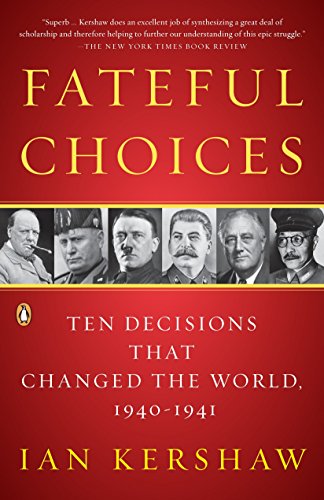
Ebook Info
- Published: 2008
- Number of pages: 672 pages
- Format: PDF
- File Size: 3.31 MB
- Authors: Ian Kershaw
Description
The newest immensely original undertaking from the historian who gave us the defining two-volume portrait of Hitler, Fateful Choices puts Ian Kershaw’s analytical and storytelling gifts on dazzling display. From May 1940 to December 1941, the leaders of the world’s six major powers made a series of related decisions that determined the final outcome of World War II and shaped the course of human destiny. As the author examines the connected stories of these profound choices, he restores a sense of drama and contingency to this pivotal moment, producing one of the freshest, most important books on World War II in years’ one with powerful contemporary relevance.
User’s Reviews
Editorial Reviews: Review ? Superb . . . helps to further our understanding of this epic struggle? as well as of the role of contingency in history.? ?”The New York Times Book Review” ? The central achievement of Ian Kershaw’s latest book is to make new some bits of history you thought you already had a handle on. . . . Full of surprises.? ?”San Francisco Chronicle”Superb . . . helps to further our understanding of this epic struggle as well as of the role of contingency in history. “The New York Times Book Review” The central achievement of Ian Kershaw s latest book is to make new some bits of history you thought you already had a handle on. . . . Full of surprises. “San Francisco Chronicle”a Superb . . . helps to further our understanding of this epic strugglea as well as of the role of contingency in history.a a”The New York Times Book Review” a The central achievement of Ian Kershawas latest book is to make new some bits of history you thought you already had a handle on. . . . Full of surprises.a a”San Francisco Chronicle” About the Author Ian Kershaw, author of To Hell and Back, The End, Fateful Choices, and Making Friends with Hitler, is a British historian of twentieth-century Germany noted for his monumental biographies of Adolf Hitler. In 2002, he received his knighthood for services to history. He is a fellow of the British Academy, the Royal Historical Society, the Wissenschaftskolleg zu Berlin, and the Alexander von Humboldt-Stiftung in Bonn, Germany. His newest book, Personality and Power, will be published in November, 2022.
Reviews from Amazon users which were colected at the time this book was published on the website:
⭐Excellent book that explains how many of the key and controversial decisions in the 2nd world war were made. Makes you realize you would probably have made the same call given the proper context.
⭐If you haven’t read much of WWII, this book would be an ideal place to start or to expand your understanding. If you’re an experienced reader, you can still appreciate the straightforward and informative way the author has compiled this history.The author has chosen ten decisions by six of the leading commanders of the war. He carefully describes the decision and then provides a fairly comprehensive history leading up to that decision as well as the subsequent impact of the future prosecution of the war. During the discussion, you will not only learn about the progression in making that decision but also learn about the individual making that decision and the circumstances and people surrounding him that try to influence that decision.The ten Fateful Choices are:1. Churchill’s decision in May, 1940 to continue the war rather than negotiate with Hitler and Mussolini.2. Hitler decides to attack the Soviet Union.3. Japan decides to attack China.4. Mussolini decides to join the war on Hitler’s side.5. Roosevelt decides to lend a helping hand to Britain.6. Stalin decides he knows best and ignores all the clear signals that Germany is going to invade.7. Roosevelt decides to wage undeclared war.8. Japan decides to go to war against the US.9. Hitler decides to declare war on the US.0. Hitler decides to commit genocide.These ten events are laid out chronologically, starting out with the pugnacious Churchill refusing to negotiate with Mussolini and Hitler in mid 1940 and winds up with Hitler deciding on a formal program of genocide in late 1941. You will also read about Hitler’s obsession to invade Russia that will blind him from alternative action or the politically savvy Roosevelt who is cautious to enter the fray. There is both Mussolini and Tojo who thought their country was destined for greater accomplishments and disregarding logic, overreach and take steps that will destroy their countries. Stalin, the supreme leader and confident manipulator who “knows” Hitler will not invade until 1942 and can’t believe it when he’s proven wrong.While the author covers the alternative choices each commander had before him, Mr Kershaw refuses to be drawn into the realm of alternate history. That’s too bad; with the author’s experience it would have been interesting to hear his views on how the war would have played out if Hitler decided to conquer North Africa and the Middle East before invading Russia. There are many alternate histories that could have been discussed but it just wasn’t in the author’s purview.Of the ten decisions, Churchill made one, Hitler 3, Tojo 2, Mussolini 1, Roosevelt 2 and Stalin 1. The average length of these chronicles is 42 pages, with the shortest being 33 pages and 59 pages for the longest. President Roosevelt has the honor of having both the shortest and longest chronicle.There are five maps and 28 photos. Being an academic, Mr Kershaw provides an extensive Notes Section and Bibliography of secondary sources as well as a useful Index if further study is desired.This synergistic book is comprehensive and well documented within specific spheres of the early events of the war, making a good reference for many of us and is recommended.
⭐I read this in paperback. It was not easy to read. The print is small and light. End of criticism. This book is an absolute necessity for anyone who wants to understand how the major decisions of WW2 evolved. Kershaw’s facility with original sources and documents and the relevant secondary works make his theses convincing and explanations riveting. Yes, it gets into the weeds which, in another author’s hands, might distract from what the narrative is about. Kershaw never loses site of the objective of the chapter, such as how a particular decision was arrived at. I’ve read a great deal about the topics, but I gained new insights how and why certain actions were taken, particularly by Mussolini and the Japanese. And even a topic like the Holocaust with which I’m very familiar unfolds in a way that makes that grotesque event a little more understandable within the context of a nervous Nazi regime’s time frame.
⭐Author Kershaw looks through a microscope at 10 key decisions that resulted in practically the whole world becoming engaged in war. The unique aspect of this book is to combine the fateful decisions made by five world leaders (and one imbecile) during the years 1940 and 1941.Other reviewers have spelled out the ten decisions so I won’t repeat them. First of all I will explain what I mean by saying one member of this group is an imbecile. I’m talking about Mussolini, and at the end of a chapter on him Mr. Kershaw, in frustration, calls him that name. Indeed the chapter on Mussolini can almost be considered, tragically of course, a bit of comic relief. Mussolini was like a puppy dog trying to tag along with his master, Hitler, and get some glory for himself. What should he do in the midst of victory after victory by Germany. He decides why not invade Greece. He sits down with his marginally competent general staff, and in an hour and a half discussion they decide to invade. That’s it. No long term, detailed plans, just that short chat. Italy is almost bankrupt, does not have a well trained army, lacks sophisticated equipment yet invades Greece within weeks of that meeting, and gets, well, stuck in the mud so to speak.What’s interesting about the other fateful decisions is that each leader was well out on a limb when his country decided to ease or jump into war. At that time, for example, the United States had an army about the size of the Dutch army. All of the countries faced economic problems, and most of them had not learned an awful lot from their experiences in WWI.Roosevelt’s task was to ease the country toward helping Britain by gradually coaxing the public and congress along toward that end. Japan’s leaders vacillated about entering a war with the U.S., but felt they had to do just that following America’s embargo on scrap iron and oil shipments. Stalin was deluded into thinking that Germany would not invade Russia until 1942, and tended to disregard all evidence that indicated the attack would be in 1941. When the invasion took place he was so shaken that he could not function for several days. Hitler, Tojo and Mussolini were prompted by maintaining national prestige. Roosevelt, Stalin, and Churchill were trying to keep their world from collapsing. Hitler declared war on the U.S. without consulting with any of his advisors.This is a fascinating book that ties together all of the elements that led our world leaders into the worst war of all time. I might point out that for some WWII buffs certain chapters may not provide new information to the reader. There are other books, such as biographies of Hitler, Roosevelt and Stalin, that cover one of these chapters in even greater detail, but this may be the only book that examines all the major world leaders during the time period 1940-1941. The only thing that frustrated me is that each chapter usually ends at a momentous decision point, and you think “more, more, don’t stop here.” Well the thing to do is just get more books that do go on from there.
⭐I read this book with real pleasure and I learned a lot, even if I am quite familiar with this period of history.Ian Kershaw had an excellent idea when he decided to focus on this crucial period of World War II between May 1940 and December 1941 during which indeed almost all most important decisions were taken which would determine the fate of the whole humanity for the next 50 years. Author also very well establishes connections between those decisions, showing how each one of earlier ones greatly helped to decide the later choices.——The ten Fateful Choices that comprise Kershaw’s work are:1. The British War Cabinet’s decision to continue the war rather than negotiate a settlement with Hitler.This was maybe the most difficult and the most crucial of all the ten decisions described here. In my opinion, there is no doubt that British leaders held in their hands in May and June 1940 the fate not only of their country but that of whole humanity. Settling with Hitler in June 1940 would mean safety and peace for United Kingdom, but Nazi domination for many, many years to come for continental Eurasia, as it would also most probably seal the fate of Soviet Union… The decision to fight on taken unanimously by Churchill, Fairfax, Attlee, Chamberlain and Greenwood saved humanity from Nazism and Fascism – but as all five men knew, it was also a death sentence for British Empire… All the circumstances of this terrible dilemma are here well described.2. Hitler decides to attack the Soviet Union.Once again, a well described point, establishing firmly that Hitler decided to attack Soviet Union soon after his victory over France and decided to do it as soon as possible as the result of British persistence to resist him. In this point however author describes also very well that once United Kingdom decided to fight on, Hitler found himself without a plan and as a consequence he wasted all oportunities of alternate strategies (especially the Mediterranean/Near Eastern one) in futile and half-hearted negotiations with Spain, Italy and Vichy France…3. Japan decides to seize the “Golden Opportunity” and turn south, going after the colonial empires of the countries that have fallen to Hitler.A very interesting point which especially well illustrates how extremely weird and complicated was the process of decision taking in Japanese government in those times. This decision was not entirely irrational or wrong, because even if it placed Japan on a direct collision course with United States and United Kingdom, there was still room for future negotiations. One thing however, which I will never understand, is why the heck the Japanese, when occupying French Indochina, failed to secure in the same time the strategically crucial New Caledonia…4. Mussolini decides to join the war on Hitler’s side to grab a share of the spoils.The decision itself seemed rational at this time – but the abysmal performance of Italian army in North Africa and Greece transformed it into a disaster not only for Mussolini but also, very luckily for the rest of the world, for Hitler. In fact, in a certain way, the only thing that Mussolini managed to do when entering the war, was to HELP the allies and doom Axis…5. Roosevelt decides to lend a helping hand to England.A very good account of Roosevelt relentless but extremely cunning manoeuvring to push his country into war. Roosevelt knew immediately in 1939 that war in Europe was not only a problem but also an occasion to seize to establish American dominion over the planet – and he was determined to do it at all costs! In fact, he wanted to do exactly the same thing that the Japanese and Mussolini wanted – get his share of spoils. But unlike the Japanese and Italians, he had the means of his ambitions…6. Stalin decides he knows best and ignores all the clear signals that Germany is going to invade.After five finally rather rational choices, here we enter the realm of stubborn folly. A great point, well described – but not explained as irrational madness can simply not be explained. It cost Soviet Union millions and millions of perfectly avoidable casualties, both military and civilian…7. Roosevelt decides to wage undeclared war.Once the possibility of Axis triumph over Soviet Union and Hitler’s domination over the whole Eurasia appeared, Roosevelt found it much easier to steer his country towards war. He just needed a priming charge, to detonate the enormous potential of USA. By pushing Japan to the limit with the embargo and pushing III Reich to the limits with aggressive moves in Atlantic Roosevelt was certain that one of those countries will oblige him by attacking first. And he was not disappointed…8. Japan decides to go to war against the United States.Unlike what author states, I believe this decision was not as irrational as it may seem and I think Japan could have fought USA to a standstill awaiting German victory in Europe – but the initial Japanese strategic war plan was so wrong that it simply guaranteed American victory. Also, between June and December 1942, a certain admiral Yamamoto simply handed to the Americans two major victories, at Midway and in naval Guadalcanal battles and therefore greatly shortened the war…9. Hitler decides to declare war on the USA.Author describes this point very, very well indeed, offering, I believe, a good insight into Hitler’s mind and states here that war between USA and III Reich was in December 1941 simply unavoidable. Well, maybe. But still I think that this is another case of irrational folly. It was in Hitler’s best understood interest to delay war with USA as long as it was humanly possible – instead he decided to make things easy for Roosevelt and simply declared war himself… Quem Deus vult perdere, dementat prius…10. Hitler decides to commit genocide.The most irrational and the most abject and evil decision EVER taken in whole human history. There is no rational explanation for this move, which was made by Hitler for reasons which could be fully understood by his own sick mind. Author couldn’t of course explain WHY Hitler did it – but the whole ideological process which brought Hitler to take this step and the circumstances in which his orders were given to his henchmen is well described.I personally always had the impression, that even if Holocaust started already on 22 June 1941 on Nazi-occupied Soviet territories, it was Hitler’s defeat at Moscow in December 1941 that decided him to launch the extermination of Jews in the whole Europe, because deep inside him he already knew at that moment that he was going to lose – and he wanted to make certain, that Jews, whom for some irrational reason he considered as his deadliest enemies, would not survive him, so they cannot laugh at his defeat…——If there is one more decision that I believe could and should figure here it is the choice Hitler made to treat Ukrainians, Belarussians and Russians like chattel and slaves, rather than potential allies. Hitler had a great opportunity to recruit hundreds of thousands of devoted soldiers for his fight against Stalin, as in many regions, especially in Ukraine and Belarus, German soldiers were initially welcomed with flowers by civilian populations! And even many Russians were ready to join the Germans (some actually did) if offered a perspective of future non-communist Russian government. Instead, in barely six months Hitler turned most of populations in Ukraine, Belarus and Russia against the Germans by his crazy racial ideology and the incredible, absurd brutality of his security forces…Another strong candidate would be the decision taken by Roosevelt on 9 October 1941 to approve the atomic program, with the first meeting of S-1 Uranium Committee held on 18 December 1941, during which it was decided to develop an atomic bomb based on uranium. It could also cover the point of co-operation with United Kingdom on atomic problem, a co-operation boldly refused by the British in January 1942 – something that would be greatly, greatly regretted by all British Prime Ministers from 1945 to 1956…CONCLUSION: I liked this book a lot, I read it with real pleasure and I learned a lot. I am going to keep it preciously for a future re-reading and later for my children. Enjoy!
⭐A brilliant book which provides answers to some of the key questions from the SWW. Why did Germany attack the USSR? Why did Japan bomb Pearl Harbor? Why did Hitler declare war on the US?A number of reviewers have questioned Kershaw’s writing style. It is true that he uses complex constructions at times but the book is far from a hard read. On the contrary, the writing style simplifies brilliantly subjects that are intrinsically difficult to explain concisely.This is “academic” popular history at its absolute best.My one gripe is with the font used. As with many Penguin publications, it is really small. It takes so much pleasure away from the reading that I almost reduced the stars.
⭐This is a very well-written narrative that you will find hard to put down once you have started reading. At the same time, those already fairly familiar with the history of WW II will find much that they already knew. For them it is hardly a surprise that Hitler reached his decisions without consulting anyone, that Stalin refused to believe that Russia was about to be attacked, that Mussolini was obsessed with the fear of being left out of the glory and spoils of the war that Hitler seemed to be winning hands down, and that it took Rooseveld a lot of cajoling to get his isolationist country into the war. But these are stories very well told, to the extent that you are annoyed that the story simply stops once the decision has been reached. But of course that is the point of this book.Certainly for those who only know the big picture on WW II-history, this book provides valuable insight in how its major developments came about.
⭐This is one of the best books I’ve read on the Second World War. It was like reading a thriller; I couldn’t put it down even knowing how it ended. This book clarified for me the events leading up to the war. I had many misconceptions of how it came about. For instance I had always thought that Hitler was just nuts for not invading Great Britain and for going ahead to invade the Soviet Union. Now I understand the reasons. I can understand Hitler’s position and thinking which prompted his actions. I must mention that Kershaw’s writing is very reader friendly. He writes in a conversational style even using a slang expression now and again. It is anything but pedantic. This book is a thriller. Anyone who wants to understand the greatest and most destructive debacle of recent centuries can do no better than to start here.
⭐Well researched really solid piece of work. Really opened my eyes to how events developed especially in the Pacific theater and what role Hirohito played in the decision making. (Though the scope of the book is far wider!)
Keywords
Free Download Fateful Choices: Ten Decisions That Changed the World, 1940-1941 in PDF format
Fateful Choices: Ten Decisions That Changed the World, 1940-1941 PDF Free Download
Download Fateful Choices: Ten Decisions That Changed the World, 1940-1941 2008 PDF Free
Fateful Choices: Ten Decisions That Changed the World, 1940-1941 2008 PDF Free Download
Download Fateful Choices: Ten Decisions That Changed the World, 1940-1941 PDF
Free Download Ebook Fateful Choices: Ten Decisions That Changed the World, 1940-1941