Ebook Info
- Published: 2009
- Number of pages: 352 pages
- Format: PDF
- File Size: 5.49 MB
- Authors: Morris Rossabi
Description
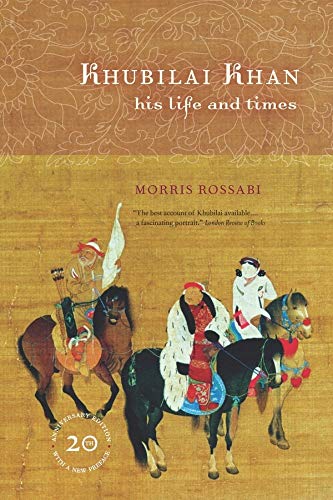
Living from 1215 to 1294, Khubilai Khan is one of history’s most renowned figures. Morris Rossabi draws on sources from a variety of East Asian, Middle Eastern, and European languages as he focuses on the life and times of the great Mongol monarch. This 20th anniversary edition is updated with a new preface examining how twenty years of scholarly and popular portraits of Khubilai have shaped our understanding of the man and his time.
User’s Reviews
Editorial Reviews: About the Author Morris Rossabi is Professor of History at Queens College and the Graduate Center of the City University of New York and Visiting Professor at Columbia University.
Reviews from Amazon users which were colected at the time this book was published on the website:
⭐Review of Rossabi’s “Khubilai Khan” by Paul F. Ross A movie reminded this reader that he knew essentially nothing about the Mongols and their dominance across the northern land mass now known as Europe and Asia. Thinking Chinggis (Genghis) Kahn was the most successful, I searched for a biography. However I failed to make the distinction between Chinggis (1162-1227, early leader uniting Mongol power) and Khubilai (1215-1294, Chinggis’____________________________________________________________________________________Rossabi, Morris “Khublai Khan: His life and times” 1988, University of California Press, Berkeley CA, xvii + 323 pages____________________________________________________________________________________grandson and the Khan that ruled over the largest territory). Thinking I was buying a biography of Chinggis, I actually bought a biography of Khubilai. I had much to learn. Among other things, I relearned that Marco Polo made his trip from Venice, Italy, to China in about 1272 and, among many other things, visited the court of Khubilai Khan in Ta Tu. Nicolo and Maffeo Polo reached Khubilai Khan’s court in about 1265 or 1266. The Polos knew a good trading mission when they saw one. Morris Rossabi, author of this history of Khubilai Khan, taught Chinese history at Case Western Reserve University in Cleveland and the China Institute, Columbia University, and Queens College in New York. Rossabi and all other historians seeking to review the history of the Khans face a difficult task. The Mongols had no written language. So there are no histories of the Mongols written by the Mongols. The sources available to the historians are Confucian Chinese, Muslim Persians, and Shinto Japanese, and Nestorian Christians … primarily the first two … and the Confucian Chinese of the Southern Sung dynasty were the largest and most advanced population conquered by Khubilai. These several sources were recorded with points of view held by peoples subjugated by the Mongols. The sources differed in their descriptions of the Mongols and their governance. Rossabi reports that Khubilai was relatively even handed in supporting all of the cultures coming under his rule, supporting their religions, avoiding extensive damage to their economies, carefully avoiding imposition of the nomadic hunting-gathering economy of the Mongols on the agriculturists in the Chinese economies, respecting many of the Chinese governing traditions, actively seeking to build the economies of the conquered peoples (thus allowing the collection of more taxes), supplying food and other support such as tax relief when disasters (such as drought) struck, supporting their arts. As in ruling families worldwide, Khubilai had to cope with a few relatives who led rebellions against Khubilai as well as some rebellions among the conquered peoples. Khubilai was elected the Great Khan (ruler of the Mongols) in 1260 and held that role until his death in 1294. Khubilai’s reign in China was designated the Yuan dynasty in Chinese history and it concluded in 1368, less than seventy five years after Khubilai’s death. Rossabi seeks to present a broad sweep of Khubilai’s times by telling the military stories, Khubilai’s governance stories as Rossabi sought to balance competing political forces, stories about collecting taxes, stories describing the theater, stories describing Khubilai’s efforts to create a written language for the Mongols, and so on. Rossabi struggles with his diverse sources and their conflicting points of view, frequently warning the reader that his description is a guess, he having tried to weigh the differing points of view of his sources and report what Rossabi regards as the likely truth. One can get another look at the Yuan dynasty through the eyes of Fairbank and Goldman (1998, p 119-142) as the Mongol rule under Khubilai Khan is embedded by these historians in their history of China. It is a brief report, twenty three pages, in a 500+ page history of China. “The Mongols were despised … and Mongol rule lasted less than a century, more brief than Ruzhen rule had been in North China. Except along the Great Wall the Mongols could not take root (p 122),” Fairbank and Goldman write. The difference between a history written with Rossabi’s sources from 800 years ago and current history or biography is enormous. With many sources including people who experienced the events, histories describing recent events are very much more satisfying than this history of a people who had no written language. For current standards, see Bernanke’s account (2015) of the 2007-2009 worldwide economic recession and the efforts to recover. See Canellos and colleagues (2009) describing the life of Teddy Kennedy. Davies (1996) views the history of Europe over a long timeline and his history has little to say about the Mongols’ invasion by Chinggis Khan. History, one must judge, is always a set of events sifted by the values of the historian and the richness and perspectives of the sources. Rossabi’s history of Khubilai Khan has the marks of careful workmanship, given the sources available to him. Rossabi organizes his topics into chapters, opens by telling you what he’s going to tell you, then tells you, and finally summarizes what he’s told you. Some of Rossabi’s generalizations about Khubilai are repeated many, many times. However my ignorance of the Mongols and their history was stark and my knowledge of Chinese history was very sketchy. So long as memory sustains what I’ve learned, that ignorance has been pushed away in at least some areas by this read of Rossabi’s history of Khublai Khan.Bellevue, Washington19 November 2015Copyright © 2015 by Paul F. Ross. All rights reserved.ReferencesBernanke, Ben S. The courage to act: A memoir of a crisis and its aftermath 2015, W. W. Norton & Company, New York NYCanellos, Peter S. (Editor) Last lion: The fall and rise of Ted Kennedy 2009, Simon & Schuster, New York NYDavies, Norman Europe: a history 1996, Harper Perennial, New York NYFairbank, John King, and Goldman, Merle China: A new history Enlarged Edition. 1998, Harvard University Press, Cambridge MARossabi, Morris Khublai Khan: His life and times 1988, University of California Press, Berkeley CA
⭐I read it.
⭐This is a great source for research papers on Khubla Khan. It contains almost any information you would need to know.
⭐very good
⭐Great book
⭐Morris Rossabi’s appropriately titled Khubilai Khan: His Life and Times is a well-written and extensively researched biography of the founder of the Yuan dynasty, Khubilai Khan. The benefit of this text, according to Rossabi, is that unlike others, it relies on a wide variety of sources in both Western and Eastern languages. While this text is organized both chronologically and topically, it can well be divided in to three sections. The first section provides background information on the Mongol Empire and traces Khubilai’s ascension to the throne of the Great Khan. However, Rossabi argues that a great deal of credit for Khubilai and his brother’s success should go to their mother, Sorghaghtani Beki. In the next section, Rossabi examines Khubilai’s largely successful endeavors as Great Khan and the Emperor of China. The final section discusses the decline of Khubilai and his empire. Throughout this text, Rossabi portrays Khubilai has a fair ruler who is profoundly influenced by his relationships with his various advisors, including his wife Chabi. Unfortunately, there are several instances where the author fails to provide adequate evidence to support his interpretations. On some topics, Rossabi is also disappointingly vague. These flaws notwithstanding, this biography is an adequate starting point for scholars and non-academic readers interested in Khubilai Khan or the Yuan dynasty.Sorghaghtani plays a central role in the beginning of this book. In fact, Rossabi declares that Sorghaghtani “had lofty ambitions for her four sons,” but he provides little evidence to support this assertion (11). Instead, Rossabi discusses a litany of excessively flattering comments about Sorghaghtani made by men such as John of Plano Carpini, Rashid al-Din, and Bar Hebraeus without even a word about her actions that directly resulted in this praise. Additionally, Rossabi does not clearly illuminate the relationship between Sorghaghtani’s actions and her son’s success. For instance, the most direct example of her involvement in her son’s success is when she warned Batu, the Khan of the Golden Horde, that Güyüg, the reigning Great Khan, was planning to attack him. This action won Batu’s favor and after Güyüg’s death, he supported Sorghaghtani’s son Möngke to become the Khaghan. Still, this action directly benefited Sorghaghtani because she controlled an appanage in Northern China. Thus, she might have acted out of self-interest rather than a desire to see her son become the Great Khan. The remaining evidence revolves around the example she set in governing her appanage and seeing to Khubilai’s education, but it seems likely that he would have received an education regardless since he was a member of the royal family.After he ascends to the throne of the Great Khan, Rossabi pays particular attention to the interplay between Khubilai and his numerous advisors, many of whom died during the 1270s (15). Yet, while Rossabi argues that Khubilai was not a “puppet” of his advisors, he does not address why his fortunes were so dependent upon their wise recommendations. For example, by 1279 Khubilai faced severe financial difficulties due to his ambitious policies and profligate spending during the first two decades of his reign. To solve these financial problems, Khubilai sought the assistance of Ahmad, Sangha, and Lu Shih-jung, known as the “three villainous ministers” (179). These men not only exacerbated Khubilai’s financial problems, they also alienated his Chinese subjects. In addition, Khubilai embarked upon several unsuccessful military forays in the decades following the 1270s; the most significant being the disastrous invasion of Japan in 1281. However, Khubilai’s troops were also less than successful in military engagements against Pagan, Annam, Champa, and Java. All of these failures significantly undermined Khubilai’s authority. As such, there seems to be a strong correlation between Khubilai’s early success and his advisors who died during the 1270s. Nevertheless, Rossabi still gives a large amount of credit to Khubilai for the successful policies and military accomplishments during his reign.Rossabi also tends to be frustratingly vague on important topics and overlooks occasions to give the reader a glimpse of Khubilai, the man, as opposed to the ruler. One of the best examples of this comes from the final chapter when Rossabi writes, “[Khubilai] grew obese and suffered from ailments associated with alcoholism” (206). Given the diverse nature of the “ailments” associated with alcohol abuse, this is a perfect occasion to provide examples of the behavior to which he is referring. Instead, Rossabi moves on to another topic without as much as a footnote. Rossabi is also elusive on the details of how Chabi aided Khubilai in his duties as the Great Khan and Emperor of China, despite asserting that Chabi was an “ideal helpmate” and “was just as anxious as her husband to set up a government in China” (69). As a result, Rossabi not only weakens his argument, he also loses crucial opportunities to provide the reader with a personal glimpse of the individuals he discusses.Even with these flaws, this book does have some positive qualities. Perhaps the most significant benefit of this text is the clear and concise language with which it is written. Unlike other similar studies, this book also uses a large quantity of sources spread throughout the former Mongol Empire. Therefore, this study is a good starting point for historians interested in Khubilai Khan or this era of Chinese history. Nevertheless, a successful biography requires a great amount of insight into the character, relationships, and intimate details of the person it examines, and it seems that Rossabi passed over several opportunities to relay these types of details.
⭐This scholarly biography, published in 1988, is sympathetic to the Mongol emperor of China, Khubilai Khan who founded the Yuan Dynasty in 1271. This is formal history with footnotes galore, from divergent sources, whether Mongol, Chinese, or Muslim. The Khan is praised as a ruler who “endeavoured to protect the welfare and promote the interests of his diverse subjects” (p 231). The details of the Khan’s personal life are only hinted at, such as his harem. But where are his spoken words? If you want an entertaining read, or a pro Chinese account, this book is not for you.
⭐Genghis Khan biography is a better book to read, here it seems all goes in one direction and manipulates historical facts about what china and pekin were before the mongols united what we now as china, better read Genghis book.
Keywords
Free Download Khubilai Khan: His Life and Times, 20th Anniversary Edition, With a New Preface in PDF format
Khubilai Khan: His Life and Times, 20th Anniversary Edition, With a New Preface PDF Free Download
Download Khubilai Khan: His Life and Times, 20th Anniversary Edition, With a New Preface 2009 PDF Free
Khubilai Khan: His Life and Times, 20th Anniversary Edition, With a New Preface 2009 PDF Free Download
Download Khubilai Khan: His Life and Times, 20th Anniversary Edition, With a New Preface PDF
Free Download Ebook Khubilai Khan: His Life and Times, 20th Anniversary Edition, With a New Preface