Ebook Info
- Published: 2024
- Number of pages: 418 pages
- Format: PDF
- File Size: 2.04 MB
- Authors: Morris Rossabi
Description
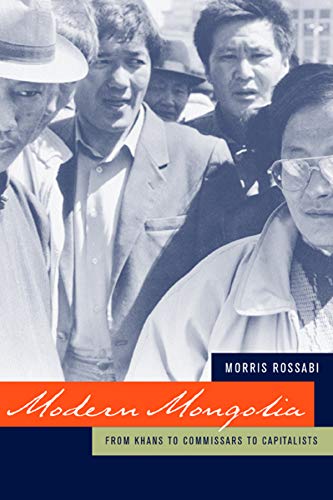
Land-locked between its giant neighbors, Russia and China, Mongolia was the first Asian country to adopt communism and the first to abandon it. When the Soviet Union collapsed in the early 1990s, Mongolia turned to international financial agencies―including the International Monetary Fund, the World Bank, and the Asian Development Bank―for help in compensating for the economic changes caused by disruptions in the communist world. Modern Mongolia is the best-informed and most thorough account to date of the political economy of Mongolia during the past decade. In it, Morris Rossabi explores the effects of the withdrawal of Soviet assistance, the role of international financial agencies in supporting a pure market economy, and the ways that new policies have led to greater political freedom but also to unemployment, poverty, increasingly inequitable distribution of income, and deterioration in the education, health, and well-being of Mongolian society. Rossabi demonstrates that the agencies providing grants and loans insisted on Mongolia’s adherence to a set of policies that did not generally take into account the country’s unique heritage and society. Though the sale of state assets, minimalist government, liberalization of trade and prices, a balanced budget, and austerity were supposed to yield marked economic growth, Mongolia―the world’s fifth-largest per capita recipient of foreign aid―did not recover as expected. As he details this painful transition from a collective to a capitalist economy, Rossabi also analyzes the cultural effects of the sudden opening of Mongolia to democracy. He looks at the broader implications of Mongolia’s international situation and considers its future, particularly in relation to China.
User’s Reviews
Editorial Reviews: About the Author Morris Rossabi is Professor of History at the City University of New York and Adjunct Professor of East and Inner Asian History at Columbia University. Among his books are Governing China’s Multiethnic Frontiers (2004), Bounty from the Sheep (2000), Voyager from Xanadu (1992), Khubilai Khan: His Life and Times (California, 1988), and China among Equals (California, 1983).
Reviews from Amazon users which were colected at the time this book was published on the website:
⭐This is the only book that comprehensively details the history of the post socialist period. However, it is extremely biased and ideological. The author presents every thing that happens through his anti-capitalist anti-IMF perspective. The book suffers from a complete lack of nuance and perspective. While I read it and found it useful at times, it was a slog and often infuriating in its lack of understanding and nuance. I live here in Mongolia and am very interested in its history, so I read it, but I had to grit my teeth to finish it.While some of his critiques of the changes brought after end of the socialist period are legitimate, he fundamentally misunderstands the nature of the transition. He fails to understand that the changes were necessary because the old system was fundamentally flawed and in the end it self-destructed. For example, he faults the international financial institutions (IMF/World Bank/ADB, etc) for “forcing” a reduction in social spending missing the point that while social spending under the socialist period had some extremely positive outcomes (dramatic improvements in health care, education, etc), the government did not have a choice. The old system left the Govt broke and massively in debt to the Russians. The socialist system was fiction. Not only was the Mongolian govt massively broke and hugely in debt to Russia (something like 8 times their national GDP if I remember correctly – Mongolia is still paying it off today), but the entire basis of their economy collapsed with the collapse of the Soviet Union.Another example is his critique of the privatization of the herds. He makes it sound like the Socialist period of collective herds was really great. Except that every herder I have spoken to, hates that period. Yes, privatization has led to some serious problems, and the collective approach had some benefits, but the people themselves prefer the new system by a wide margin. A point lost in the authors anxiousness to critique privatization.There are legitimate and serious critiques that can be made about the world’s response to Mongolia’s predicament, but this book completely misses the target. In the end, if you are really interested in learning about the post-socialist period, then you should read it (but with a healthy dose of skepticism).
⭐Very interesting book, albeit the writing is a little dry. Book explores the history of Mongolia as it developed in the 20th century, and the social/socioeconomic issues that arose during that time.
⭐Amazingly easy to read, this book immediately sucked me in with its details of revolution, democratic transition, corruption, coersion, and underdog populace that you’ll root for with anger and hope throughout.
⭐Professor Rossabi may be a fine historian, but his foray into political and economic developments in post communist Mongolia is a disappointment. The book is billed as covering the period up to 2004. However, much of the narrative is caught in a time warp, c. 1997. Having plowed through many of the same development reports on Mongolia that are regularly cited in the text, I noted a disappointing tendency for the author to “stack the deck,” eagerly emphasizing any item that supports his thesis (that virtually everything that has happened in Mongolia since the fall of communism has been an unmitigated disaster) while ignoring or discounting any views or evidence to the contrary. For example, his account of the privatization of both Trade and Development Bank and the Agricultural Bank (Xaan Bank) is unreliable. Similarly, there is no mention of survey research through 2004 showing that four out of five Mongolians continued to support the political and economic transition–an astonishing high figure in any post Soviet country and especially in Mongolia, where some elements of the transition have indeed been difficult. I started this book hoping that it would be the badly needed “classic account” of Mongolia during the post communist period, one that is nuanced and recognizes complexity. Unfortunatley, this one dimensional account of post communist Mongolia fails to deliver.
⭐The Following link is the review of the book by Baabar, a Mongolian politician who actually participated in the 1990 democratic revolution of Mongolia. Baabar says “Modern Mongolia” by Morris Rossabi is full of incorrect information and it should not be considered as a history book but a fiction. English translation will be posted soon.
⭐Modern Mongolia is an excellent book: balanced, easy to read and very insightful. I believe Dr. Rossaby deserves applause for being able to formulate in such a structured way all that new rulers (both Democrats and MPRP) and their advisors (USAID and IMF) inflicted on Mongolia and its people.For years, rumors and accusations of misappropriation, corruption and erroneous policy decisions floated within the Mongolian society. And the evidence of those stared bluntly into one’s face in form of new houses and prosperous companies being owned by government officials, and dire poverty into which almost 1/3 of the population descended. This book brilliantly showed that both Democrats and the MPRP essentially pursued same policies, and one was as corrupt as the other.More importantly, this book criticized the “help” of the donor community. For too long Mongolia remained the darling of the US and IMF for implementing their advice without question. And for too long the donors lip-served the government on their “achievements”. At the same time, the government was constantly undermined by the donors’ insistence on certain policies, the benefits of which to the country sometimes were, at best, doubtful.This book sets the precedent for structured criticism of donor activities in Mongolia. It adds a strong voice to growing demands for reassessment of current policies and priorities.As a Mongol myself, I am sick and tired of foreigners painting a rosy picture of Mongolia’s “democratization”, it is time for a book like this!
⭐I definitely recommend reading this book. The author – a historian of Central and Inner Asia having many years experience of working in Mongolia and collaborating with different institutions and their people including academia, civil society organizations and etc. examined his collected data and sources very well, scrutinized social, economical and political conditions in Mongolia after the collapse of the Socialist regime and the Centrally planned economic system, spoke up his opinions on international “donor” agencies, attempted to describe the reality in social, political and economic life in Mongolia of that period. The book is worth reading.
⭐Rossabis Werk beschreibt die Entwicklung der Mongolei von 1990 bis Anfang des 21 Jahrhunderts. Es konzentriert sich hauptsaechlich auf wirtschafts- und sozialpolitische Aspekte, und darauf, was nach Meinung des Autors falsch gemacht wurde. Das Buch enthaelt einige recht interessante Aussagen und eine sehr umfangreiche Literaturliste im Anhang, allerdings konnte ich nur wenig fuer mich neues entdecken, und einige Saetze schienen sich staendig zu wiederholen. Das groesste Problem fuer mich waren offensichtliche Fehlinterpretationen des Autors: Wenn 37% der Rekruten aus medizinischen Gruenden ausgemustert werden, heisst dass nicht, dass sie wirklich zu krank fuer die Armee sind, sondern dass sie es geschafft haben, das passende Attest zu besorgen. Die meisten Autos in UB sehen nicht so aus, als wuerden sie Auslaendern oder Neureichen gehoeren, etc. etc.
⭐
Keywords
Free Download Modern Mongolia: From Khans to Commissars to Capitalists in PDF format
Modern Mongolia: From Khans to Commissars to Capitalists PDF Free Download
Download Modern Mongolia: From Khans to Commissars to Capitalists 2024 PDF Free
Modern Mongolia: From Khans to Commissars to Capitalists 2024 PDF Free Download
Download Modern Mongolia: From Khans to Commissars to Capitalists PDF
Free Download Ebook Modern Mongolia: From Khans to Commissars to Capitalists