

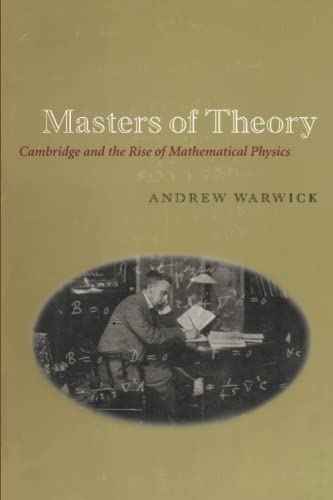
Ebook Info
- Published: 2003
- Number of pages: 520 pages
- Format: PDF
- File Size: 2.35 MB
- Authors: Andrew Warwick
Description
Winner of the the Susan Elizabeth Abrams Prize in History of Science. When Isaac Newton published the Principia three centuries ago, only a few scholars were capable of understanding his conceptually demanding work. Yet this esoteric knowledge quickly became accessible in the nineteenth and early twentieth centuries when Britain produced many leading mathematical physicists. In this book, Andrew Warwick shows how the education of these “masters of theory” led them to transform our understanding of everything from the flight of a boomerang to the structure of the universe. Warwick focuses on Cambridge University, where many of the best physicists trained. He begins by tracing the dramatic changes in undergraduate education there since the eighteenth century, especially the gradual emergence of the private tutor as the most important teacher of mathematics. Next he explores the material culture of mathematics instruction, showing how the humble pen and paper so crucial to this study transformed everything from classroom teaching to final examinations. Balancing their intense intellectual work with strenuous physical exercise, the students themselves—known as the “Wranglers”—helped foster the competitive spirit that drove them in the classroom and informed the Victorian ideal of a manly student. Finally, by investigating several historical “cases,” such as the reception of Albert Einstein’s special and general theories of relativity, Warwick shows how the production, transmission, and reception of new knowledge was profoundly shaped by the skills taught to Cambridge undergraduates. Drawing on a wealth of new archival evidence and illustrations, Masters of Theory examines the origins of a cultural tradition within which the complex world of theoretical physics was made commonplace.
User’s Reviews
Editorial Reviews: From the Inside Flap Winner of the the Susan Elizabeth Abrams Prize in History of Science.When Isaac Newton published the Principia three centuries ago, only a few scholars were capable of understanding his conceptually demanding work. Yet this esoteric knowledge quickly became accessible in the nineteenth and early twentieth centuries when Britain produced many leading mathematical physicists. In this book, Andrew Warwick shows how the education of these “masters of theory” led them to transform our understanding of everything from the flight of a boomerang to the structure of the universe.Warwick focuses on Cambridge University, where many of the best physicists trained. He begins by tracing the dramatic changes in undergraduate education there since the eighteenth century, especially the gradual emergence of the private tutor as the most important teacher of mathematics. Next he explores the material culture of mathematics instruction, showing how the humble pen and paper so crucial to this study transformed everything from classroom teaching to final examinations. Balancing their intense intellectual work with strenuous physical exercise, the students themselves—known as the “Wranglers”—helped foster the competitive spirit that drove them in the classroom and informed the Victorian ideal of a manly student. Finally, by investigating several historical “cases,” such as the reception of Albert Einstein’s special and general theories of relativity, Warwick shows how the production, transmission, and reception of new knowledge was profoundly shaped by the skills taught to Cambridge undergraduates.Drawing on a wealth of new archival evidence and illustrations, Masters of Theory examines the origins of a cultural tradition within which the complex world of theoretical physics was made commonplace. From the Back Cover Winner of the the Susan Elizabeth Abrams Prize in History of Science.When Isaac Newton published the Principia three centuries ago, only a few scholars were capable of understanding his conceptually demanding work. Yet this esoteric knowledge quickly became accessible in the nineteenth and early twentieth centuries when Britain produced many leading mathematical physicists. In this book, Andrew Warwick shows how the education of these “masters of theory” led them to transform our understanding of everything from the flight of a boomerang to the structure of the universe. Warwick focuses on Cambridge University, where many of the best physicists trained. He begins by tracing the dramatic changes in undergraduate education there since the eighteenth century, especially the gradual emergence of the private tutor as the most important teacher of mathematics. Next he explores the material culture of mathematics instruction, showing how the humble pen and paper so crucial to this study transformed everything from classroom teaching to final examinations. Balancing their intense intellectual work with strenuous physical exercise, the students themselves—known as the “Wranglers”—helped foster the competitive spirit that drove them in the classroom and informed the Victorian ideal of a manly student. Finally, by investigating several historical “cases,” such as the reception of Albert Einstein’s special and general theories of relativity, Warwick shows how the production, transmission, and reception of new knowledge was profoundly shaped by the skills taught to Cambridge undergraduates.Drawing on a wealth of new archival evidence and illustrations, Masters of Theory examines the origins of a cultural tradition within which the complex world of theoretical physics was made commonplace. About the Author Andrew Warwick is a senior lecturer in the history of science at Imperial College, London, and coeditor of Teaching the History of Science and Histories of the Electron: The Birth of Microphysics. Read more
Reviews from Amazon users which were colected at the time this book was published on the website:
⭐This book shows how mathematical physicists were trained at Cambridge University in the 19th century. It was a test-driven system in which students worked like mad in order to do well on the big test, the Mathematical Tripos. Ranking highly on this test could shape the rest of a student’s career. A small cottage industry of tutors sprang up to train the students. This led to stronger students, which led to harder tests, and thus to more need for tutoring. This system also shaped the way Cambridge physicists approached their research after graduation. They tended to see research topics as mathematical problems to be solved. For many research topics of the day, this worked well and a lot of important work was done. However, it did create blind spots. Warwick spends quite a bit of time discussing the special and general theories of relativity and the slow reception they received at Cambridge. He feels that Cambridge physicists, with their problem solving focus, couldn’t appreciate Einstein’s insights and ended up embracing the ether for too long.One unexpected aspect of the “wrangler system” was the emphasis on exercise. As part of their training regime, students would typically exercise for two or three hours each afternoon. This could be a brisk walk, rowing on the River Cam or playing a team sport. There was a belief that in order to be in top mental shape, you needed to be in top physical shape.There are a few equations here and there, but this is not a mathematical book. It is a description of how men (and a few women) learned math and physics at Cambridge. However, it is helpful to be familiar with some of the ideas of math and physics. If you have never heard of Euclid’s Elements or Maxwell’s Treatise on Electricity and Magnetism, you probably aren’t the type of person who would find this book interesting.Overall, this is a fascinating book. If you are interested in 19th century physics or the training of physicists, I strongly recommend it. I deduct one star for the plodding, repetitious writing style. If you can avoid getting hung up on that, the story is well worth reading.
⭐An incredibly informative work. This book presents, in the author’s words: ” an attempt to cross the great divide that separates the knowing expert from the unknowing outsider. ” ( page 9). In this goal, he has succeeded. No review will adequately convey the breadth and depth of this work. The modern reader will note parallels between academia today to academia in times past. We read: “…one reason the new mathematical sciences did not initially flourish at postgraduate level..is that these were primarily undergraduate institutions whose structure were conducive neither to effective communication between professors and undergraduates nor to the specialized study of technical subjects (p.169).(1) Also, “…the technical expertise of Cambridge mathematicians was generated and preserved through a pedagogical economy based on small-class teaching, long hours of supervised study, and the use of locally written textbooks and past examination questions.”( Page 299, Taken from a chapter devoted to making ‘sense’ of Maxwell’s Treatise on Electricity and Magnetism).(2) Read: ” Circulating a radically new theory in the form of a paper publication provides no guarantee that it will be studied by the wider community of prospective readers, and, even if it is studied, no guarantee that it will be understood or interpreted in the manner intended by the author.” ( Page 403, The Cambridge reception of Einstein’s Special Theory of Relativity).(3) Concluding this scholarly exegesis, the author writes:”..that the theorist’s world has come to constitute a distinct form of life worthy of the same cultural analysis as the experimental workplace.” (p.504) Lastly, from the review in American Scientist ( 5/2004):(4) “Warwick successfully reconstructs the content, and more so the experience, of working through those answers by triangulating from sources that touch on the learning experience: diaries, correspondence, autobiographies and textbooks.” Also, “If one measure of the value of a book is the number of new avenues of research it suggests, Warwick’s succeeds remarkably.”A masterful, detailed, presentation written by sure hands.Get a copy, read, and enjoy the immersion.
⭐A recreational read this book is not. However, if you hang in there, bit by bit a truly wonderful story of the history science teaching in the English college system emerges. Here is a detailed description of the origins of “homework” and “end-of-the-chapter” problems! The whole teaching approach to science, which is a problem-solving approach, was developed at Cambridge in the early 1800’s. Probably a similar tact was taken in German and French schools too.I found the descriptions of the “wrangler” system that ranked students by exam scores, the nine-day examinations, the required walks taken by students and tutors, and all that, to be fascinating.This book was favorably reviewed in Science magazine when it was published, which is how I got onto it.-a university chemistry professor
⭐This is my third major rewrite of my review on this book. So far…1st review was ***** (5 stars)2nd review was * (1 star)3rd (this) review is ***** (5 stars)Turns out that book shows that a respect for manual labor and working with one’s own hands were probably as important to Masters of theory such as James Clerk Max as were their razor sharp minds. Recommend some of the major works by the Dutch Historian Reijer Hooykaas to understand reference to respect for working with one’s own hands. (At first I thought this book was taking us down the dark road scientific materialism of Marxist-Lenism, but Hooykaas reveals that I was completely mistaken.)
⭐While this is certainly a niche book for those familiar with both the university and the subject matter, it is a convincing account of the rise (and fall) of Cambridge as the most dominant institution in mathematics and physics in the eighteenth and nineteenth centuries.
⭐El libro se centra en los orígenes de la física matemática en Cambridge a través de los Mathematical Tripos. En realidad, podemos conocer como fue la transición de las matemáticas puras y mixtas a las nuevas disciplinas especializadas.
⭐
⭐イギリス・ケンブリッジ大学出身の数理物理学者たちがアインシュタインの特殊相対性理論をなかなか受け入れようとしなかったという歴史的事実はイギリス物理学がエーテルの実在性を頑なに信じ続けた結果ですが、本書はイギリス数理物理学コミュニティがエーテルにこだわっていた根本理由を突き止めた研究。ケンブリッジ大学伝統の数理物理学試験トライポスの準備のためのテキストとそのチューターを通じた解答訓練が長年に渡りケンブリッジの学生たちにクーンの言う問題設定と解法の「範例」を与えていたためだというのが著者の主張。クーンが示唆しながら詳しく追究しなかった問題を初めて本格的に追究した著作ですね。伝説的なチューターのホプキンス氏がトムソンやマクスウェルに与えた影響については以前ハーマンの編著Wranglers and Physicistsで読んだことがあるが、著者はさらに徹底してケンブリッジ学派の研究に表れているトライポス訓練の影響を20世紀まで追跡している。チューターからの対面指導抜きでは伝わらない暗黙知の重要性を浮き彫りにします。ケンブリッジ学派の研究プログラムの一体性は人的な結び付きだけで説明しようとするにはあまりに長期に渡る連続性があり、それはケンブリッジで受けてきた訓練経験の共通性でしか説明できないという。本書は特定コミュニティにおいて特定分野での高い生産性が世代を超えて保たれる現象全体の理解に資するものと思う。
⭐
Keywords
Free Download Masters of Theory: Cambridge and the Rise of Mathematical Physics 1st Edition in PDF format
Masters of Theory: Cambridge and the Rise of Mathematical Physics 1st Edition PDF Free Download
Download Masters of Theory: Cambridge and the Rise of Mathematical Physics 1st Edition 2003 PDF Free
Masters of Theory: Cambridge and the Rise of Mathematical Physics 1st Edition 2003 PDF Free Download
Download Masters of Theory: Cambridge and the Rise of Mathematical Physics 1st Edition PDF
Free Download Ebook Masters of Theory: Cambridge and the Rise of Mathematical Physics 1st Edition