Ebook Info
- Published: 1999
- Number of pages: 306 pages
- Format: PDF
- File Size: 14.86 MB
- Authors: Chris J Isham
Description
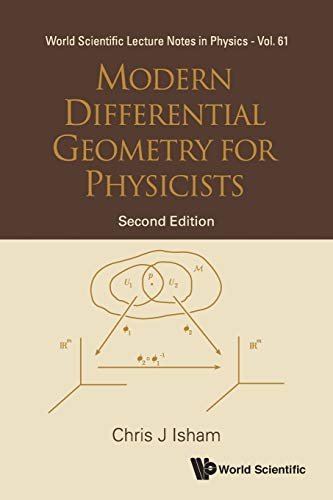
This edition of the invaluable text Modern Differential Geometry for Physicists contains an additional chapter that introduces some of the basic ideas of general topology needed in differential geometry. A number of small corrections and additions have also been made.These lecture notes are the content of an introductory course on modern, coordinate-free differential geometry which is taken by first-year theoretical physics PhD students, or by students attending the one-year MSc course “Quantum Fields and Fundamental Forces” at Imperial College. The book is concerned entirely with mathematics proper, although the emphasis and detailed topics have been chosen bearing in mind the way in which differential geometry is applied these days to modern theoretical physics. This includes not only the traditional area of general relativity but also the theory of Yang-Mills fields, nonlinear sigma models and other types of nonlinear field systems that feature in modern quantum field theory.The volume is divided into four parts: (i) introduction to general topology; (ii) introductory coordinate-free differential geometry; (iii) geometrical aspects of the theory of Lie groups and Lie group actions on manifolds; (iv) introduction to the theory of fibre bundles. In the introduction to differential geometry the author lays considerable stress on the basic ideas of “tangent space structure”, which he develops from several different points of view — some geometrical, others more algebraic. This is done with awareness of the difficulty which physics graduate students often experience when being exposed for the first time to the rather abstract ideas of differential geometry.
User’s Reviews
Reviews from Amazon users which were colected at the time this book was published on the website:
⭐Wow! What a great Table of Contents. It has all the stuff I’ve been wanting to learn about. So I bought the book in spite of seeing only one review of it. After one day, I’m now only at page 26, but I already have read enough to make some comments about it.The main point about this book is that it is, as the author specifically states, LECTURE NOTES, not, I repeat, not a textbook. What are the implications of this (outside of a somewhat more chatty style than a textbook)? [“chatty” isn’t quite what I mean; “smooth” might be a better word’] There are two which are noticable to me. 1) A lot of math knowledge is taken for granted. 2) It has a somewhat sloppy style to it.Regarding point one, make sure you have a lot of math under your belt before picking up this book. By page 18 the author uses these terms without defining them: Differentiable Manifold, semigroup, Riemannian Metric, Topological Space, Hilbert Space, the “
⭐This book (“lecture notes”) strikes a negative tone with all too many readers. I surmise that that tone arises due to one issue: this is not a complete textbook and should not be approached as if it were ! If you expect more than “lecture notes” you will be disappointed. Otherwise, you might learn some interesting things. Read:(1) “the subject of topology proper is of considerable significance in many areas of modern theoretical physics, and is well-worth studying in its own right.” (page two). If you disagree with that pronouncement, turn away. An introduction to topology will occupy chapter one. Topology is not an easy topic to assimilate, I will not claim that Isham’s approach will make it easier, but it is here. I make a stronger statement: the initial sixty-pages will either turn you on, or turn you off, to the remainder of the notes. If the first chapter of the notes is assimilated (that is: topology via algebraic properties of partially ordered sets, lattices, filters) then, continue !(2) The difficult part behind you (topology), continue with geometry. Motivation comes through Albert Einstein. Read: “…in general relativity a spacetime is modelled by a differential manifold…that remains one of the major motivations for studying differential geometry.” Chapter two will do that: introduce charts, maps, tangent spaces (via equivalence class of curves, page 72). Continue reading: “…to some extent, a tangent space can be regarded as a local linearization of the manifold.” (page 77). Chris Isham retains the “summation notation” explicitly: therefore, the greek letter Sigma is retained throughout the exposition. You do not utilize the so-called “Einstein summation convention,” where a sum over repeated indices is implied. That is excellent pedagogy ! If terminology such as isomorphism, homomorphism, equivalence class and surjective is foreign to your mathematical vocabulary, then nothing here will make sense !(3) Time for generalization. We will take the material of the first and second chapter and generalize everything. That implies “fields.” Read: “vector fields encode certain global, topological properties of a manifold.” (page 101). You will go from vector fields to differential forms (page 123). Learn more terminology: “module over a ring” and “pull-backs.” I reiterate: if the definitions (module, pull-back) are not learned, nothing will make sense. An introduction to exterior derivatives (pages 137-140) segues to a nice discussion of De Rham Cohomology (pages 140-147).(4) Lie groups: ” a group in the usual sense, with the additional property that it is also a differential manifold.” A nice discussion (page 172) of Cartan-Maurer form as it relates to analogy of wedge-products to invariant one-forms. This is a chapter which is crucial for the discussion ahead (chapter five): fibre bundles. However: “Lie algebras are not treated in any detail…and readers should supplement the text at this point…” (Isham’s preface).(5) Two chapters devoted to bundles, a discussion of seventy-five pages. This makes a nice excursion. However, if you are unfamiliar with “diagrams” (page 214) and their commutative properties, you will be lost. I suggest reading George McCarty for learning about them: Topology, an Introduction With Application to Topological Groups, 1967. You will meet (again) pull-backs (you developed some skill previously, chapter three-page 127). Read: “it is highly significant that a fibre bundle can also be pulled-back by a map into its base space.” (page 216). Reading: “a principal fibre bundle does not have any smooth cross-sections unless it is untwisted.” (page 230). This chapter, five, meshes with chapter six, the conclusion of bundles. This includes: Connections, parallel transport, covariant derivatives. There is a nice analogy (comment #1, page 274) to an analogy we had been introduced earlier (Cartan-Maurer).(6) Taking stock of what we have: This is not a full-fledged textbook. There are no student-exercises to work (although, you will derive things on your own, Problem/Answer format: see page 91 or 129). There are definitions to learn. There are many examples and comments to enliven the discussion. There are rather few figures or illustrations (I counted three figures in chapter four, largely superfluous). The lecture notes are not intended to replace a textbook.(7) Conclusion: I believe that the notes are successful if utilized as precursor to one of the detailed texts, for example: Analysis, Manifolds and Physics, by Choquet-Bruhat, DeWitt-Morette, Dillard-Bleick. The lecture notes will need to be supplemented by other resources to get full benefit. However, Chris Isham does offer a beginning for perusal of more advanced material. Thus, Isham’s second edition, is recommended.
⭐This is a brief overview for physicists. It was delivered as a series of lectures to D.I.C. students at Imperial, few (none?) of whom had a pure math background and for whom a formal presentation of definitions, theorems, and proofs would have been futile. It succeeds in imparting some of the terminology of differential geometry (pullbacks, pushbacks, fibre bundles, connections, Lie groups and algebras, etc.) without giving any real technical facility in the subject. But the only way to acquire that facility is to take proper math courses with proper texts (such as do Carmo and O’Neill). If you want to be able to speak the lingo without being able to calculate the torsion of a curve or the first fundamental form of a surface, this book fits the bill.
⭐This book should be called an outline of lecture notes (not even lecture notes) instead of textbook. The whole book composes of list of numbered definitions followed with comments, with zero explanation. Notations are not familiar to any theoretical physicist and only very few notations are explained. The whole book looks like the first page (outline) of classroom presentation.This book is suitable for professors who plan to give a lecture so he has a list of topics. Don’t waste your money if you are a theoretical physicist looking for a geometry textbook.
⭐Chris Isham has written several books, which I have, in this brief, clear yet complete style – it’s a joy to read this “simple” style. I should have gone to Imperial, though I can’t complain about the teachers at my uni
⭐Ottimo testo, tra l’altro ad un prezzo inferiore a quello medio del mercato. E’ molto consigliato per un pubblico di fisici , in quanto introduce in maniera graduale al formalismo della geometria differenziale, che spesso in una triennale in fisica non viene affrontata, con le tecniche più moderne, senza ricorrere al linguaggio e ad una notazione antiquata.Consigliato!!Amazon ovviamente impeccabile!小林先生の曲線と曲面の微分幾何と松本先生の多様体の基礎を読みました。両書ともよい本だとは思いますが、情報幾何を学ぼうとしたとき、それらだけでは微分幾何の知識が足りませんでした。図書館で他の微分幾何(日本語の本ではないので、他に良いものがあれば教えてください)に関する本をパラパラとめくりましたが、小林先生、松本先生の本でカバーされているような内容かクレイジーな感じのものしかなかったです。その中、これが中間くらいかなという感じで良かったです。
⭐
Keywords
Free Download Modern Differential Geometry for Physicists: Second Edition (World Scientific Lecture Notes in Physics) in PDF format
Modern Differential Geometry for Physicists: Second Edition (World Scientific Lecture Notes in Physics) PDF Free Download
Download Modern Differential Geometry for Physicists: Second Edition (World Scientific Lecture Notes in Physics) 1999 PDF Free
Modern Differential Geometry for Physicists: Second Edition (World Scientific Lecture Notes in Physics) 1999 PDF Free Download
Download Modern Differential Geometry for Physicists: Second Edition (World Scientific Lecture Notes in Physics) PDF
Free Download Ebook Modern Differential Geometry for Physicists: Second Edition (World Scientific Lecture Notes in Physics)