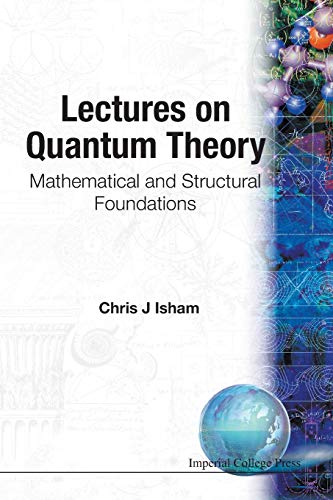
Ebook Info
- Published: 1995
- Number of pages: 274 pages
- Format: PDF
- File Size: 13.42 MB
- Authors: Chris J Isham
Description
This book is based on material taught to final-year physics undergraduates as part of the theoretical physics option at Imperial College. After a self-contained introduction to the essential ideas of vector spaces and linear operators, a bridge is built between the concepts and mathematics of classical physics, and the new mathematical framework employed in quantum mechanics. The axioms of nonrelativistic quantum theory are introduced, and shown to lead to a variety of new conceptual problems. Subjects discussed include state-vector reduction, the problem of measurement, quantum entanglement, the Kochen-Specker theorem, and the Bell inequalities. The book includes twenty-five problems with worked solutions.
User’s Reviews
Editorial Reviews: From Scientific American “The proper role of mathematics is to make things easy. When something can be expressed in the precise language of mathematics, results can be obtained by the application of given rules. Calculations are so simple that even computers can do them. Chris Isham’s lectures on the mathematical and structural foundations of quantum theory, reproduced in this book, provide an excellent illustration of this truth … a welcome addition to the modern literature on quantum theory … It is good to have a book that gives such an excellent description of the mathematical structure of quantum theory …” From The New Yorker “Chris Isham’s book is a welcome addition to the existing literature. If you already have some familiarity with quantum theory and you want one book – get this one!” Review “… this is a clear, elegant and beautifully structured introductory account of some of the most puzzling aspects of physics … I believe that this book will be particularly influential, however, because it makes the basic philosophical ideas and the mathematical theorems that underpin the rapidly developing field of quantum technology so accessible … The novice can seek no more cultured or congenial guide than Chris Isham. I am convinced that this book – to indulge in that hackneyed but totally appropriate phrase – is destined to become a classic. — Gary Gibbons, Physics World, 1996″In the US it could serve as an excellent supplement for an introductory graduate course on quantum mechanics … The discursive style and clear exposition make for equally attractive reading by someone familiar with the subject or by a student with only rudimentary knowledge … The main text is supplemented by a substantial number of problems with solutions, which should help the beginner master the mathematics … I would strongly recommend that anyone teaching the subject use this little book as supplementary reading.” — Meinhard Mayer, Physics Today (USA), Aug 1996 From the Publisher Published by Imperial College Press and distributed by World Scientific Publishing Co. Read more
Reviews from Amazon users which were colected at the time this book was published on the website:
⭐We read the… “scope of this book is to explore some of the deep conceptual issues that arise in quantum theory.” (page 3). That “scope” being a good reason to consult this well-written lecture-book. A masterful mixture of elementary and advanced quantum mechanics awaits the student. We recall elementary wave mechanics, proceed to Hilbert space, then such things as Kochen-Specker Theorem and Bell’s inequalities.A few words from Chris Isham (alongside others):(1) “The heart of the radically different natures of classical and quantum probability is just the difference between numbers obtained from ratios of volumes, and numbers that come from the Pythagorean Theorem.” (page 17).(2) “The differential operators of introductory wave mechanics are ‘almost’ linear operators, and is one of the reasons why, mathematically speaking, wave mechanics is far from being elementary.” (page 47).(3) ” We come to the Spectral theorem, a result upon which hangs the entire edifice of quantum theory.”(page 59). (Jauch: “In general situations we must fall back on the spectral representation.” (1968, page 64, Foundations Quantum Mechanics).(4) “The crucial problem of state preparation is closely related to the idea of the reduction of the state vector.” (page 154). (Kurt Gottfried: “The reduction postulate is an independent axiom. If one accepts Von Neumann’s formulation of quantum mechanics, one is led to far reaching and not entirely palatable conclusions.” (1966, page 188, Quantum Mechanics).(5) Read: “The phenomenon of quantum entanglement suggests a holistic structure for the physical world.” (page 174). (Arno Bohm’s 1979 Quantum Mechanics text: “a holistic method is needed also.”(6) “A thing is arguably better understood as a bundle of latent, or potential, properties that are brought into being…” (page 77). (Daniel Gillespie: “the very act of measuring a value essentially ‘develops’ a value of the observable.” (page 61,1970, Quantum Mechanics Primer).(7) “In truth, the heart of the matter is that we still have not succeeded in understanding how the transition from ‘potential’ to ‘actual’ really comes about.” (page 183). (Vladimir Fock, Quantum Mechanics text: “..the idea of probability and thereby the idea of potential possibility…” 1978).(8) “Time tends to disappear completely in certain natural approaches to quantum gravity.”(page 186).(Misner, Thorne and Wheeler: “the concept of spacetime is incompatible with the quantum principle; there is no time, no before, no after…” Gravitation, 1973, page 1182).(9) “The concept of an individual system ‘possessing’ a value for all its physical quantities is difficult to reconcile with the actual formalism of quantum theory.” (page 190).Pedagogic attributes of Isham’s Lecture Notes: straightforward exercises replete with solutions (in twenty pages). Probability is met at more than one juncture: First, its “meaning” (pages 150-155), then with more than a cursory approach utilizing conditional probability (pages 161-165). Principles of logic met more than once (page 28), then more than cursory (page 198, compare to Roland Omnes, pages 99-101, 1999). Astute commentary expanding upon the discussion (i.e., an extension of Von Neumann’s postulate, pages 158-160 ). Detailed examples: the examples break the monotony of the “theorem-proof” format (e.g., Groups, pages 21-22). Examples to demonstrate utilization of formalism (simple example: measurement of spin, page 102).One reviewer writes: “serves as an excellent supplement for introductory graduate course in the USA.” (back-cover). It would be a pity if the book were only used as a supplement at the graduate level as Isham writes “intended to be a short textbook for undergraduates.” (And that it is !).I propose an avenue of study: First, study Gillespies’ Primer of Quantum Mechanics (1970, intended for sophomore-level). Next, study Christopher Isham’s insightful text. Then, if need be, avail yourself of the more detailed textbook Quantum Theory, by Asher Peres. Consulting those three textbooks (progressing from elementary to more advanced) should prove efficacious !
⭐Very fine lectures on the foundations of quantum mechanics but definitely not for beginners. Prof. Isham states: “These lectures were part of a third year theoretical physics option (preface, p. v)”, so be prepared. Before tackling this book on your own, I think you should understand something about vector spaces, basic linear functional analysis and Hilbert spaces and also feel comfortable with a fairly high degree of mathematical and logical abstraction.Prof. Isham’s exposition is admirably clear and he provides a great deal of very helpful discussion of a number of difficult / subtle foundational issues, concepts and theorems central to quantum mechanics. The topics go well beyond what’s in introductory or even more advanced textbooks, e.g. in chapter 4, he discusses the classical physics notion of property, which is compared to the quantum mechanical situation; in chapter 5 (General Formalism of Quantum Theory), he states informally and elucidates four rules providing the basic conceptual underpinnings of QM. Rule 3 deals with the central notion of expected result of measuring an operator on a quantum state and then later in section 5.3, he discusses in detail an alternative form of rule 3 and its implications, all of which I found quite interesting. Chapter 6 discusses a number of key technical topics including density matrices, a subject typically missing from introductory accounts. Chapter 7 includes a nice discussion of uncertainty relations. Chapter 8 (Conceptual Issues in Quantum Theory) and Chapter 9 (Properties in Quantum Physics) is where he really gets into various controversial topics: the meaning of probability, reduction of state vectors, quantum entanglement, the measurement problem, all in ch. 8; followed by the Kochen-Specker theorem, quantum logic and non-locality and Bell’s inequalities, all in ch. 9. It is really wonderful to be able to learn how a world-class theoretical physicist like Prof. Isham, who takes conceptual issues seriously unlike many practicing quantum physicists, thinks about these arguably arcane issues. These discussions are introductory and somewhat superficial but nevertheless insightful and well worth one’s time.In summary, if you’re interested in the deep and perplexing conceptual issues of quantum mechanics, then these lectures will provide you with a pedagogically sound, totally reliable introduction by a world-class physicist who is also a gifted writer.
⭐”Lectures of Quantum Theory” is an excellent and elementary introduction to (non relativistic) quantum mechanics from a peculiarly pedagogical point of view. The author treats, for example, topics that are not in general dealt with in elementary texts, like the following: the nature of things (the old substances) and properties, the meaning of determinism and of causality, the notions of probability in classical and quantum mechanics, quantum logic, the signification of superposition and of entanglement in quantum theory, the Einstein-Podolsky-Rosen “paradox” and the incompleteness of quantum mechanics, and the epistemological meaning of results such as those of Kochen-Specker and of Bell. So, “Lectures on Quantum theory” is not only an introduction to (non relativistic) quantum mechanics, but also to its underlying philosophical problems. The book can as well be used as a supplement for graduate and undergraduate courses on quantum theory. It will surely interest physicists, philosophers, and anyone willing to make an idea of one of the most important sciences of our time, as well as of its foundations and some of its philosophical implications.
⭐I have had this book for many years but mislaid my copy so bought it again. Isham writes with clarity and authority (his other books in this series are excellent, too) so what more is there to say – oh yes, the book is very useful and a very handy reference at this level – hence my need to replace my “lost” copy
⭐I remember Prof. Isham teaching the final year course Foundation of QM at Imperial college so many years ago. The lecture notes was from the book and its a treat to be able to read this again!
⭐This is one of my favorite books in quantum mechanics. It takes a slightly unconventional road with a very geometric tone, characteristic of Chris Isham style.
Keywords
Free Download Lectures On Quantum Theory: Mathematical And Structural Foundations in PDF format
Lectures On Quantum Theory: Mathematical And Structural Foundations PDF Free Download
Download Lectures On Quantum Theory: Mathematical And Structural Foundations 1995 PDF Free
Lectures On Quantum Theory: Mathematical And Structural Foundations 1995 PDF Free Download
Download Lectures On Quantum Theory: Mathematical And Structural Foundations PDF
Free Download Ebook Lectures On Quantum Theory: Mathematical And Structural Foundations