Ebook Info
- Published: 1997
- Number of pages: 296 pages
- Format: PDF
- File Size: 9.94 MB
- Authors: Friedrich Nietzsche
Description
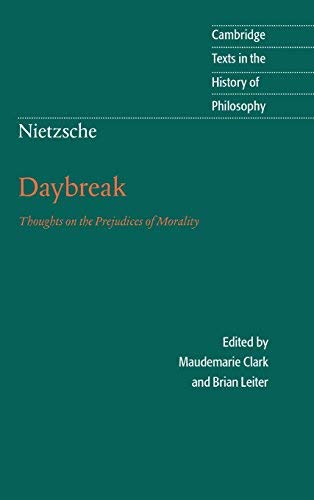
Daybreak marks the arrival of Nietzsche’s ‘mature’ philosophy and is indispensable for an understanding of his critique of morality and ‘revaluation of all values’. This volume presents the distinguished translation by R. J. Hollingdale, with a new introduction that argues for a dramatic change in Nietzsche’s views from Human, All Too Human to Daybreak, and shows how this change, in turn, presages the main themes of Nietzsche’s later and better-known works such as On the Genealogy of Morality. The main themes of Daybreak are located in their intellectual and philosophical contexts: in Nietzsche’s training as a classical philologist and his fascination with the Sophists and Thucydides; in the moral philosophies of Kant and Schopenhauer, which are the central foci of Nietzsche’s critique of morality; and in the German Materialist movement of the 1850s and after, which shaped Nietzsche’s conception of persons. The edition is completed by a chronology, notes and a guide to further reading.
User’s Reviews
Reviews from Amazon users which were colected at the time this book was published on the website:
⭐Daybreak being as much the culmination of Nietzsche’s early philosophy as the beginning of his mature philosophy, is the marker from which he would later depart for new philosophical territories, latitudes and altitudes of thought and inquiry. The thoughts ‘left on ice’ will soon melt-over in a true eruption as seen in The Gay Science through Beyond Good and Evil. If Human All Too Human is the Groundwork for the Revaluation of All Values, Daybreak delineates the nihilistic abyss and chasm over which Nietzsche poses his challenge to the overman and their forefathers, the philosophers of the future. The bridge to the future begins with the Dawn, and the Great Noontide and Twilight of the Idols begin with the gloaming thought in this text: Artemis hunts at night.
⭐Cambridge University Press must have a fetish for horrible translations and inept scholarship.These bad translations are everywhere, and here is another one. Way too stiff and literal. There is obviously something wrong here. The translation is barely intelligible at times. Nietzsche was a good writer. It should be a pleasure, not a form of torture, to read him, but you would never know it from this translation.The author (or should I say ‘perpetrator’?) of this translation has a way with words, and that way is….awful.This translation does not merit a ‘review’, only a denunciation. It’s horrid, inept translating. Hollingdale has all the literary skill of a dishrag. Varies from merely adequate at best to ludicrous and unintentionally (one hopes) hilarious.The more of this travesty I read, the angrier I become.Cambridge initially issued this translation back in the 1980s, with an introduction by the late Michael Tanner. Cambridge has re-issued the Hollingdale translation with a new introduction and notes, but Cambridge is so cheap they did not re-set the text to accommodate the notes. Instead, they just stuck the notes at the end and put the section number above it. There is no reference within the text itself that alerts the reader to the presence of a note at the end. Cheap bastards!
⭐The ideas in Daybreak are like waves on an ocean that wishes the rim of fire was more active. People who are looking for a perfect wave to surf might run into some rocks before they get to any sandy beaches. I am amazed how many times I have picked up this book and found some comment on the sociology of denial that rings true.
⭐To one who has read Nietzsche’s mature works, this book is indispensable in an understanding of the infancy of the great ideas that were to follow
⭐Great addition to Genealogy or BG&E, and to the beginning phase of the mature Nietzsche’s writing; Leiter’s introductory material is top-notch.
⭐Bought it for a college course, so that might have something to do with my dislike of the book. This book is worth it for classes, however.
⭐Friedrich Wilhelm Nietzsche (1844-1900) was a German philosopher, cultural critic, poet and composer, most known for his statement, “God is dead.” He suffered a mental collapse, and spent the last eleven years of his life in a psychiatric clinic. He wrote many books, such as
⭐,
⭐,
⭐, the posthumously-published
⭐, etc. As a young man, he even tried his hand at composition
⭐].He wrote in the Preface to this 1881 book, “In this book you will discover a `subterranean man’ at work, one who tunnels and mines and undermines. You will see him—presupposing you have eyes capable of seeing this work in the depths—going forward slowly, cautiously, gently inexorable, without betraying very much of the distress which any protracted deprivation of light and air must entail; you might even call him contented, working there in the dark. Does it not seem as though some faith were leading him on, some consolation offering him compensation? As though he perhaps desires this prolonged obscurity, desires to be incomprehensible, concealed, enigmatic, because he knows what he will thereby also acquire: his own morning, his own redemption, his own DAYBREAK? He will return, that is certain: do not ask him what he is looking for down there, he will tell you himself of his own accord, this seeming … subterranean, as soon as he has `become a man’ again. Being silent is something one completely unlearns if, like him, one has been for so long a solitary mole…”[Later in the book, he advises: “A book such as this is not for reading straight through or reading aloud but for dipping into, especially when out walking or on a journey; you must be able to stick your head into it and out of it again and again and discover nothing familiar around you.” §454, pg. 191]He says, “Custom represents the experiences of men of earlier times as to what they supposed useful and harmful—but the SENSE FOR CUSTOM (morality) applies… to the age, the sanctity, the indiscussability of the custom. And so this feeling is a hindrance to the acquisition of new experiences and the correction of customs: that is to say, morality is a hindrance to the creation of new and better customs: it makes stupid.” (§19, pg. 18)He asserts, “You say that the morality of pity is a higher morality than that of stoicism? Prove it! But note that `higher’ and `lower’ in morality is not to be measured by a moral yardstick: for there is no absolute morality. So take your yardstick from elsewhere and—watch out!” (§139, pg. 88)He observes, “Men have on the whole spoken of love with such emphasis and so idolized it because they have had little of it and have never been allowed to eat their fill of this food: this it became for them `food of the gods.'” (§147, pg. 93)He says, “Beware of all spirits that lie in chains! Of clever women, for example, whom fate has confined to a petty, dull environment, and who grow old in there. It is true they lie apparently sluggish and half-blind in the sunlight: but at every unfamiliar step, at everything unexpected, they start up and bit, take their revenge on everything that has escaped from their dog-kennel.” (§227, pg. 138)He comments, “A historian has to do, not with what actually happened, but only with events supposed to have happened: for only the latter have PRODUCED AN EFFECT. Likewise only with supposed heroes. His them, so-called world history, is opinions about supposed actions and their supposed motives, which in turn give rise to further opinions and actions, the reality of which is however at once vaporized again and produces an EFFECT only as vapour… All historians speak of things which have never existed except in imagination.” (§307, pg. 156)Fans of Nietzsche (and particularly of his aphorisms) will enjoy this relatively “early” work. (Which is also known as “Dawn,” in some other translations.)
⭐Content is challenging and subversive. As ever. The print for me is too small and takes me a lot of effort to read (Human all too Human in the same series has larger print). This is though rewarding to read though sometimes Nietzsche’s posturing becomes a trifle embarrassing.
⭐Good old solid Nietzsche, as ever. Full of aphorisms, and has all the typical ‘spot-on’ astute reflections that Nietzsche always provides. Well worth it, though possibly not as an ‘entry-level’ introduction to Nietzsche (see Beyond Good and Evil for that).
⭐Excellent read of post Hegel enlightenment, 19th Century German philosophy at its best!
Keywords
Free Download Nietzsche: Daybreak: Thoughts on the Prejudices of Morality (Cambridge Texts in the History of Philosophy) 2nd Edition in PDF format
Nietzsche: Daybreak: Thoughts on the Prejudices of Morality (Cambridge Texts in the History of Philosophy) 2nd Edition PDF Free Download
Download Nietzsche: Daybreak: Thoughts on the Prejudices of Morality (Cambridge Texts in the History of Philosophy) 2nd Edition 1997 PDF Free
Nietzsche: Daybreak: Thoughts on the Prejudices of Morality (Cambridge Texts in the History of Philosophy) 2nd Edition 1997 PDF Free Download
Download Nietzsche: Daybreak: Thoughts on the Prejudices of Morality (Cambridge Texts in the History of Philosophy) 2nd Edition PDF
Free Download Ebook Nietzsche: Daybreak: Thoughts on the Prejudices of Morality (Cambridge Texts in the History of Philosophy) 2nd Edition