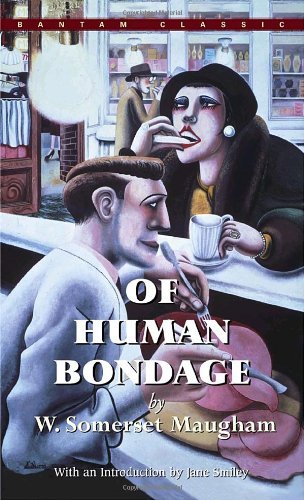
Ebook Info
- Published: 2006
- Number of pages: 459 pages
- Format: PDF
- File Size: 1.57 MB
- Authors: W. Somerset Maugham
Description
A masterpiece of modern literature that mirrors Maugham’s own career.Of Human Bondage is the first and most autobiographical of Maugham’s novels. It is the story of Philip Carey, an orphan eager for life, love and adventure. After a few months studying in Heidelberg, and a brief spell in Paris as a would-be artist, Philip settles in London to train as a doctor. And that is where he meets Mildred, the loud but irresistible waitress with whom he plunges into a formative, tortured and masochistic affair which very nearly ruins him.
User’s Reviews
Reviews from Amazon users which were colected at the time this book was published on the website:
⭐It’s difficult to approach this wonderful book afresh, as there have been several film versions — none of them really satisfying — and to tell the truth this wasn’t the first time I’ve read it. This was my third read over a period of 50 years, and each time was like a new experience. This is a long novel — no getting away from that — and there are moments when the reader might wonder why Mr. Maugham didn’t condense his story somewhat. But novels were long in those days (1916), and this is in the tradition of a lengthy Dickens novel like David Copperfield. There are similarities, too, with Dickens in theme and treatment: a boy orphaned at a young age, brought up by relatives inexperienced in the rearing of a shy, sensitive child, the constant struggle with poverty, the finding of one’s place in the world.So yes, this is a long book but it has a magical forward thrust — Maugham was a master storyteller — and except for a couple of doldrums it moves right along up to its somewhat unconvincing finish. What stood out for me this time around is how shockingly self-absorbed the hero, Philip Carey, really is! Painfully shy, he is flawed in many ways, but extremely bright. The reader often wants to just slap some sense into him, wishing he would learn from his mistakes and get over himself, as we say nowadays. This is maddening, but it makes Philip a fascinating character study. He doesn’t learn from his mistakes, and like many young people is completely ruled by his emotions, complicated in this case by his pride and class snobbery. In other words, he is his own worst enemy. It’s interesting, and crucial to the tension of the plot, that the reader is more aware than Philip is where his self-destructive behavior will lead him. We fear for him and mourn with him when misfortune comes.Oddly, for such a long book, the character who becomes his nemesis has to wait until the volume is half over before she makes her appearance.The central and most famous sections of the story deal with his disastrous involvement with Mildred Rogers, a selfish, ignorant virago of a woman who instinctively recognizes in Philip an unconscious masochism and uses it to manipulate him, like a puppet on a string. Her cruelty is almost beyond belief at times, and the reader learns to both dread and look forward to her appearances, like a terrible accident we’re compelled to watch. And it should be said that these are the most exciting scenes in this powerful novel. The protagonist’s attraction to her is a mystery even to himself, but it is undeniable. A kind of bondage.But there are other women in Philip’s life and invariably he treats them quite badly. His men friends don’t fare much better. He doesn’t seem to have a sense of what makes people tick. He is simply oblivious to the suffering of a fellow art student who is in love with him, although her tragic end does provoke some pricks of conscience.On the other hand, despite many setbacks Philip eventually becomes an excellent doctor, sympathetic and liked by his patients. These contradictions in our hero’s character are part of why he is such an enduring character in literature. For me, the most moving parts of his story are when he is forced by dire circumstance to accept help from the people who care for him. He seems surprised that they would want to, so precarious is his self-esteem.This makes Philip Carey very modern in some ways. He has to touch bottom several times before the way forward becomes clear.This is one of the great books of the twentieth century, and one of the most entertaining.
⭐Anyone who’s ever taken themselves too seriously will recognize a kindred soul in Philip Carey of W. Somerset Maughum’s Of Human Bondage. We meet him when he’s still a child and very recently orphaned, going from a relatively privileged life with his mother to a much sparser one with his aunt and uncle, the latter of whom is a pastor in a small town in the British countryside. Scared a bit by his that uncle, he escapes into books and becomes a voracious reader. The next year, he’s sent to boarding school, where his disability (he has a clubfoot, which gives him a limp), combined with his shyness and sensitivity, makes for a generally unhappy experience. He becomes passionately religious and plans on a career in the clergy, but when his prayers for a cure for his foot are unanswered, he loses both his faith and his direction in life.He goes to Germany briefly, comes back to England and tries being an accountant, which doesn’t take, then to France to study art, then back to England again, where he decides to settle down and study medicine, which was his father’s career. But all his indecision has driven down his available resources so he’ll need to live very modestly until he’s a doctor and can start earning a living…and then he meets Mildred. Despite Philip’s self-pity, he’s had a few relationships with women at this point, and is actually in a good one, when he meets the waitress his friend has a crush on. Philip becomes obsessed with her, despite her obvious disinterest in him and lack of social skills. His situation eventually becomes desperate, but with some kindness and a bit of luck, it resolves itself.I refuse to stop reading a book before I finish it. This does backfire on me sometimes, but other times it pays off to stick with a book, and this was one of those instances. About halfway through it, I was sick of Philip and his moping and the garbage way he treated women and his refusal to understand that as wonderful as self-discovery is, there’s no money in it. The whole book is his story of growing up, and he was so grating that I wasn’t at all invested in him or rooting for him to succeed. But then he starts to mature, puts his head down and works, uses his own hard-earned life lessons and experiences to be a good doctor to the people he sees. And by the end of it, when he does find some measure of happiness and chooses to do the harder, better thing, I couldn’t have been happier for him if he were an actual person and a friend at that.I’ve always been a character-over-plot type of reader, and this book is all the former…the only major outside event is the Boer War, which happens late in the book and while it does have an impact on Philip, it’s pretty far removed from the central themes of the coming-of-age story. In some ways, it suffers for its fixation on Philip…like I said above, he can be a hard character to really sympathize with, particularly early on. But the payoff in the back half is real, and seeing him grow as a person is really rewarding. This is a good book, a very good one even, but it may not be the right book for every reader. If you’re looking for a dynamic plot, or lack the patience for/interest in a long-term character study, this probably isn’t going to be something you enjoy. If you’ve read what I’ve written and are intrigued, though, I highly suggest you get ahold of it…it’ll be a rewarding experience!
⭐I believe there are quite a few parallels with Somerset Maugham’s own early life in this forensic study of a boy growing to become a man at the dawn of the last century: his hero Philip was orphaned young, brought up by a self-centred clergyman and his downtrodden sister, neither with much idea about children, bullied at school for his club foot, and grew up to be acutely observant, often using sarcasm to mask his hypersensitivity.We see Philip moving from earnest piety to the conscious rejection of religion, with the startling sense of freedom this brings, trying out a variety of occupations, experimenting with romantic escapades but, to the reader’s frustration, continually falling under the influence of a woman who seems likely to destroy his future. Apart from providing a profound study of Philip’s thoughts and changing emotions, this is interesting for the details of daily life in late Victorian/Edwardian England: what things cost, how people trained for various qualifications, what they wore or ate and so on.This reminds me of Michel Leon’s more recent “The Foundling Boy” (Le Jeune Homme Vert) published recently, but strikes a more serious and realistic note. Maugham should not be condemned for his narrator’s snobbish tone towards, say Cockney clerks or young women unaware of their lack of class as they fret over their respectability, since he must himself have been an inevitable product of the stuffy conventions in which he was raised. Yet, despite its often slow pace and dated attitudes, this classic stands the test of time and still deserves to be read for the wry humour, fluency and insight of the author’s warped genius.
⭐I first read this book many years ago and it has been interesting to re-read it. Most notably because I could remember so much about it, despite the length of time between re-visiting the story. This is a huge book, both in scope and in length. It concerns the life of Philip Carey, from his childhood to manhood and encompasses many events and themes. The book begins with the death of Philip’s beloved mother and his going to live with his uncle and aunt. In a sense he is taken from romance and frippery to the genteel poverty which shadows him throughout his life.On reading this novel again, I was surprised at just how meandering it was – we read of schooldays and bullying (Philip has a club foot and his deformity makes him overly sensitive throughout much of his life), varying career paths, years in Paris attempting to be an artist, life as a medical student and several love stories. The central and dominant affair though is that with Mildred Rogers; tall and thin, insolent and rude, of a lower social class and with whom he becomes utterly besotted.This is W. Somerset Maugham’s most personal and autobiographical novel and it is both ambitious and wide ranging. I hesitate to say this, but I imagine any author would have problems getting a novel like this published today, which is a shame. For although it is very long and despite the fact that no particular character, including that of Philip himself, is totally sympathetic, it is a book that will stay with you. Maugham was a great author and this is a true classic.
⭐I enjoyed the book and it is beautifully written, but I found it hard-going from time to time. There is just too much detail about Philip’s friends and acquaintances in Heidelberg and Paris and the saga of Philip’s relationship with Mildred is interminable. OK, the story is about the bonds of human life, but the 700 pages could easily have been cut to 400 without losing any of the main message. Worth reading, though.
⭐Of Human Bondage is widely regarded as Somerset Maugham’s best work and I’m inclined to agree from the novels I have read of his so far. It was written in 1915 but is set around about the turn of the twentieth century for the most part when the second Boer war was being fought (1899-1902) evoking a vibrant picture of how life was in those long gone days. I found the social fabric which Maugham creates so vividly of particular interest, the times may have changed but human nature remains a constant. Maugham trained and qualified to be a doctor before he found his true vocation as a writer and with the book being semi-autobiographical it provides a wonderful insight of the medical practices of those times. The prose is beautifully constructed and without being verbose Maugham has got an uncanny knack of always finding the right words from his seemingly infinite vocabulary. Readers will find some of the vocabulary in this story ‘archaic’ as it has been rendered obsolete by the progression of the English language so will need to define the meanings of certain words used in the book. I don’t want to include any spoilers in this review for readers who have yet to read this masterpiece but the book did have a happy ending, which was essential after all the hardship Philippe endured. The thing is when reading Maugham is that he creates his characters so cleverly and authentic that you cannot fail to empathise with them. I can highly recommend the authors short stories, some of which are the best short stories ever written. An underlying theme in a lot of Maugham’s work is the class divide and the conflict it engenders and this is very apparent in this book. If you’re like me you will be rooting for him throughout the whole story as he is the ultimate underdog who has to battle against the ill fortunes of life over which we have no control. He evokes sympathy in every chapter. Truly essential reading for any admirer of the literary genius who was Somerset Maugham. A longish book at 550 pages (kindle edition) but a beautifully written story which will transport you back to the times in which it was written. Maugham’s greatest gift as a writer was his extreme perspicacity and perception to summarise the human condition that he succeeds at so elegantly in this book. A five star read by a five star author.
⭐Absolutely loved this book from the first page to the last. Passion, obsession, despair, beauty, poverty, fulfilment are some of the themes: all woven through a captivating story, and written in glorious language. I just want to start it again now
Keywords
Free Download Of Human Bondage in PDF format
Of Human Bondage PDF Free Download
Download Of Human Bondage 2006 PDF Free
Of Human Bondage 2006 PDF Free Download
Download Of Human Bondage PDF
Free Download Ebook Of Human Bondage