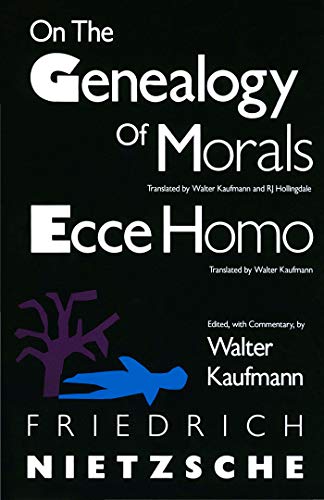
Ebook Info
- Published: 1989
- Number of pages: 384 pages
- Format: PDF
- File Size: 14.60 MB
- Authors: Friedrich Nietzsche
Description
Masterful translations of the great philosopher’s major work on ethics, along with his own remarkable review of his life and works. On the Genealogy of Morals (1887) shows him using philsophy, psychology, and classical philology in an effort to give new direction to an ancient discipline.The work consists of three essays. The first contrasts master morality and slave morality and indicates how the term “good” has widely different meanings in each. The second inquiry deals with guilt and the bad conscience; the third with ascetic ideals—not only in religion but also in the academy. Ecce Homo, written in 1898 and first published posthumously in 1908, is Nietzsche’s review of his life and works. It contains chapters on all the books he himself published. His interpretations are as fascinating as they are invaluable. Nothing Nietzsche wrote is more stunning stylistically or as a human document.Walter Kaufmann’s translations are faithful of the word and spirit of Nietzsche, and his running footnote commentaries on both books are more comprehensive than those in his other Nietzsche translations because these two works have been so widely misunderstood.
User’s Reviews
Editorial Reviews: From the Inside Flap The great philosopher’s major work on ethics, along with ECCE HOMO, Nietzche’s remarkable review of his life and works. Translated by Walter Kaufmann. From the Back Cover The great philosopher’s major work on ethics, along with ECCE HOMO, Nietzche’s remarkable review of his life and works. Translated by Walter Kaufmann. About the Author FRIEDRICH NIETZCHE was a philosopher born in Prussia in 1844. After the death of his father, a Lutheran minister, Nietzsche was raised from the age of five by his mother in a household of women. In 1869 he was appointed Professor of Classical Philology at the University of Basel, where he taught until 1879 when poor health forced him to retire. He never recovered from a nervous breakdown in 1889 and died eleven years later. Known for saying that “god is dead,” Nietzsche propounded his metaphysical construct of the superiority of the disciplined individual (superman) living in the present over traditional values derived from Christianity and its emphasis on heavenly rewards. His ideas were appropriated by the Fascists, who turned his theories into social realities that he had never intended.WALTER KAUFMANN was a philosopher and poet, as well as a renowned translator of Friedrich Nietzsche. His books include Nietzsche: Philosopher, Psychologist, Antichrist, From Shakespeare to Existentialism, and Existentialism: From Dostoevsky to Sartre. Hewas a Professor of Philosophy at Princeton University, where he taught after receiving his Ph.D. from Harvard in 1947 until his death in 1980. He held visiting appointments at many American and foreign universities, including Columbia, Cornell, Heidelberg, Jerusalem, and the Australian National University; and his books have been translated into Dutch, German, Italian, Japanese, and Spanish. Read more
Reviews from Amazon users which were colected at the time this book was published on the website:
⭐Ecce Homo: His wit and wisdom shines through in his hyperbole, irony and deel learning on many topics. Nietzsche on Nietzsche? A work to be treaured.GOM: His analysis of the origins of comteporary morality is striking. His counter intuitive and historically grounded insights leave one shaken, yet hopeful that a better, life-affirming morality may still be posssible. His explanation of the phenomenon of “ressentiment” and the “Slave Revolt” in Christianity is perhaps more relevant than ever. A dense, conplext, systematic work of philosophy that avoids that cardinal sin which so many commit: lack of a proper historical sense.In both boooks, the prose is second-to-none.
⭐The translation is very good in this book and it has enough remarks from the translator to not be overwhelming but still give you the information you need to understand some of the things Nietzsche references from his time. The paper and binding are a good quality. The way I read tends to wear down bindings, but this one had no trouble.The content itself is great. Genealogy of Morals is extremely insightful into the human psyche and explains very well where a lot of our morality stems from. What’s even more interesting, in my opinion, is that he talks at length about what the psychology of this morality causes in society.Ecce Homo is great on another level. It’s rare to see a great thinker make great note of his faults. He talks about his thought process for each book he wrote. While this may not seem greatly informative I think this books main purpose it to encourage people to not deify him the way we tend to do with long dead figures.Nietzsche is a great writer, but if this is your first book of his I would strongly recommend reading it in entirety before agreeing or disagreeing with it. He likes to speak in extremes. I find this a great approach when it comes to understanding his entire book, but it’s easy to get the wrong idea if you only read part of it. For instance, he’s call the Jews some of the most harmful forces in human history and then many pages later (and with some of these things even books later) he will say that despite that their general mentality is essential to our survival and that any form of antisemitism is horrifically misguided. In general it’s best not to quote Nietzsche, rather paraphrasing tends to be more accurate. He writes so that you have to actually read his work, not just read the wiki on him.
⭐It’s Nietzsche at his best. Great take of religion and the resentment mentality sadly still relevant today
⭐Great read! Currently reading
⭐Cream of the crop.Kaufman and Hollingdale deserve a medal for the work they’ve done here. A true gem of a book!Soooo happy it’s still in print!
⭐Quality paperback (I am not a fan of paperbacks, and prefer hardbacks) and good translation. If you want to read an interesting work on ethics and morality, read this book.
⭐Great book and great value for your money!
⭐Book came swiftly without any issues. 🙂
⭐A good “taster” of the work of Nietzsche of whom I know little. Has prompted me to look deeper
⭐I have only read the first in full. The second is an adjunct to reading Nietzsche’s other works giving his own interpretations and self-criticisms.The Geneaolgy is a crazy and anachronistic theory about the origins of “morality” – by which Nietzsche meant most of all conventional Christian morality. The theory in paraphrase is the weak conspired to take revenge on the strong by inventing guilt. From biographical sources, it is clear that the apparent anti-semitism in this work was a rhetorical device. What makes the book interesting is that it anticipates many of Freud’s ideas – and read as a psychoanalytical text it is intriguing, particularly Nietzsche’s discussion of the idea of “resentiment”.
⭐Nietzsche é un filosofo di cui tutti hanno sentito parlare. Nell’immaginario collettivo é un filosofo complicatissimo e che aveva idee un poco tendenti verso ideologie pericolose: prezza della razza, il mito del superuomo che prevale su titti gli altri, ecc. ecc. Tutte sciocchezze che servano solo dal fatto che non si sono letti gli scritti di Nietzsche. La Genealogia della Morale in particolare rappresenta non certo una “summa”, ma un interessante compendio di alcune tra le idee più importanti del filosofo. Il suo pensiero é moderno, intenso e per molti versi attuale. Di cero non é l’ideologo del nazismo come molti credono.
⭐
⭐it’s a must read Neitsche book, the quality is cheap, but at least no page is missing
⭐人間社会では常にモラルは中心的問題でありますゆえ、これもまた必読の書。英訳はシンプルでわかり易いです。
⭐
Keywords
Free Download On the Genealogy of Morals and Ecce Homo in PDF format
On the Genealogy of Morals and Ecce Homo PDF Free Download
Download On the Genealogy of Morals and Ecce Homo 1989 PDF Free
On the Genealogy of Morals and Ecce Homo 1989 PDF Free Download
Download On the Genealogy of Morals and Ecce Homo PDF
Free Download Ebook On the Genealogy of Morals and Ecce Homo