Ebook Info
- Published:
- Number of pages:
- Format: PDF
- File Size: 1.76 MB
- Authors: D. E. Wittkower
Description
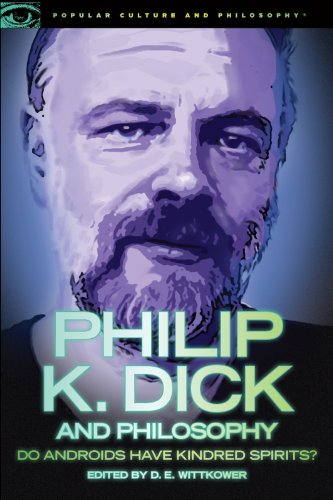
Science fiction writer Philip K. Dick (1928–1982) is the giant imagination behind so much recent popular culture—both movies directly based on his writings, such as Blade Runner (based on the novel Do Androids Dream of Electric Sheep?), Total Recall, Minority Report, and The Adjustment Bureau plus cult favorites such as A Scanner Darkly, Imposter, Next, Screamers, and Paycheck and works revealing his powerful influence, such as The Matrix and Inception. With the publication in 2011 of volume 1 of Exegesis, his journal of spiritual visions and paranoic investigations, Dick is fast becoming a major influence in the world of popular spirituality and occult thinking.In Philip K. Dick and Philosophy thirty Dick fans and professional thinkers confront the fascinating and frightening ideas raised by Dick’s mind-blowing fantasies. Is there an alien world behind the everyday reality we experience? If androids can pass as human, should they be given the same consideration as humans? Do psychotics have insights into a mystical reality? Would knowledge of the future free us or enslave us? This volume will also include Dick’s short story “Adjustment Team,” on which The Adjustment Bureau is based.Philip K. Dick and Philosophy explores the ideas of Philip K. Dick in the same way that he did: with an earnest desire to understand the truth of the world, but without falsely equating earnestness with a dry seriousness. Dick’s work was replete with whimsical and absurdist presentations of the greatest challenges to reason and to humanity—paradox, futility, paranoia, and failure—and even at his darkest times he was able to keep some perspective and humor, as for example in choosing to name himself ‘Horselover Fat’ in VALIS at the same time as he relates his personal religious epiphanies, crises, and delusions. With the same earnest whimsy, we approach Philip K. Dick as a philosopher like ourselves—one who wrote almost entirely in thought-experiments and semi-fictional world-building, but who engaged with many of the greatest questions of philosophy throughout the Euro-American tradition.Philip K. Dick and Philosophy has much to offer for both serious fans and those who have recently learned his name, and realized that his work has been the inspiration for several well-known and thought-provoking films. Most chapters start with one or more of the movies based on Dick’s writing. From here, the authors delve deeper into the issues by bringing in philosophers’ perspectives and by bringing in Dick’s written work. The book invites the reader with a casual familiarity with Dick to get to know his work, and invites the reader with little familiarity with philosophy to learn more. New perspectives and challenging connections and interpretations for even the most hard-core Dick fans are also offered. To maximize public interest, the book prominently addresses the most widely-known films, as well as those with the most significant fan followings: Blade Runner, Total Recall, Minority Report, A Scanner Darkly, and The Adjustment Bureau. Along with these “big five” films, a few chapters address his last novels, especially VALIS, which have a significant cult following of their own. There are also chapters which address short stories and novels which are currently planned for adaptation: Radio Free Albemuth (film completed, awaiting distribution), The Man in the High Castle (in development by Ridley Scott for BBC mini-series), and “King of the Elves” (Disney, planned for release in 2012).
User’s Reviews
Reviews from Amazon users which were colected at the time this book was published on the website:
⭐I’ll preface this review by saying I’m not a philosopher in the strictest sense: I never studied it in school beyond incidental exposure and a single 101 class, and I’m certainly not a professor. But I don’t think you need to be to enjoy Philip K. Dick and Philosophy. There are a lot of cool ideas that dovetail off of those presented in Dick’s work and the movies based off of them (after reading Ethan Mills’ chapter “Hollywood Doesn’t Know Dick” I am careful to draw that distinction!), so if you enjoy either, you’ll probably enjoy the book as much as I did.I did find myself skipping a chapter here and there (“Yes, I get it, I can’t prove the world is real – but I only have a 30 minute lunch break, folks, let’s get to something new!”) but the vast majority of the essays here are novel, interesting, and thought-provoking. I particularly enjoyed “Just Who And How Many Are You?” by Richard Feist, which, in part, explores a study looking at the duality of the human brain. The ramifications of this study are fascinating. The two sides of your brain are far more independent than you probably realize. Different enough to bring up the question: Are you actually two people or one person?The book delves deeply into the ideas presented in “Do Androids Dream of Electric Sheep?” (or “Bladerunner” as we Hollywood Luddites may think of it); by the end of the book I was pretty well convinced that we probably ARE all robots, but that I really didn’t mind.Overall, it’s well worth your time and nicely segmented, so if you do get philosophy overload but are still enjoying yourself, it’s no big deal to put it down for a couple weeks and pick it up when your brain is ready for another thrashing. If you enjoy questioning the nature of reality, wish you’d looked a bit more into philosophy when you’d actually had time in your life to do so, or enjoyed any of the ideas presented by Philip K. Dick in his novels or the movies based off them, do yourself a favor and check it out. It’s a cool read.
⭐Being old enough to remember when PKD was alive and writing, I have seen his works fade, then be re-discovered. I liked them then, and have found more depth in them with the passage of time. This collection helps me understand why.
⭐This is a wonderful panorama of reviews and analyses of many of PKD’s works. The diversity of opinion is illuminating. Whereas I may not agree with all authors’ ideas, I credit them their thoughtful presentations.
⭐I really enjoy the philosophy and pop culture series. The books provide a lot of insight into the subject matter, as well as show how philosophy interacts with it.
⭐I spent more time Reading “Philip K. Dick and Philosophy: Do Androids Have Kindred Spirits?” than I expected to and it wasn’t because I didn’t enjoy the book. I spent time understanding the different philosophers and philosophies, and essentially re-adapting/reorganizing what I know about Philip K. Dick to the idea of the philosophizing storyteller (which is referred to several times in the book). I think looking at Dick’s work from the eye of a philosopher in addition to the eye of a literary critic brings much value to his works that I never imagined before.The book consists of a series of topics each containing about three to four essays on that topic. Each of the essays is written by different academics so there is variety in the work that you wouldn’t have in a book written by one person. There were some essays that I didn’t like as much as others but overall I enjoyed the writing and I learned about many different philosophers, some I’d heard of or knew about and some I hadn’t. My background is in literature so I am accustomed to approaching writing from the literary critic or the English major/academic and this is the first philosophy of… book I’ve read so this shift of focus was new to me but I welcomed it.Some of my criticisms of the book center around the essays that discussed the movies to explain philosophies (with exception of the section on Hollywood) but aren’t clear that the movies may be more or less faithful to the original story. The most guilty of these movies and the most often discussed are Adjustment Bureau, Minority Report, and Total Recall. I also have a background in Film Studies and I generally to believe that the director is the “author” of the movie so the implication that the ideas are Dick’s didn’t work for me. Some essays pointed out both the movie and the story, and compared the two which I appreciated. But this is not an issue with a majority of the book only part of it.Many sources discuss how much of a visionary Philip K. Dick was and sources discuss his storytelling themes and ideas but to my knowledge, until this book, his work was not explored using different philosophies which makes this an essential book for any student or fan of Philip K. Dick.
⭐This is a brilliant book.The chapters are essays which examine PKD’s work in relation to the philosophical concerns of his novels.A lot of information on all the philosophical concerns of PKD’s oeuvre.Very good for students of literature/philosophy/critical theory. I used it for a Master’s level essay which I got a good grade for.
Keywords
Free Download Philip K. Dick and Philosophy: Do Androids Have Kindred Spirits? (Popular Culture and Philosophy Book 63) in PDF format
Philip K. Dick and Philosophy: Do Androids Have Kindred Spirits? (Popular Culture and Philosophy Book 63) PDF Free Download
Download Philip K. Dick and Philosophy: Do Androids Have Kindred Spirits? (Popular Culture and Philosophy Book 63) PDF Free
Philip K. Dick and Philosophy: Do Androids Have Kindred Spirits? (Popular Culture and Philosophy Book 63) PDF Free Download
Download Philip K. Dick and Philosophy: Do Androids Have Kindred Spirits? (Popular Culture and Philosophy Book 63) PDF
Free Download Ebook Philip K. Dick and Philosophy: Do Androids Have Kindred Spirits? (Popular Culture and Philosophy Book 63)