Ebook Info
- Published: 2002
- Number of pages: 166 pages
- Format: PDF
- File Size: 1.05 MB
- Authors: Plato
Description
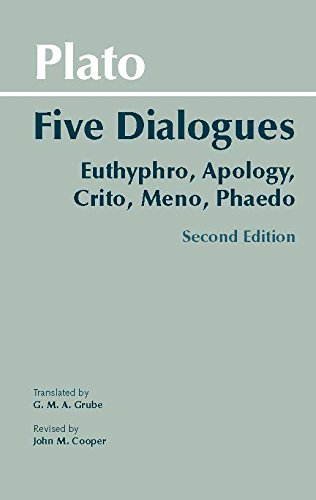
The second edition of Five Dialogues presents G. M. A. Grube’s distinguished translations, as revised by John Cooper for Plato, Complete Works. A number of new or expanded footnotes are also included along with an updated bibliography.
User’s Reviews
Reviews from Amazon users which were colected at the time this book was published on the website:
⭐An excellent introduction to Plato’s philosophy. If you’re interested in the historical figure of Socrates, these dialogues are most are most concerned with his life.Philosophically, these “Five Dialogues”–Euthyphro, Apology, Crito, Meno, Phaedo–along with Phaedrus, Symposium and the Republic form the bulk of Plato’s thought on Forms and the soul. This is a great place to start. The Euthyphro is a typical early dialogue and sets the stage for the charges that face later Socrates in the Apology. Both are very readable. Crito and Phaedo show Socrates in prison accepting his fate with poise and refusing to escape. They are also the most vivid explanation of the immortality of the soul. Meno is a middle dialogue that poses important problems of knowledge and learning resolved by the theory of Forms and Recollection. It’s also the most difficult and rewarding of the bunch.This Hackett edition is nice but not great. The dialogues are the Grube translation, edited by Cooper. The introduction by Grube is rather short and just explains the logic behind the grouping of the five dialogues, which is disappointing compared to other Hackett’s. However, the translation is good, if a bit literal. There are explanatory footnotes for all of Socrates’ idioms and historical references.The margins and book design are nice and readable for such a compact book. The main advantage this little 8×5 paperback has is that it’s cheap, easy to carry, and perfect for writing in. I feel the same way about the other excellent Hackett editions of “Symposium”, “Phaedrus”, and “Laches and Charmides”. Now that my interest in Plato has solidified, I will likely invest in the Hardcover collection “Plato: Complete Works”. However, you will miss out on the introductions found in the individual Hackett’s, in particular Symposium’s and Phaedrus which are fantastic.
⭐I purchased this volume of 5 Dialogues on my journey through the great works of western civilization. This title was not originally on my list, but an impulse buy on my order of Aristotle. I thoroughly enjoyed the Grube/Reeve translation of Republic and was delighted to recognize Grube’s prose. This is a great edition if you are on a similar journey, or if you want to sample the writings of Plato without committing to a larger work (if that’s you, Apology and Crito are ‘must-reads’ in terms of their clarity, short length, and drama).Each of the work adds extra flavor to the writing of Plato. Four of the dialogues tell the story of Socrates’ trial, awaiting execution, and his final day and death; one dialogue (Meno) occurs before the trial, but transitions beautifully into the final piece (Phaedo). The nature of the dialogues aids tremendously in their readability, especially with repetition of the main points and conclusions.
⭐. . . was of all those we have known the best, and also the wisest and most upright” (p. 154).These Five Dialogues by Plate on Socrates are not easy reading, at least not for me. Even so, they were worth reading as they give insight into the mind of a great world-known and renowned philosopher.Today we like to get to the point, and quickly. That was not the case with Aristotle and his companions who endlessly discussed in the Dialogues the meaning of life and the soul. On many occasions in the Dialogues, when I had thought that Plato (summarizing Socrates) has reached a logical conclusion, we would find that he hadn’t! And then we took another look at things.I finally realized that Socrates on these topics was part of a long line of philosophers seeking to understand mystery. He did not give up, and (in Christian understanding) points the way to further discussion. For me, some of these issues were more clearly settled by St. Thomas Aquinas, who considered them nearly two thousand years later in the Summa. (Others would say that Thomas didn’t settle them either, which I do not agree with for the most part.)If you are looking for a definitive answer, this in not the place to look. But it is if you are looking to understand the development of these ideas. And that is an important and worthy search.Enjoy year search, and do not become discouraged!
⭐I am giving these translations 5 stars. They are the translations I learned from. I bought a paperback copy years ago. I now decided to buy a kindle copy for convenience. I was unhappy to find that, at least in the case of the Meno, the numerous explanatory notes in the paperback version were omitted from the kindle version. Bad! However, the notes were included in the case of the Euthyphro, so maybe it was carelessness rather than a deliberate policy in the case of the Meno.
⭐As Wittgenstein said, do not be overwhelmed by the many questions that are under inquiry in this little gem of a book. But, take them one at a time.These words are written about 2500 years ago. The thoughts, the questions, the feelings of the interlocutors.. you will find very familiar. How so?One major difference seems to be the acceptance of slavery. But, who knows, 2500 years from now, our future selves may be shocked that we are accepting of hunger, homelessness, capital punishment, states in trade wars, war on terror and war on drugs, “correctional” facilities where the focus is on keeping our fellow humans locked up, not their rehabilitation.To end on a positive note, the spark that shines in Socrates hasn’t been lost. Let’s keep it up!
⭐Great for an introduction to philosophy! Very affordable and contains some of my favorites from Plato!
⭐Excellent collection with helpful introductions and annotations for each of the five dialogues
⭐A very erudite obviously painstaking but smooth English translation. Reads very comfortably. In line with today’s metre and (my imagined) Athenian sensibility of that day. Deserves a prestigious prize. Submit for a Nobel literature award..
⭐Contained all the info. which by nature is brief, but the book itself is overpriced. I ordered Plato’s Symposium which is similar in size but less than half the price! Don’t waste your £9.99 read up online, especially if you’re a student.
⭐Purchased this as a light read to help with my research into the origins of CBT therapy. Where the first thought processes came from and I am so impressed. The book itself is broken down into palatable segments so even someone with little to no knowledge can easily understand the writings.
⭐When I bought the book over a year ago a was transitioning from GCSE to A level and now I am taking A level philosophy. It was a tough read over the summer but as I’ve eased into the language I can take in the theory and ideas much better. The book is a great recount of Socrates and I would recommend it as rudimentary reading.
⭐Boring. Are you supposed to learn anything from these conversations?
⭐Some fantastic material by Plato. A great mix of topics and of course Socrates comes up smelling of roses! Essential reading for any philosophy student.
Keywords
Free Download Plato: Five Dialogues: Euthyphro, Apology, Crito, Meno, Phaedo (Hackett Classics) 2nd Edition in PDF format
Plato: Five Dialogues: Euthyphro, Apology, Crito, Meno, Phaedo (Hackett Classics) 2nd Edition PDF Free Download
Download Plato: Five Dialogues: Euthyphro, Apology, Crito, Meno, Phaedo (Hackett Classics) 2nd Edition 2002 PDF Free
Plato: Five Dialogues: Euthyphro, Apology, Crito, Meno, Phaedo (Hackett Classics) 2nd Edition 2002 PDF Free Download
Download Plato: Five Dialogues: Euthyphro, Apology, Crito, Meno, Phaedo (Hackett Classics) 2nd Edition PDF
Free Download Ebook Plato: Five Dialogues: Euthyphro, Apology, Crito, Meno, Phaedo (Hackett Classics) 2nd Edition