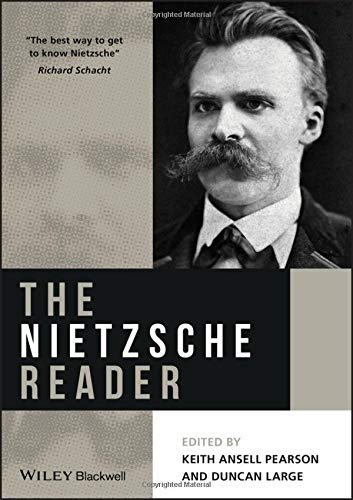
Ebook Info
- Published: 2006
- Number of pages: 574 pages
- Format: PDF
- File Size: 2.40 MB
- Authors: Keith Ansell-Pearson
Description
The Nietzsche Reader brings together in one volume substantial selections from the entire body of Nietzsche’s writings, together with illuminating commentary on Nietzsche’s life and importance, and introductions to his major works and philosophical ideas. • Includes selections from all the major texts, including The Birth of Tragedy, The Gay Science, Thus Spoke Zarathustra, Beyond Good and Evil, The Anti-Christ, and Ecce Homo • Offers new translations of key pieces from Nietzsche’s unpublished “Lenzer Heide” notebook • Provides a wealth of pedagogical features, such as editorial sections on Nietzsche’s life and importance, an opening introduction to his philosophical ideas, introductions to each major section, and a comprehensive guide to further reading
User’s Reviews
Editorial Reviews: Review “Intended to introduce students to Nietzsche’s writings, the Reader is of considerable value. It includes comprehensive selections from Nietzsche’s early, middle and late writings in English. The chronological presentation of the selections is particularly useful in helping students to appreciate Nietzsche’s philosophical development.” International Journal of Philosophical Studies “The Nietzsche Reader offers an extremely comprehensive collection of Nietzsche’s philosophical writings, ranging from his youthful essays on fate to the pithy, epochal books written in the twilight of his sanity. Perfect for classroom use, in any number of courses across a variety of academic disciplines.” Daniel W. Conway, The Pennsylvania State University “Thorough yet manageable, this Reader is an excellent introduction to Nietzsche. The editors’ balanced commentary is accessible to the novice while still engaging for scholars. This book is a great contribution to Nietzsche studies.” Kathleen Higgins, University of Texas Austin From the Inside Flap “The best way to get to know Nietzsche” Richard Schacht”The Nietzsche Reader offers an extremely comprehensive survey of Nietzsche’s philosophical writings, ranging from his youthful essays on fate to the pithy, epochal books written in the twilight of his sanity. This is the best collection of Nietzsche’s writings since The Portable Nietzsche; perfect for classroom use, in any number of courses across a variety of academic disciplines.” Daniel W. Conway, The Pennsylvania State University”Thorough yet manageable, this Reader is an excellent introduction to Nietzsche. The editors’ balanced commentary is accessible to the novice while still engaging for scholars. This book is a great contribution to Nietzsche studies.” Kathleen Higgins, University of Texas at AustinNietzsche’s impact on modern thought cannot be overstated. Generations have been influenced by this controversial and exciting thinker whose work nourishes academic fields as diverse as philosophy, literary studies, and political theory. This collection brings together in one volume substantial selections from Nietzsche’s complete oeuvre, including some never before published in book form in English. It also contains impressive pedagogical features, including editorial sections on Nietzsche’s life and importance, an introduction to his philosophical ideas, introductions to each major section of writings, and a comprehensive guide to further reading. All of Nietzsche’s major texts are generously excerpted here. Also showcased are selections from his lesser-known writings, and new translations of key pieces from unpublished notebooks of the 1880s. From the Back Cover “The best way to get to know Nietzsche” Richard Schacht”The Nietzsche Reader offers an extremely comprehensive survey of Nietzsche’s philosophical writings, ranging from his youthful essays on fate to the pithy, epochal books written in the twilight of his sanity. This is the best collection of Nietzsche’s writings since The Portable Nietzsche; perfect for classroom use, in any number of courses across a variety of academic disciplines.” Daniel W. Conway, The Pennsylvania State University”Thorough yet manageable, this Reader is an excellent introduction to Nietzsche. The editors’ balanced commentary is accessible to the novice while still engaging for scholars. This book is a great contribution to Nietzsche studies.” Kathleen Higgins, University of Texas at AustinNietzsche’s impact on modern thought cannot be overstated. Generations have been influenced by this controversial and exciting thinker whose work nourishes academic fields as diverse as philosophy, literary studies, and political theory. This collection brings together in one volume substantial selections from Nietzsche’s complete oeuvre, including some never before published in book form in English. It also contains impressive pedagogical features, including editorial sections on Nietzsche’s life and importance, an introduction to his philosophical ideas, introductions to each major section of writings, and a comprehensive guide to further reading. All of Nietzsche’s major texts are generously excerpted here. Also showcased are selections from his lesser-known writings, and new translations of key pieces from unpublished notebooks of the 1880s. About the Author KEITH ANSELL PEARSON holds a Personal Chair in Philosophy at the University of Warwick. He co-founded the Friedrich Nietzsche Society and is renowned for his work on Nietzsche, Bergson, and Deleuze. He is editor of A Companion to Nietzsche (Blackwell, 2006). DUNCAN LARGE is Senior Lecturer in German at the University of Wales Swansea and former Chairman of the Friedrich Nietzsche Society. He is the author of Nietzsche and Proust: A Comparative Study (2001), and translator and editor of both Nietzsche’s Twilight of the Idols (1998) and Sarah Kofman’s Nietzsche and Metaphor (1993). Read more
Reviews from Amazon users which were colected at the time this book was published on the website:
⭐Good introduction to the man and his thinking; the excerpts from his works are long; and the Notes and annotations are helpful. Reminds me of what a true “syllabus” used to be in rigorous college programs, not what we often see today, which are textbooks with short short excerpts and simplified explanations and a few pictures and stupid questions at the end of each chapter. This book respects the reader. About Nietzsche himself: the man continues to be perplexing. One can see how Fascists found succor in his writings but you can just as easily see him as a kind of secular John the Baptist who is rejecting dogma; who accepts science and rigor over philosophy; and, most of all, thinks some men can (and should) be able to figure out things for themselves.
⭐this is, at bottom, a textbook for a 3rd or 4th year undergraduate college philosophy course. if you’re comfortable approaching and “using” a philosopher like nietzsche in this way, then you won’t have any qualms about this volume. certainly the translations are generally among the best available, and the inclusion of several minor but illuminating texts (such as “homer’s contest” and “on truth and lies”) is valuable. the index amounts to a syntopicon of nietzsche’s references, keywords and themes across all the included works, which is very useful.the main problem is that all the included works are not all included — they’re heavily excerpted. this can be excused in the verbose, aphoristic or rhapsodic texts up to “beyond good and evil”, but at least one of the last three books (“götzendämmerung”, “antichrist”, “ecce homo”) should have been included entire, as all three are short and trenchant. nietzsche’s reputation as scattershot and unsystematic is not helped by editing him into confetti. but as i said: this is a book for readers who will not miss what has been omitted.i was truly underwhelmed by the introduction and prefaces. we get a little of nietzsche, a lot of what people say about nietzsche, and more about what people say about what people say about nietzsche. as another reviewer noted, european academic fashion intrudes too far and too often, and nietzsche’s sarcasms about the petty fussing of scholars are regretfully ignored.for the mature reader seriously interested in nietzsche, there is much to commend walter kaufmann’s two collected volumes — the “portable nietzsche” and “the basic writings of nietzsche” — which comprise eight major works unabridged in excellent translation, and excerpts of many other works, notes and letters, with insightful prefaces and annotations. like kaufmann’s superb “nietzsche: philosopher, psychologist, antichrist,” they were published four to six decades ago, and are still in print. i doubt the same will be true of this “reader”.
⭐This reader is a great way to get to know Nietzsche – the editorial material provides clear and thoughtful commentary on his philosophy, and the works selected give a good survey of his entire body of writing. It is organized chronologically and walks you through Nietzsche’s life as a writer and a historical figure. All the material is laid out very well; I would recommend this reader for anyone looking for a broad introduction to Nietzsche.
⭐Excellent for anyone curious about Nietzsche. I’m reading everything he wrote that I can get hold of. If you read Bonhoeffer and Marx, you must read Nietzsche.
⭐got my book on time, in great condition. Great read, I’d highly recommend for anyone who’s getting into Nietzsche, the editors does an excellent job of breaking down his thought and I guess you could say almost spoon feeding it to you but still, for this material and its difficulty, that’s not such a bad thing. So far from what I can tell, I’d say the editors are about the best Nietzsche scholars ive seen.
⭐If one is willing to deal with this kind of large, unwieldy and heavy book, and if one wants an edition with material selected from every period of Nietzsche’s life (from the early years of Nietzsche’s philosophizing to several of his last letters, then this is a decent enough purchase. Certainly the price is very low for a nearly 600 page Blackwell paperback.The book contains material from every important Nietzschean text, as well as bits from inaccessible pieces and some letters. These are organized chronologically rather than thematically, divided into 5 sections (e.g., Beginnings, Early Writings, the Middle Period, Zarathrustra, and Late Writings), which are introduced by the editors Duncan Large and Keith Ansell Pearson. There’s a comprehensive bibliography, organized thematically.But I don’t care for the editors’ take on philosophy in general and Nietzsche in particular. Their biases (caveat: I don’t know Large’s work well but I have read more than plenty of Ansell Pearson’s) in favour of what one can broadly call the Deleuze and Foucault tradition are disappointing to me, because I think the virtues of the general post-war French treatment of Nietzsche are overrated, and unsatisfactory when not mistaken. This means I didn’t appreciate the various section introductions, much of which is straight out of Continental Philosophy for Dummies (if no such text exists, one should be invented, pronto). Then there are the elementary errors: e.g., in the General Introduction the editors say that they agree with Michel (“one of the preeminent intellectual figures of the post-war period”, a telling phrase) Foucault that there is no single or core Nietzscheanism. Maybe not. But across the page they then speak of this very core: “at the center of Nietzsche’s thought”… (Note: for the ‘great’ French thinker, the truth of something is always subordinate to how this something can be used by Foucault for whatever project he is engaged in. Perhaps the editors have taken this to heart….)There are drawbacks, too: the weight and size of it, the philosophical slant given by the editors, and of course the fact that it consists of selections (e.g., about 15 pages from Daybreak and about 30 from The Gay Science). Selections are never the best way to go, if only because this means one has to rely on the editorial nous and philosophical temperament, which I’m unwilling to do in the case of these two editors. And reading a selection is unnecessary when dealing with Nietzsche, not when his unabridged works are widely available. So I would encourage readers to stick with the individual editions of the works(Cambridge especially but also Oxford or Penguin). I suppose this work is handy to have if one’s books are not all in the same place (e.g., keeping this one at the office and other Nietzsche books at home). But even so, I’d give it a miss.On the other hand, a book that does look very important indeed, for Nietzsche readers, though it is prohibitively expensive until the paperback edition comes out, is Ansell Pearson’s A Companion to Niezsche. I may not care for the philosophical contributions of the editor but he has ensured that many of the best and most important Nietzsche scholars and experts have contributed essays to the book.
⭐https://www.amazon.co.uk/dp/0631226540/ref=cm_cr_ryp_prd_ttl_sol_15text book – very very good for philosophy students
⭐excellent anthology and good commentaries
⭐Brilliant collect – will never replace the complete books but good translations and very good selections.If you can only lug around one Nietzsche book – make sure it is this one
⭐good quality paperback.
Keywords
Free Download The Nietzsche Reader in PDF format
The Nietzsche Reader PDF Free Download
Download The Nietzsche Reader 2006 PDF Free
The Nietzsche Reader 2006 PDF Free Download
Download The Nietzsche Reader PDF
Free Download Ebook The Nietzsche Reader