Ebook Info
- Published: 2013
- Number of pages: 256 pages
- Format: PDF
- File Size: 5.12 MB
- Authors: Martin Heidegger
Description
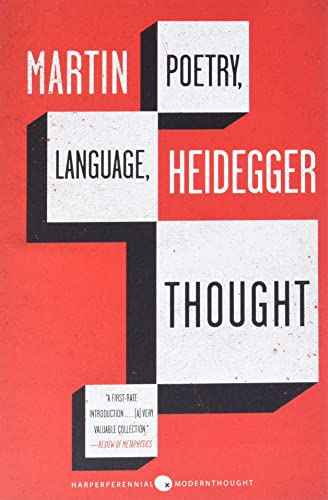
Poetry, Language, Thought collects Martin Heidegger’s pivotal writings on art, its role in human life and culture, and its relationship to thinking and truth. Essential reading for students and anyone interested in the great philosophers, this book opens up appreciation of Heidegger beyond the study of philosophy to the reaches of poetry and our fundamental relationship to the world. Featuring “The Origin of the Work of Art,” a milestone in Heidegger’s canon, this enduring volume provides potent, accessible entry to one of the most brilliant thinkers of modern times.
User’s Reviews
Editorial Reviews: About the Author Martin Heidegger (1889-1976) was born in Baden-Württemberg, Germany. He studied at the University of Freiburg and became a professor at the University of Marburg in 1932. After publishing his his magnum opus, Being and Time (1927), he returned to Freiburg to assume the chair of philosophy upon Husserl’s retirement.
Reviews from Amazon users which were colected at the time this book was published on the website:
⭐This was the first of Heidegger that I ever read, and it pushed me to pursue many philosophical questions about art and thought. P.L.T. deserves at least two read-throughs to understand all of what Heidegger is saying. Many of the thoughts he writes about in this book, he further develops in other writings. Heidegger tackles many deep subjects about the nature of art and how humans interact with it. His philosophy seems clearly influenced by the Ancient West—people like Plato and Aristotle—but he opposes Plato especially by arguing that poetry (and art) is the highest form of truth.
⭐Acute boredom due to wordy repetition. It’s as if he’s trying to vilify the precincts of language whilst using the very same language to elaborate on most topics. Not his best of works by a long chalk…
⭐The product was advertised to be in very good condition. It was not. It has significant wear and tear, with pages at the verge of falling out.
⭐Clean and pristine.
⭐Wrong frontpage compared to the one received
⭐These essays were a rather unenlightening analysis of the poetic “process.” Heidegger seems to indulge in enumerating the merits of, and illustrating his preference for certain German poets (i.e. Fredrich Holderlin), adherents to the “flowery” school of expression. The emphasis he places on these works, and the soaring epiphanies he experiences in the rather mundane wordplay he attempts to aggrandize by theoretical justifications…convinced me that at the very least, he is a poor judge of the poet’s mission.I am of course familiar with Heidegger by reputation, but concede “Poetry, Language, Thought” is my first exposure to his theoretical writings. In examining his ideas, I think it is critical to be aware of Heidegger “the man,” as what one thinks can not but be influenced by what makes up the person who propounds a world view or as a professional philosopher, a theoretical discipline.I think it is of significance that Heidegger was able to retain his university post when the Nazis came into power in Germany. He was a member of the Nazi Party from 1933 to 1945, and apparently saw no ethical or moral conflicts between his role as educator and adherent to a totalitarian political system, which in every way was contrary to free expression and the conveyance of truth. Some post-World War II apologists explained this alliance as a personal failing, but it must stand as illustrative of the man and the impact this association had on his professional gravitas.Heidegger’s early life was also greatly impacted by the Catholic church, his father being in its employ, and there is a strong underpinning of Christian consciousness impacting the rigor of his theoretical process and conclusions. For a much more cogent, revelatory exposition on the same topic, I would recommend Roland Barthes essays on writing and language, specifically “Writing Degree Zero.”
⭐This collection of essays on the purpose of art and the relationship between art, language, and thought epitomized through poetry is a dense but fascinating read.Heidegger ultimately argues that the purpose of art is to mark the boundary between things and being. The contemplation of what it is to Be is the defining characteristic of humanity. All things Are but only humans think about what it is or means to Be.According to Heidegger, language is merely utilitarian unless it points to beingness. Without illuminating the gap between merely doing things and the awarenss of beingness, language is dead. Language speaks only when it demarks the boundary of the mystery of Being.Because much poetry explicitly uses language to explore existence beyond the literal, it is the epitome of art – dancing in the gap between language and inarticulable consciousness.The essays indicate a spiritual understanding of the profound humanness of consciousness of that which is beyond and engages with some poems in a way that tend to indicate a willingness to accept a literal embodiment of Heaven and Earth that strikes me as contrary to the understanding of the mystery of Being discussed outside the context of the specific poems.Although Heidegger presents himself as a philosopher and a rational thinker, he cannot remain so in the context of this conversation. He is explicitly trying to use language to point out how language is used to illuminate the gap between concrete, objective facts and subjective understandings of the world, amd to do that, he is required to use language in exactly the poetic way he is describing. This is what makes him both so hard to comprehend rationally and so beautiful to read. He is writing poetically on the nature of poetic use of language.As a reader of poetry and a writer and storyteller, there was nothing in these essays that I didn’t already know from my experience working with language and art, but it was a pleasure to engage with a serious thinker thinking seriously about these ideas.In the final essay in the collection, he makes an argument that Kindness is foundational for human being and awareness of the world that allows for understanding.Although it is not addressed in this book, this final point about Kindness gets to the heart of the biggest intellectual problem with Heidegger for a modern audience – his anti-Semitic acts and his relationship with Nazism. In Heidegger’s thinking, caring is fundamental for knowledge and because human beings are incapable of caring about everything, we cannot help living in a bubble of knowledge surrounded by ignorance. And, it is clear that in his life, his caring did not encompass politics enough for him to see what we now see about the world he lived in.
⭐This is a great collection of some of the central writings of Heidegger. Highly recommended.
⭐Great book and was delivered in good condition.
⭐Very dense- as is most of Mr Heidegger; but if taken slowly & patiently, is very instructive.
⭐Great delivery time. Thank you.
Keywords
Free Download Poetry, Language, Thought (Harper Perennial Modern Thought) in PDF format
Poetry, Language, Thought (Harper Perennial Modern Thought) PDF Free Download
Download Poetry, Language, Thought (Harper Perennial Modern Thought) 2013 PDF Free
Poetry, Language, Thought (Harper Perennial Modern Thought) 2013 PDF Free Download
Download Poetry, Language, Thought (Harper Perennial Modern Thought) PDF
Free Download Ebook Poetry, Language, Thought (Harper Perennial Modern Thought)