Ebook Info
- Published: 2002
- Number of pages: 288 pages
- Format: PDF
- File Size: 1.89 MB
- Authors: Robin Seager
Description
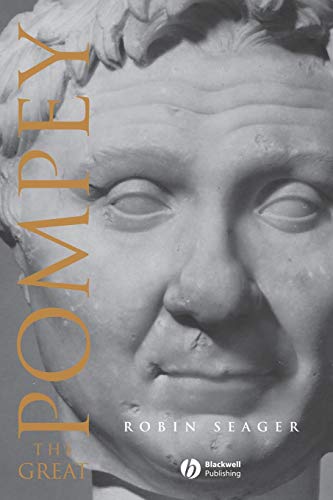
Pompey the Great gives readers a look inside the political and military world of ancient Rome and at one of the characters that shaped its destiny.
User’s Reviews
Editorial Reviews: Review “Displays a high degree of expertise and professional competence . . . an important contribution to the understanding of the late Republic and a valuable tool for future researchers.” History “An authoritative volume which is likely for many years to remain essential reading for students of the Late Republic. . . highly recommended.” Greece and Rome “The new edition makes this volume one of the most ready references on this subject in English, and the chronological table and the glossary are exemplary for a biography on a Roman topic. Seager’s work has stood the test of time and will continue to do so.” Bryn Mawr Classical Review From the Inside Flap Pompey the Great was one of the most important military commanders and politicians in the history of the Roman republic. Ruthless and manipulative — “moderate in everything but seeking domination,” according to the historian Sallust — he also inspired devotion from his soldiers and friends. His achievements — including the defeat of Rome’s most dangerous enemy, the conquest of large territories in the Near East, and the suppression of piracy in the Mediterranean – made him worthy of comparison with his namesake, Alexander the Great. This clearly written and dynamic biography is ideal for readers interested in the last generation of the Roman republic, the age of Lucullus, Crassus, Cato, Cicero and Julius Caesar. The book features a substantial introduction providing the historical background essential for understanding Pompey’s career. Its afterword assesses the most up-to-date scholarship on the age of Pompey. A chronological table and glossary orient newcomers to Roman history. Pompey the Great gives readers a look inside the political and military world of ancient Rome and at one of the characters that shaped its destiny. From the Back Cover Pompey the Great was one of the most important military commanders and politicians in the history of the Roman republic. Ruthless and manipulative — “moderate in everything but seeking domination,” according to the historian Sallust — he also inspired devotion from his soldiers and friends. His achievements — including the defeat of Rome’s most dangerous enemy, the conquest of large territories in the Near East, and the suppression of piracy in the Mediterranean – made him worthy of comparison with his namesake, Alexander the Great. This clearly written and dynamic biography is ideal for readers interested in the last generation of the Roman republic, the age of Lucullus, Crassus, Cato, Cicero and Julius Caesar. The book features a substantial introduction providing the historical background essential for understanding Pompey’s career. Its afterword assesses the most up-to-date scholarship on the age of Pompey. A chronological table and glossary orient newcomers to Roman history. Pompey the Great gives readers a look inside the political and military world of ancient Rome and at one of the characters that shaped its destiny. About the Author Robin Seager is Reader in Classics and Ancient History at the University of Liverpool. He has previously lectured at the University of Illinois at Urbana-Champaign and was a Visiting Research Fellow at the University of New England, Armidale and Langford Eminent Scholar Chair at Florida State University. His previous books include Tiberius (1972) and Ammianus Marcellinus, Seven Studies in His Language and Thought (1986). Read more
Reviews from Amazon users which were colected at the time this book was published on the website:
⭐I like the book it covers Pompeii’s life pretty thoroughly. I don’t like how the author doesn’t write the full name, example T. Gracchus. Solid book a must read.
⭐I remember once reading, in a Batman comic of all things, a quote that asked how many great champions are known not for their victories but how they were done in by time and a new generation. Does anyone remember Sony Liston for anything else other than being beaten by Muhammad Ali? Although there are a great many historical figures who legacies survive defeat–Hannibal, Napoleon, Robert E. Lee, and Erwin Rommel are great examples–Ca. Pompeius Magnus does not seem to be one of them. On Amazon a list for `Pompey’ only four books came up that were just about Pompeius, two that were about him and Caesar, and the rest were about the famous city or other people with `Pompey’ in their names. After the first page, Pompeius does not appear much. Caesar on Amazon has endless works about him carrying into the hundreds. It is strange that Pompeius is confined to the dustbin of history; he is just part of Caesar’s story not a character in his own right. Robin Seager does a great job of telling Pompeius’ own story, in which Caesar plays just a part and only shows up half way through.The book begins with a summary of the major historic events that had happened to Rome since the fall of Carthage. The Republic was coming to pieces because it could not, with rare exception, function as intended. Pompeius starts his career by raising a private army in the service of the Roman Dictator, Lucius Cornelius Sulla. Pompeius earns the nickname the `young butcher’ in his early service to Sulla.”On a practical level it seemed best to Sulla to find Pompeius further immediate employment. So Pompeius’ position was for the first time placed on a legal footing. He was invested with praetorian imperium by decree of the senate and sent in pursuit of Carbo, who had fled, when the resistance to Sulla collapsed, and despite his pleas for mercy he was put to death and his head sent to Sulla. His defense of Pompeius in 86 might have given him cause to hope, but Pompeius was never to show any hesitation in betraying old friends when the occasion demanded. For him his link with Carbo must merely have underlined the need to prove his loyalty to Sulla by a suitably harsh and dramatic gesture.”(p.27)After the Marian forces are defeated Pompeius embarks, first under Sulla, then under a restored Republic, on a career that–for a time–makes him the greatest Roman that had ever lived. He becomes the golden boy who has victories all over the Empire. He wins in Africa, Spain, and Greece. He lifts the pirates from the Mediterranean Sea, and settles the Greek east for the Roman Empire. He serves as consul but his career takes an interesting turn when he forms the `First Triumvirate’ with Marcus Crassus and Julius Caesar. The triumvirate dominates the Republic for the next decade. Pompeius holds on to power in Rome while Caesar conquers Gaul and Crassus gets himself killed in Parthia. This leads to a standoff with two of the greatest leaders in the history of any civilization. As it was said centuries later as battle between a man who could not accept any other as an equal (Pompeius) vs. the man who would tolerate no superior (Caesar).”What would Pompeius do if Caesar wanted to exercise it while still retaining his army? `What’, said Pompeius very gently, `would I do if my son wanted to take a stick to me?’ This reply puts his position in a nutshell. He saw himself as a father, Caesar as his son. In that there was a message, for the optimates could rest assured that Pompeius would act to keep Caesar in his place, subordinate as a son should be to his father, but they were also being warned that he was still not prepared to abandon Caesar, that a bond still existed between them as close as that between a father and his son. Similarly Caesar could read in the words a promise that Pompeius would not forsake him but protect him as a man should his son, but only if he accepted that he owed obedience to Pompeius as a father.”(p.143)Pompeius chooses to fight for the cause of the optimates but, in opposing Caesar, Pompey is chased out of Italy and in the first time of his life he tastes defeat at the battle of Pharsalus. He has to run as his friends abandon him. Pompeius flees to Egypt where a pharaoh who owes him his crown is expected to provide assistance in his time of need. Pompeius is instead greeted with murder.The story of C. Pompeius Magnus is one of glory and tragedy. He is raised as high as anyone can go only to be defeat at the hands of one friend and killed at the hands of another. Robin Seager wrote a great book that I would recommend to anyone who wanted to learn more about the famous general Pompey the Great.
⭐I found this to be a good biography on one of my favorite characters of the late republic. There are few biographies on Pompey, and this one does a good job chronicling the man’s life and assessing his political choices. Some of the best moments of the book come when Seager tries to assess the calculations Pompey’s courting of the optimates versus Caesar. I also appreciate the introduction for the context it provided. Seager does have a good sense of humor, which shows through at interesting points (for example, noting that Saturninus won his election for tribune “only” at the “cost” of murdering a fellow candidate. You have to love Roman politics, and Seager does a great job portraying its complexities and ugliness.As other reviewers have noted, this is not a book for a neophyte in ancient Roman history. I have read several other books about the late republic and consider myself reasonably well-informed. However, I do think at some points it would have been useful to provide more background on characters who appear. In particular, it would have been nice to get more of a flavor of people who appeared to play an important role, such as Gabinius. Too often, such men are named and the events are narrated, but the reader never really understands who exactly they were. Likewise, Pompey’s relationship with Crassus receives much less attention than I thought it would. I’m sure some of this is due to Seager’s admirable reluctance to not stray too far from the sources. On the other hand, it is sometimes useful to understand the author’s view of such characters. For example, the new introduction provides some background history, but also tells us much about Seager’s own opinion and sympathies (for example, he views the Gracchi and populares relatively favorably), which in turn could impact our reading of the book.
⭐The book was great … informative and an easy read . Amazon , however , sucks .
⭐very very pleased with service and book
⭐Thoroughly enjoyed this biography. Interesting, short but informative, and balanced (unlike other biographies I have read on Sulla or Caesar). Pompey was a central figure in the late republic and Seager treats his subject with respect but also with a healthy degree of cynicism. A must read for those interested in the period.
⭐item arived in excellent condition
Keywords
Free Download Pompey the Great: A Political Biography 2nd Edition in PDF format
Pompey the Great: A Political Biography 2nd Edition PDF Free Download
Download Pompey the Great: A Political Biography 2nd Edition 2002 PDF Free
Pompey the Great: A Political Biography 2nd Edition 2002 PDF Free Download
Download Pompey the Great: A Political Biography 2nd Edition PDF
Free Download Ebook Pompey the Great: A Political Biography 2nd Edition