

Ebook Info
- Published: 2006
- Number of pages: 160 pages
- Format: PDF
- File Size: 7.70 MB
- Authors: Emiel W. Owens
Description
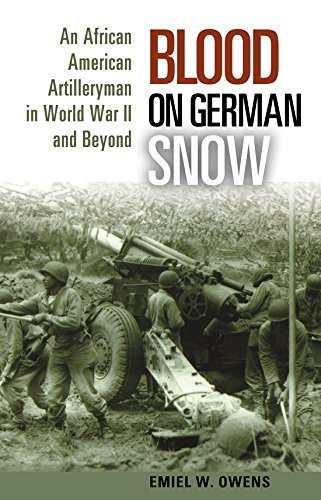
Emiel Owens served his country in the 777th Field Artillery, involved in actions from Omaha Beach to the occupation army in the Philippines. Like the rest of the U.S. Army at the time, the 777th was a segregated unit. Remarkably few memoirs by African Americans have been published from the World War II era, making Owens’s account especially valuable. Because he situates his military experience in the larger context of his life and the society in which he lived, his story also reveals much about the changing racial climate of the last several decades. A native Texan, Owens recounts his early experiences in a small, rural school outside Austin during the hard times of the Depression. In 1943, he was drafted into the army, landing in England in August 1944. Ten days later he was on Omaha Beach. By November 3 Owens and his unit were supporting the 30th Infantry Division as it attacked German towns and cities leading into the Ruhr Pocket and the Huertgen Forest. Owens starkly portrays the horror of the Kohlscheid Penetration. He was awarded a certificate of merit for his actions in that theater. With help from the G.I. bill, Owens returned to college and then to graduate school at Ohio State University, since universities in his home state were still closed to African Americans. He earned a Ph.D. in economics, which led to a productive academic and consulting career. This is a uniquely captivating story of an African American man’s journey from a segregated Texas town to the battlefields of Europe and on to postwar success in a world changed forever by the war Americans—black and white—had fought.
User’s Reviews
Editorial Reviews: Review “. . . a compelling window into the social history of the African American soldier in World War II.”–G. Kurt Piehler, author of Remembering War the American Way — G. Kurt Piehler, author of Remembering War the American Way About the Author EMIEL W. OWENS is now a retired professor of finance living in Houston, following a distinguished career in the field of health management research.
Reviews from Amazon users which were colected at the time this book was published on the website:
⭐If anyone is interested in the Greatest Generation and the second World War, here is a story well told. A biography that explains how the American army was able to meet and defeat the German army in the field of battle. This man’s life embodies the motto of the Field Artillery- “Mission First People Always “.
⭐My dad never liked to talk about his WWIi experience. Some of it had to do with the racism he experienced as a soldier at war for a country that had no appreciation for the sacrifices he and his friends endured; the other reason came from the trama of the war. I was in Germany and tried to get him to come over so we could go back to some of the places he visited, would not come to Germany a second time.I read this book from the aspect of what my dad experienced.
⭐A moving memoir of an extraordinary man who, despite all the insults and mind-numbing experiences he lived through, overcame all obstacles to serve proudly and with honors in the U.S. Army and complete a college education with postgraduate degrees. As a professor, a researcher, an international consultant, his chosen pathways always involved service and research benefiting his fellow man. This is the story of an authentic hero–not a fly-by-night sports or music idol–a REAL, genuine heroic role model of a man. Should be required reading for today’s young men.
⭐Well written, very interesting. A rare perspective of that time period.
⭐Late in World War II, a severe shortage of combat troops forced the United States Army to rescind its policy of racial segregation. They began assigning African American army units to combat duty. Until then, these soldiers had been relegated to such thankless tasks as burial detail, supply transport, mess hall staffing, and longshoreman work. This change, author Emiel Owens contends, played a significant role in spurring the civil rights movement twenty years later.The son of a Smithville farmhand, truck driver and jack-of-all-trades, Owens excelled in school and graduated at the top of his high school class. He was serving in an ROTC unit at Prairie View A&M when the United States entered the war in 1941. In the spring of 1943, Owens was thirty-four credit hours from a horticulture degree when his unit was ordered to report to Fort Sam Houston. There they began training on the 155-mm “Long Tom,” an artillery gun used by the newly formed 777th Field Artillery, an African American Battalion that fought in major battles in western Europe, from the Hurtgen Forest to the Ruer Valley and over the Rhine.At the outset of the Rhineland campaign, Owens’ gun battery was called upon to fire the opening salvos across the river. The five thousand guns of XVI Corps followed in unison, firing for three hours in preparation for Operation Flash Point, the crossing of the Rhine. “The fire was deafening, and the earth shook … and gave the impression that hell itself had come ….”There are many stirring battle scenes and acute observations of war in this book. Owens has a knack for detail, describing the Siegfried Line and the human-made fortifications: Hitler’s “dragon teeth” and the hundreds of pill boxes situated with overlapping fields of fire. He also manages to see Texas in the the black furrowed fields and long green valleys his units passes through. They looked “as if they had been plucked from around the Hill Country back home in Central Texas and just relocated to this spot.” But there is also an undercurrent of racial injustice glimmering just beneath the surface of the narrative. Sometimes it’s seen in a trifling way: the curious stares from Europeans unused to black faces. But other times it’s insidious: the army’s policy of breaking up African American combat units overseas rather than back in the States, with a result that no homecoming African American troops received a ticker-tape parade down Broadway.Owens returned to Smithville a decorated veteran. With the help of the GI Bill, he went back to Prairie View A&M, got his degree, and went on to to graduate work at the University of Ohio. He ended his academic career as Professor of Finance at the University of Houston. His story is a uniquely engaging one, giving a view of the social history of an African American soldier in combat, as well as providing noteworthy battlefield accounts of some of the more formidable World War II campaigns.
⭐White, the military history is fascinating, the truly gripping parts of this book are about his life before and after the war.It cannot be stressed enough that there was a time when a person could not attend any school or pursue any academic program they wanted just because of the color of their skin. (To correct the previous reviewer, Owens earned his PhD from The Ohio State University . . . there is no “University of Ohio.”)
Keywords
Free Download Blood on German Snow: An African American Artilleryman in World War II and Beyond (Volume 10) in PDF format
Blood on German Snow: An African American Artilleryman in World War II and Beyond (Volume 10) PDF Free Download
Download Blood on German Snow: An African American Artilleryman in World War II and Beyond (Volume 10) 2006 PDF Free
Blood on German Snow: An African American Artilleryman in World War II and Beyond (Volume 10) 2006 PDF Free Download
Download Blood on German Snow: An African American Artilleryman in World War II and Beyond (Volume 10) PDF
Free Download Ebook Blood on German Snow: An African American Artilleryman in World War II and Beyond (Volume 10)