

Ebook Info
- Published: 2017
- Number of pages: 206 pages
- Format: PDF
- File Size: 3.77 MB
- Authors: Fitting
Description
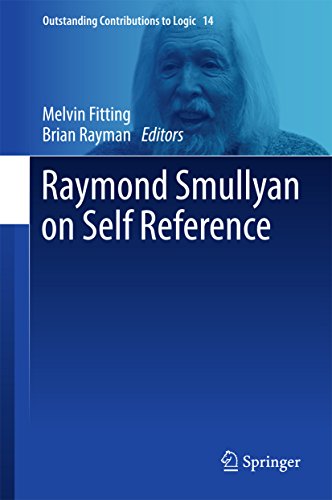
This book collects, for the first time in one volume, contributions honoring Professor Raymond Smullyan’s work on self-reference. It serves not only as a tribute to one of the great thinkers in logic, but also as a celebration of self-reference in general, to be enjoyed by all lovers of this field. Raymond Smullyan, mathematician, philosopher, musician and inventor of logic puzzles, made a lasting impact on the study of mathematical logic; accordingly, this book spans the many personalities through which Professor Smullyan operated, offering extensions and re-evaluations of his academic work on self-reference, applying self-referential logic to art and nature, and lastly, offering new puzzles designed to communicate otherwise esoteric concepts in mathematical logic, in the manner for which Professor Smullyan was so well known. This book is suitable for students, scholars and logicians who are interested in learning more about Raymond Smullyan’s work and life.
User’s Reviews
Reviews from Amazon users which were colected at the time this book was published on the website:
⭐
⭐
Keywords
Free Download Raymond Smullyan on Self Reference (Outstanding Contributions to Logic Book 14) in PDF format
Raymond Smullyan on Self Reference (Outstanding Contributions to Logic Book 14) PDF Free Download
Download Raymond Smullyan on Self Reference (Outstanding Contributions to Logic Book 14) 2017 PDF Free
Raymond Smullyan on Self Reference (Outstanding Contributions to Logic Book 14) 2017 PDF Free Download
Download Raymond Smullyan on Self Reference (Outstanding Contributions to Logic Book 14) PDF
Free Download Ebook Raymond Smullyan on Self Reference (Outstanding Contributions to Logic Book 14)