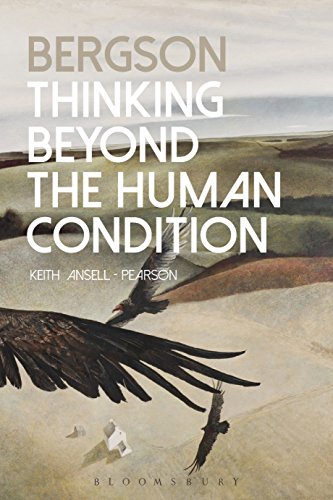
Ebook Info
- Published: 2018
- Number of pages: 208 pages
- Format: PDF
- File Size: 0.71 MB
- Authors: Keith Ansell-Pearson
Description
A thought-provoking contribution to the renaissance of interest in Bergson, this study brings him to a new generation of readers. Ansell-Pearson contends that there is a Bergsonian revolution, an upheaval in philosophy comparable in significance to those that we are more familiar with, from Kant to Nietzsche and Heidegger, that make up our intellectual modernity. The focus of the text is on Bergson’s conception of philosophy as the discipline that seeks to ‘think beyond the human condition’. Not that we are caught up in an existential predicament when the appeal is made to think beyond the human condition; rather that restricting philosophy to the human condition fails to appreciate the extent to which we are not simply creatures of habit and automatism, but also organisms involved in a creative evolution of becoming. Ansell-Pearson introduces the work of Bergson and core aspects of his innovative modes of thinking; examines his interest in Epicureanism; explores his interest in the self and in time and memory; presents Bergson on ethics and on religion, and illuminates Bergson on the art of life.
User’s Reviews
Editorial Reviews: Review “Ansell-Pearson remains one of the most important Bergson scholars writing in English.” – The Review of Metaphysics“Ansell-Pearson (Univ. of Warwick, UK) has written the best introduction to Henri Bergson (1859–1941) now on the market … Ansell-Pearson touches on most of Bergson’s major works and clearly articulates the most crucial Bergsonian concepts. Interest in Bergson is suddenly on the rise, and this volume, which is both spirited and rigorous, will more than meet the needs of newcomers to Bergson’s corpus. But the book is much more than an introduction. It will offer clarity and support to those already immersed in Bergsonian philosophy. In sum, this book demonstrates that Bergson readily addresses 21st-century questions about the human condition. Readers of all stripes will appreciate this volume because it speaks to concerns about freedom and self; time and memory; politics, ethics, and religion; the nature of science and philosophy; and, ultimately, how to live well. Summing Up: Essential. Lower-division undergraduates through faculty; general readers.” – CHOICE”The fruits of Keith Ansell-Pearson’s years of labour to bring Bergson the philosophical attention he deserves reaches an apogee in this book. And the results are brilliant.” – Times Higher Education Supplement”Ansell-Pearson’s book is unquestionably a remarkable introduction to a large swath of Bergson’s work and an invaluable contribution to the ongoing resurgence of interest in Bergson … [A] fresh and lively reading of Bergson’s thought and provides us with a significant number of scholarly engagements with Bergson’s influences, concepts, and potential further contributions.” – Notre Dame Philosophical Reviews”Keith Ansell-Pearson claims that Henri Bergson’s thought marks an upheaval in philosophy of equal magnitude to Kant, Nietzsche, and Heidegger. I can’t think of a better author or book to make the case.” – Alexandre Lefebvre, Department of Government and International Relations and the Department of Philosophy, University of Sydney, Australia”Yet another great book from one of our most important scholars on Bergson (and Nietzsche, and Deleuze). There is no question that Ansell-Pearson succeeds in introducing Bergson more thoroughly to the Anglophone world, illuminating all of the most central areas of Bergson’s thinking. Of particular note are the final two chapters on ethics and religion in Bergson, areas usually left unexplored by Bergson scholars. Bergson: Thinking beyond the Human Condition is one of the best, if not the best, studies of Bergson.” – Leonard Lawlor, Sparks Professor of Philosophy, Penn State University, USA”In his synthetic overview of the work of Henri Bergson Keith Ansell-Pearson explores how “we as human beings can think beyond our own condition.” This is an urgent question in the age of the Anthropocene and Ansell-Pearson is right to think Bergson can help us answer it. His book demonstrates, with great clarity, the importance of Bergson’s work to the present day. It will prove indispensable not only to teachers and students and but to anyone who wants to see our contemporary world in a new light.” – Suzanne Guerlac, Professor of French, UC Berkeley, USA”This is an excellent book. Ansell-Pearson’s years of sustained, quality engagement with Bergson enable him to show us Bergson as he was: an impassioned, clear philosopher steeped in the history of philosophy, many of its central ‘problems’ – freedom and determinism, body and soul, brain and mind, habit and attention, self and selfhood, the sources of morality and potential for progress – and the value of thinking those problems for human life.Ansell-Pearson’s presentation of Bergson’s response to these classical philosophical problems effectively tracks Bergson’s careful engagement with both the sciences and philosophy of his day. This informed, clear, and compelling study of the spirit and content of Bergson’s philosophy and view of philosophy will generate for analytical and continental philosophers alike new ways of thinking about central issues in their fields.” – Michael R. Kelly, Professor, Department of Philosophy, University of San Diego, USA About the Author Keith Ansell-Pearson holds a Personal Chair in Philosophy at the University of Warwick, UK.
Reviews from Amazon users which were colected at the time this book was published on the website:
⭐As an armchair philosopher I am not qualified to offer a professional critique of the book or its analysis. I can say it is well written and while Bergson can be formidable for the casual student of philosophy, the analysis is very well organized and marches to a cadence that is very digestible, assuming you don’t try to read it in one sitting.My own primary takeaway is the degree to which the book reinforces the importance of philosophy to modern science. “It is reality itself, in the profoundest meaning of the word, that we reach by the combined and progressive development of science and philosophy.”Bergson is, in my own words, a proponent of “dynamic empirical philosophy”. He very much embraces science, and evolution in particular, and insists upon the importance of empirical philosophy, as opposed to contemplative philosophy. He also rejects most static models of thought, favoring models of discovery and creative emergence. (He has his own lingo.)Bergson views science as “the mastery of matter” and philosophy as “the mastery of life,” but doesn’t value them hierarchically. In fact, he seems to resist most hierarchical assessments, preferring, instead, to see quantitative differences as fundamentally qualitative in reality.At some level, Bergson, at times, seems to take on the perspective of a naturalist. He ultimately expands his horizons beyond those of naturalism, however. “Bergson’s originality consists in placing life at the centre of the study of nature.”I share Bergson’s embrace of science and empiricism. The concern I have for modern science, however, is the question of what constitutes empiricism without philisophical perspective? And how do you interpret empirical results without some philosophical structure within which to understand them?By definition, we perceive through a perspective. “One of the most important aspects of Bergson’s approach to evolution in the book, and elsewhere, is his insistence that we should resist the temptation to shrink nature to the measure of our ideas. …we need to display a readiness to be taken by surprise in the study of nature and learn to appreciate that there might be a difference between human logic and the logic of nature.”It is natural, the author notes, for us to see the world as mechanical, discrete, and patterned. Such assumptions make comprehension and explanation an order of magnitude simpler and more accessible. But if reality, and thus context, is infinitely divisible, as Bergson seems to suggest, how can we ever know that the pattern we perceive is the one that matters? Or, assuming that they all matter, the one that matters most? And what is “most” other than a discrete, linear, and ultimately relative, concept?You can drive yourself silly in the end. But that doesn’t mean that it’s not important. And for me, at least, a whole lot of fun.I particularly enjoyed the last chapter on education. I think the following two quotes sum it up: “…Bergson does follow Nietzsche in exposing the hollowness of mere criticism as the endeavor of intellectual activity.” And, “If education is to centre on the creative needs of the child, then the focus should be on the child as a seeker and inventor, ‘always on the watch for novelty, impatient of rule, in short, closer to nature than is the grown man.’ Bergson locates a tension between the educator, who is essentially a sociable human being, and the child to be educated who is free of social conventions and expectations.”In the end, this book is a very solid synopsis of Bergson’s work and philosophy. And if you are new to Bergson I think you will get much more out of reading this book than you will reading Bergson’s original work. (Bergson scholars will get more out of it as well, but they already know that, I assume.) The book is admittedly a bit of a slog for the casual reader, as philosophy often is, but is well worth the effort.
⭐This is a really enjoyable summary of Bergson’s thought. A long introduction covers the book’s scope and is followed by sections on his essay on Lucretius and then on each of his big books: Time and Free Will, Matter and Memory, Creative Evolution and The Two Sources of Morality and Religion. Two chapters at the end encompass Bergson’s thinking about religion, and how we could enrich our lives by freeing ourselves of the straitjackets of habitual notions. Bergson differs from some other philosophers in that he doesn’t lead the reader through a solid intellectual achievement, but rather prises conventional thought apart. For the ordinary reader it is pleasurable to see things come down rather than watching them being elaborately built up, childish though that may appear. But once Bergson has deconstructed our normal views of nature, time, memory, the intellect and ourselves, he offers us surprising and life-enhancing new ideas that are not constructions built on separating things, but suggestions of how quite disparate things can form new wholes. A century after he wrote we find ourselves today an audience far more ready to receive his thinking. We are now better prepared to see ourselves as part of the natural world, and to look out for new meanings that escape dualism and lifeless conceptual definitions. Most of all we find in Bergson a serious and knowledgeable approach to science and scientific methods, so that he recovers metaphysics as an essential tool to accompany science. At the same time we may be less impressed by some of his older school views, especially his underpinning theory of human development in prehistory and history from action to philosophy.Do not be put off from buying the book by the following but it must be noted that the absence of a copy editor or even an overall editor, which is now commonplace in academic publishing, is sadly apparent. The reader will find quite a few sections in Chapter 1 that recur word for word in the subsequent chapters. In a Bergsonian way perhaps this is less crucial than our habitual demand for the absolute nailing down of things. There are even pleasures: the uncorrected ‘education of philosophy’ for ‘philosophy of education’ (p 153) seems a curiously meaningful encounter with a wholly new idea. But forget this carping. The exposition of his work is done so clearly as to make the book worth any minor technical drawbacks.
Keywords
Free Download Bergson: Thinking Beyond the Human Condition in PDF format
Bergson: Thinking Beyond the Human Condition PDF Free Download
Download Bergson: Thinking Beyond the Human Condition 2018 PDF Free
Bergson: Thinking Beyond the Human Condition 2018 PDF Free Download
Download Bergson: Thinking Beyond the Human Condition PDF
Free Download Ebook Bergson: Thinking Beyond the Human Condition