

Ebook Info
- Published: 2012
- Number of pages: 260 pages
- Format: PDF
- File Size: 3.31 MB
- Authors: Carl Walter
Description
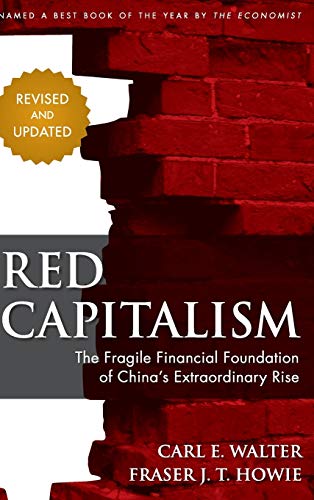
The truth behind the rise of China and whether or not it will be able to maintain it How did China transform itself so quickly? In Red Capitalism: The Fragile Financial Foundation of China’s Extraordinary Rise, Revised Edition Carl Walter and Fraser Howie go deep inside the Chinese financial machine to illuminate the social and political consequences of the unique business model that propelled China to economic powerhouse status, and question whether this rapid ascension really lives up to its reputation. All eyes are on China, but will it really surpass the U.S. as the world’s premier global economy? Walter and Howie aren’t so certain, and in this revised and updated edition of Red Capitalism they examine whether or not the 21st century really will belong to China.The specter of a powerful China is haunting the U.S. and other countries suffering from economic decline and this book explores China’s next movePacked with new statistics and stories based on recent developments, this new edition updates the outlook on China’s future with the most cutting-edge information availableFind out how China financed its current position of strength and whether it will be able to maintain its astonishing momentum Indispensable reading for anyone looking to understand the limits that China’s past development decisions have imposed on its brilliant future, Red Capitalism is an essential resource for anyone considering China’s business strategies in today’s extremely challenging global economy.
User’s Reviews
Editorial Reviews: Amazon.com Review Q & A with the authors of Red Capitalism, Revised edition Red Capitalism was recently named one of The Economist’s books of the year. Have you been surprised by the success of the book? Yes. We knew the story of bank reform and the larger picture it painted about how China is run was an important story but we were very surprised by how well received it was. We were able to give a narrative to the reform program in China which people could understand just as China was starting to suffer from and appreciate the impact of its huge stimulus program which it launched in response to the collapse of the global economy in 2008. Since publication what are the most notable changes you have seen in the China market? The most notable change is the attitude and sentiment of foreign investors and commentators. A few years ago the sentiment towards China was very positive. The large stimulus plan was seen as huge positive for China and those urging caution were lone voices. Now the sentiment has shifted significantly. The weakness of the banking system is much better understood as is the huge amount of debt that has been built up over the past few years in the pursuit of high growth rates. This change of sentiment is clearly shown by the stock prices with all the Chinese bank stocks falling significantly in 2011. What was wrong with the stimulus program? Didn’t it produce economic growth? In late 2008 as the global economy collapsed Chinese companies had to lay off workers, and lots of them. It was reported that 20 million workers were laid off in the export sector as demand for Chinese exports collapsed. In response to that the Chinese leaders turned on the credit taps via the banks and flooded the economy with money. Local governments were encouraged to get people working and a vast amount of that money went into infrastructure projects: roads, office blocks, sports stadiums and such like. The local government couldn’t borrow directly from the banks so they set up Local Government Financing Vehicles, LGFVs, to borrow on their behalf. These LGFVs entities have borrowed at least 11 trillion RMB and many of the projects they built are not economically viable i.e. they won’t produce any revenue. The net result is that growth initially came through the construction but now that the loans are coming due there is no revenue to pay the debts off! The stimulus wasn’t wrong; it just was that much of the funds went into projects which could never pay back the loans needed to build them. But even if China has wasted some of the stimulus isn’t China a rich country now? Surely they can use part of their 3 trillion US$ of foreign reserves to pay down these debts? China is still in many ways a poor country and can’t afford to waste much of its hard earned wealth on bailing out its banks or building worthless infrastructure or vanity projects. Money that is spent on wasted projects is money that can’t build schools or hospitals. The bank bailout of a decade ago has still not been fully accounted for and yet a new bad debt crisis is brewing. The foreign reserves give a false appearance of wealth. They are very important for a large trading economy which China is to facilitate trade but they cannot be used or brought back to China without stoking inflation pressures. What must China do to avoid bad debt problems in the future? The first step has to be to better price money. Basically savers in China get very low interest rates and the large State owned enterprise get cheap credit which is then used on unproductive projects. The hard working China saver is paying for the mismanagement of the State owned enterprises. But changing this system is very tough. It would mean the government can no longer set interest rates, it would ideally mean that capital controls are also substantially loosened and that State owned enterprises are no longer guaranteed access to cheap funding. Changing any of these things would be a bold step for the government and given the cautious nature of political decisions in China this will take a very long time to do. Until then China’s economy will boom and bust but with Chinese characteristics! 2012 will see a change in the leadership of China, will new leaders help re-start reform? Nothing can be ruled out but many of the problems within China cannot be solved with a simple change of faces. Many of the problems are structural and there are now so many powerful and politically connected players whose primary goal is to maintain the status quo that even the strongest of reformers will struggle to bring real change. Even if reformers gain the upper hand the global environment will be very tough for the next few years which will encourage a very cautious approach from China. From the Inside Flap In the space of just a few short decades, China has transformed itself from a nation scarcely able to cover the cost of sending its highest-ranking dignitary to speak at the UN to one with financial reserves numbering trillions of dollars. In Red Capitalism: The Fragile Financial Foundation of China’s Extraordinary Rise, Revised Edition, Carl Walter and Fraser Howie, experts in Chinese finance, tell the story of China’s incredible ascension, how it got to where it is now, and what the future holds.Exploring how China’s financial institutions—from banks to corporations—and most importantly, the national Communist Party, shape the country’s economic choices, development, and reform and what this means within China and for the rest of the world, the book examines whether or not the twenty-first century really will belong to China, calling into question the sustainability of the current system. Going deep inside the Chinese financial machine to illuminate the social and political consequences of the unique business model that has transformed the country into an economic powerhouse, Walter and Howie investigate whether the incredible gains of the last thirty-plus years really live up to their reputation.While China has seemingly adopted a Western style of economic and commercial growth—complete with stock-listed corporations and a growing class of accountants, lawyers, and investment bankers—the reality is that China remains a Communist country, one in which the state can—and frequently does—step in to save struggling industries. In contrast to the common view of China as an unstoppable freight train of growth, Red Capitalism shows how the country’s decades of development have been marked not by steady ascension but rather an ongoing series of booms and busts that many corporations would not have been able to weather without large-scale government intervention.With new and expanded coverage of China’s “Big 4″ banks; why assigning credit ratings is still a problem; the rapid growth of Chinese national debt; and more, this fully revised edition of Red Capitalism is indispensable reading for anyone looking to understand the limits that China’s past development decisions have imposed on its promising future. From the Back Cover Praise for Red Capitalism”The most important financial book of the year.” —James Grant Editor, Grant’s Interest Rate Observer”Red Capitalism peels back the faÇade of China’s economy and reveals how the dominant role of the state has led to enormous financial leverage and endemic malinvestment. China’s major role in the global economy makes Red Capitalism required reading for any financial industry fiduciary.” —Mark L. Hart III Chairman, Corriente Advisors, L.L.C.”China is bent on superpower rivalry; reserve currency status for the renminbi is a glint in the party’s eye. Red Capitalism puts a powerful case that its economy and financial system are not fully equipped to support such aspirations.” —Financial Times”This book allows us to further deepen our analysis and prepare for the tumultuous events which impend.” —Socialism Today”Walter and Howie possess a rare depth of experience in the analysis of the Chinesefinancial sector. Their hard-hitting conclusions,based on a wealth of empirical research, will stimulate debate about the future of theChinese financial system at a critical point in its evolution.” —Peter Nolan Sinyi Professor of Chinese Management, Cambridge Judge Business School, University of Cambridge”Concise and erudite, Red Capitalism is a fantastic deep dive into China’s structurally flawed financial system.” —China Economic Review”A penetrating analysis that demonstrates how hard it is to follow the old adage ‘follow the money,’ and how rewarding it is to understand what will really drive China into the future.” —Christian Murck President, American Chamber of Commerce in China”Walter and Howie put the Chinese financial system under the microscope to examine how an absence of leadership, institutional squabbling, and complacency have seen appetites for reform splutter out, replaced by stagnation and dysfunction. Theirs is a fascinating, entertaining, and necessary corrective to the hyperbole surrounding China’s seemingly miraculous rise.”—David Wilder Beijing Bureau Chief, Market News International”Red Capitalism is an important addition to the reading list of any China-watcher.”—The Hindu”Red Capitalism is a superb guide to China’sfinancial labyrinth. It’s a must-read for anyone who wants to understand the sources ofChinese economic power, and the threat posed by the nation’s vast hidden debts.”—Arthur Kroeber Editor, China Economic QuarterlyNAMED A BEST BOOK OF THE YEAR BY THE ECONOMIST About the Author Carl E. Walter lived in China for twenty years and actively participated in numerous financial reforms. He played a major role in China’s groundbreaking first overseas IPO in 1992, as well as the first listing of a state-owned enterprise on the New York Stock Exchange in 1994. He was a member of the Management Committee at China International Capital Corporation, China’s first and most successful joint venture investment bank, where he supported a number of significant domestic stock and debt underwritings for major Chinese corporations. More recently, he helped build one of the most successful and profitable domestic security and currency trading operations for a major global investment bank. Fluent in Mandarin, he holds a PhD from Stanford University and a graduate certificate from Beijing University. He currently lives in New York where he acts as an independent consultant.Fraser J. T. Howie studied Natural Sciences (Physics) at Cambridge University and Chinese at Beijing Language and Culture University. For nearly twenty years he has been trading, analyzing, and writingabout Asian stock markets. During that time he has worked in Hong Kong, trading equity derivatives at Bankers Trust and Morgan Stanley. After moving toChina in 1998, he worked in the sales andtrading department of China International Capital Corporation followed by a stint with China M&A Management Company. He has contributed to the SCMP, AWSJ, China Economic Quarterly,and China Economic Review as well as being a regularChina commentator on CNBC, BBC, Al Jazeera, and Bloomberg. Currently, he is a Managing Director at a leading Asia Pacific Brokerage firm in Singaporehelping international investors invest in both the Indian and Chinese markets. Read more
Reviews from Amazon users which were colected at the time this book was published on the website:
⭐I hope another edition of this book is forthcoming with updates to our present (mid-2015) wobbles in China’s fortunes (and ripple effects across the world). The moves now are captivating and consequential. But this book from a few years ago lays great groundwork for understanding some big weaknesses in that system, deep in the structure, and some daunting challenges even for those policymakers with the very best intentions and sharpest tools. I’m sure this book wasn’t the first to raise these critiques, but it boldly gave a detailed counter-narrative to the “invincible China” narrative pretty dominant in the west until lately. (I appreciate the calm, even tone, because I find shrill polemics or sweeping narrative prophecies unreadable.) This book gives lots of flesh and bones to the story, as it details big players over there and some of their dynamics (Ministry of Finance, People’s Bank of China, etc.) and moves over the last several decades. China will never stop surprising us, and its story is jaw-dropping historically, yet, we deserve to consider that some of these surprises might be considerably to the downside, as detailed here.
⭐I really liked the general information that the authors included in Red Capitalism. I learned a lot about the international banking system and about how China has struggled with its banks over the years. I do some work in China so I have experienced the business climate but still have a very limited knowledge of their financial system. This book helped put some of my misconceptions into perspective. This is a wonderful book to help the reader better understand China’s finances and why they do the things they do and what’s likely to happen in the future. My only criticism.is that much of the book is dedicated to China’s banking peculiarities and financial evidence of a specific nature.Thus, there is a plethora of financial data that without some knowledge of banking and international finances can be somewhat intimidating. I have a PhD and I had trouble understanding some of the financial data, but my PhD is not in finances or business. Overall, I really enjoyed Red Capitalism. Its a great source of current information on a subject that’s been under wraps for a long time: China’s banking system. Kudos to Walter and Howie.
⭐the book is like new.
⭐The book takes a critical look at the internal workings of the Chinese economy with a focus on its banking system. The authors have undertaken a thorough forensic study of Chinese financial records and are skeptical of the country’s commitment to financial liberalization. Banks have made epic amounts of bad loans at the behest of the ruling party. While these loans have been moved to special purpose vehicles, losses have not actually been taken. A substantial fraction of the Chinese economic miracle is illusory. The authors believe that the development of Chinese stock and bond markets were merely undertaken to tap western expertise in accounting, corporate governence etc – not to open up the ownership structure. Fundamentally, virtually all major enterprises remain under control of the communist party.There are lots of acronyms and numbers in the narrative. It’s a tough read even for someone with a financial background. Having said that, the authors have made a valuable contribution to research on China and one party states more generally.
⭐China’s banking system is built on an incredibly shaky foundation. The U.S. and many other nations are investing heavily in its financial sector. This book attempts to explain the incredibly complicated system. However, because the authors are seasoned Wall Street investors and the book is written so, it is difficult for the laymen to understand some details. Overall it explains the modern financial systems of China and how it got to this point. After reading this book my inclination is to never invest in China’s financial system for as long as it is configured the way it is now. A communist nation can never have a truly free market. Although the banks are supposed to be commercialized they basically just funnel investors money into state owned enterprises while maintaining a high level of bad debt. They then pass off that bad debt to Asset Management Companies who were specifically created to remove bad debt from the national bank’s balance sheets.
⭐I admit that I am no financial expert, particularly on the level of the complex Chinese economy. But if this book was looking for a wider audience (and I doubt that it was), the writers might well have at least clarified their conclusions. It does appear that China is headed in the same direction, if not on the same road, as the Europeans and Americans. They are incurring large amounts of debt that will bring on a day, or days, of economic reckoning. Political chicanery and corruption are part of the mix. As noted by other reviewers, this book is not for the uninitiated. I will look for other books to make this difficult subject clearer.
⭐I liked the book because Mr. Walter convincingly debunks the notion that there is a free market in debt and equity securities in China. He demonstrates that these markets despite their appearance of modernity are controlled by the Communist Party for the benefit of the ruling elite of the Party. He shows the pervasiveness of non-performing loans, which are hidden on the books of the central bank in order to make the state-owned banks appear financially sound. The book is clearly written and well documented/Will Irwin
⭐AMazing, unbelievable info about China’s recent financial history.
⭐Came early and love the reading so far. Very interesting and investigative writing about Chinese economy.
⭐good
Keywords
Free Download Red Capitalism: The Fragile Financial Foundation of China’s Extraordinary Rise in PDF format
Red Capitalism: The Fragile Financial Foundation of China’s Extraordinary Rise PDF Free Download
Download Red Capitalism: The Fragile Financial Foundation of China’s Extraordinary Rise 2012 PDF Free
Red Capitalism: The Fragile Financial Foundation of China’s Extraordinary Rise 2012 PDF Free Download
Download Red Capitalism: The Fragile Financial Foundation of China’s Extraordinary Rise PDF
Free Download Ebook Red Capitalism: The Fragile Financial Foundation of China’s Extraordinary Rise