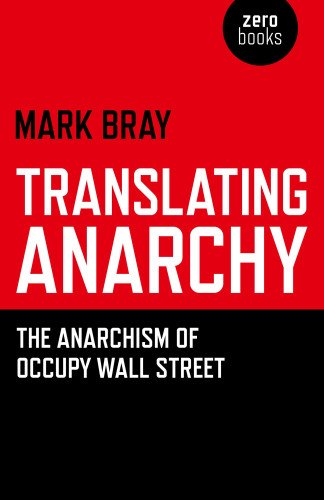
Ebook Info
- Published: 2013
- Number of pages: 342 pages
- Format: PDF
- File Size: 4.35 MB
- Authors: Mark Bray
Description
Translating Anarchy tells the story of the anti-capitalist anti-authoritarians of Occupy Wall Street who strategically communicated their revolutionary politics to the public in a way that was both accessible and revolutionary. OWS organizer Mark Bray combines his direct experience in the movement with nearly 200 interviews with the most active, influential architects of Occupy Wall Street, to reveal the revolutionary anarchist core of Occupy. Although The New York Times and CNN thought that OWS simply wanted tighter financial regulations and a millionaire’s tax, Bray shows that the vast majority of organizers called for the abolition of capitalism altogether. By “translating” their ideas into everyday concepts like community empowerment and collective needs, these anarchists sparked the most dynamic American social movement in decades.
User’s Reviews
Editorial Reviews: Review In Translating Anarchy Mark Bray provides unique insight into the inner workings and politics of OWS and its interactions with the press and the public. Straightforward and non-academic but in fact scholarly and historically informed, it provides an often witty good read. It is a must-read for anyone who wants to understand the OWS phenomenon or who may ever interpret social movements for the public and the media. -Jeremy Brecher, author of Strike!Bray’s meticulous, rich insider account of Occupy Wall Street demonstrates the central influence of anarchism on its core militants, but refuses to shy away from drawing hard lessons from its limitations. Anarchism, he convincingly argues, must position itself as an everyday movement of the ‘ordinary’ folks who alone can change the world – this requires a positive, practical programme and message, self-reflective and accountable politics, solid organisation, and clear tactics and strategy. -Lucien van der Walt (Rhodes University), co-author of Black Flame: The Revolutionary Class Politics of Anarchism and Syndicalism About the Author Mark Bray is a PhD Candidate in Modern European History at Rutgers University and longtime political activist. He was a core organizer of the Press Working Group of Occupy Wall Street. He lives in New Jersey, US. Excerpt. © Reprinted by permission. All rights reserved. Translating AnarchyThe Anarchism of Occupy Wall StreetBy Mark BrayJohn Hunt Publishing Ltd.Copyright © 2013 Mark BrayAll rights reserved.ISBN: 978-1-78279-126-3ContentsIntroduction: “Conquerors on Horseback are not Many-Legged Gods”………..11. Insight From Confusion: The Media and Occupy……………………….102. “The Bane of Occupy Wall Street”: Anarchism and the Anarchistic………393. Translating Anarchy……………………………………………..1124. Why We Need a Revolution or: Beyond “Socialism in One Park”………….171Conclusion: “Like Ectoplasm Through a Mist”…………………………..260Notes…………………………………………………………….272List of OWS Organizers Interviewed…………………………………..321Bibliography………………………………………………………324 CHAPTER 1Insight from Confusion: The Mediaand Occupy”These protests began almost two weeks ago now under thisname ‘Occupy Wall Street’ and during that time a clear goal, aclear message has yet to really surface from these myriaddemonstrators leaving many to ask ‘what does Occupy WallStreet want?'”—CNN Newsroom anchor Brooke BaldwinWhy was the media so confused about Occupy Wall Street? Whatwas so difficult to grasp about an anti-Wall Street protest in thewake the most catastrophic financial fraud in our lifetimes? Mostof the organizers I knew were baffled. Our national approvalrating was 43%, Congress’s national approval rating was an all-timelow of 9%, and we had to do a better job expressing ourmessage to the public? During the first week of the occupation ofLiberty Square, there was very little media coverage of OccupyWall Street. Some claimed this was a deliberate media blackout,but the same can be said for most demonstrations. We get inanesegments like NBC Nightly News’ “Making a Difference” whichfeatures individual tales of do-goodery rather than stories aboutcommunity organizations or immigrant workers’ centers that areactually making a difference. But after the pepper-spraying ofChelsea Elliot and Jeanne Mansfield on September 24, 2011 andthe arrests of over 700 marchers on the Brooklyn Bridge onOctober 1st, the media frenzy was in full swing and there wasactually much more positive coverage than any of us could haveexpected. However, as I’ve argued elsewhere, the sympatheticcoverage we received from seemingly liberal journalists didn’temerge from a shared understanding of the underlying natureand purpose of OWS.As conservative CNN contributor Will Cain astutely noted inearly October, “this Occupy Wall Street movement right now isjust a Rorschach test, it’s an inkblot test. People see in it whatthey want to see. It’s a projection of what they already feel.” Andso, many liberal journalists saw the liberal Tea Party that theywanted to see, but, as the days passed, their confusion didn’tabate. If anything, it increased because OWS was not sittingdown to join them at their tea party. Some of the confusionstemmed from the movement’s resistance to electoral politics,but the confusion of mainstream journalists went much deeperthan that.Activist explanations for this lingering bewildermentgenerally focused on political bias or journalistic incompetence.A common opinion was that many mainstream journalists didn’twant to understand our message because, no matter how liberalthey may have been, they were our enemies. They willfullymisrepresented it. Corporate news outlets would neveraccurately report on grassroots social movements because theywere part of the same machinery that we were working todismantle. We could do our best to nudge the coverage in ourfavor here and there, but ultimately we couldn’t trust thecorporate media to cover an anti-corporate movement.Another perspective was that some mainstream reporterswere too incompetent to understand Occupy Wall Street. Evenwhen some journalists wanted to write accurate, un-biasedarticles, it was often clear that they knew nothing about non-electoralpolitics or social movements, and were completelyunqualified for the task before them. Some reporters really didn’tunderstand what we were doing, and no amount of talkingpoints about how ‘education is a human right’ or comparisons tothe anti-nuclear movement were going to change that. Activists,of course, recognized this incompetence as a banal byproduct ofthe politics of the corporate media, which wouldn’t promoteaccurate coverage of social movements.In contrast, liberal and conservative mainstream critics offereda much more straightforward explanation for the media’sconfusion: the message of Occupy Wall Street was actuallyconfusing. Of course much of the confusion came from theunconventional nature of the idea of occupying a park, themovement’s countercultural elements, and its emphasis on directdemocracy. But if you take this confusion more seriously andmake the effort to dig beneath the superficial pundit chatterabout smelly hippies and muddled messaging, it becomesevident that there are some startling paradoxes at the heart of therhetoric of Occupy Wall Street.Unlike most, I think that both the activists and the mainstreamcritics were correct in their explanations of the media confusion.The activists were correct because there were some journalistswho were willfully confused because they opposed our politics,and even more reporters, I would argue, who wanted to understandus but lacked the information and motivation to thinkbeyond the confines of the dominant political culture. However,I would also argue that there was a profound insight at the heartof the media’s confusion. Mainstream journalists may have beenthe products of news corporations and larger social structuresthat work to systematically delegitimize non-electoral politics,but in their befuddlement they were actually on to something.They realized that there was a missing piece at the center of theOccupy puzzle, but made the mistake of assuming that it simplydidn’t exist. In truth, they didn’t know what we wanted becausewe didn’t tell them.Journalism: The Narrative Form of CapitalismTo get to the insights of the mainstream critics it’s important totake some time to explore why journalists were confused andwhat they were confused about because, paradoxically, theirinsights stemmed from their confusion. Journalists who deliberatelysought to misrepresent the rhetoric of OWS out of aconscious political bias reveal much less about the dominantpolitical culture than those whose confusion followed from anunconscious tendency to fall into familiar patterns of thought.For that reason, I will ask why so many mainstream journalistswho had some desire to understand Occupy Wall Street simplycouldn’t, and what that reveals about the strategic gaps in ourself-presentation.One of the most apparent reasons for the confusion of manyreporters was that they knew very little if anything about whereour strategies of organizing or methods of action came from.They had no context. Although a minor incident, the followinganecdote exemplified this phenomenon for me. On November30, 2011, we demonstrated against the war profiteers who met atthe “Aerospace & Defense Finance Conference” near MadisonSquare Park. There was a picket line scheduled that morning, soI showed up early to greet any press that arrived. The firstjournalist there was a young woman working for FM News 101.9in New York. After I spent a minute describing the day’s protestshe said, “I was reading the post on your website about thisprotest and there was this word I saw a lot that I didn’t understand.”Peaking my curiosity, I asked her which word and sheanswered “militarism.” I was so surprised that it took me amoment to start explaining the term for her. Yes, our anti-warstatement would be presented to the city by someone who didn’tknow what ‘militarism’ meant. To be fair, most reporters like thiswoman simply have to show up, ask us what we’re doing to geta five second sound bite, and leave. Anyone could carry out thatkind of reporting. But it’s indicative of a larger trend I noticedamong many journalists covering OWS. It would have takenvery little effort for them to rectify their lack of knowledge aboutthe movements that preceded Occupy or the history of directdemocracy, for example, if they had tried. Simply spending acouple of hours on Google would have greatly enhanced thequality of their coverage, but they usually had no professionalincentive to spend the time.The total lack of preparation was evident on the one-yearanniversary of OWS when we publicized the map of our plan ofattack on the financial district. It showed four convergence pointsthat would lead to eight intersections around the Wall Street area.I arrived an hour early on September 17, 2012 to do press work,and of the dozens of reporters I spoke with, only about 20% hadtaken the time to look at the map on the front page of our website.They had very little idea of what was going on. The reporterswere like college students rolling out of bed and coming to classwithout having done the reading. The most egregious examplefrom that day was the report from Sean Hennessey of CBS 2 inNew York live from an empty Foley Square at 6PM where hereported that our “rally” for the afternoon had been cancelled.Actually, Foley Square was our backup location, and as he wasspeaking there were thousands of people packed into Zuccotti. Ifhe had looked at our website or press releases he would haveknown this, but accuracy wasn’t important enough to him tobother. The 101.9 reporter could have figured out what’militarism’ meant on her own, but it wasn’t worth her time.Why not? There are several factors that come to mind. Fornow, I’ll just focus on one but I’ll touch upon others later in thischapter. The most obvious factor is that mostreaders/viewers/listeners don’t care about the accuracy of minordetails or the greater context of protest, so journalists don’tbother learning them. News outlets are corporations driven bythe profit incentive, and therefore aim to sell the most marketableproduct. The unfortunate reality is that most media consumerswould rather read about Occupy in relation to ‘crazy hippies,’ or,at best, in terms of strict policy matters than read aboutconsensus process or watch a news segment connecting theorigins of Occupy to the global justice movement. Regardless ofhow you explain this consumer preference, it’s pretty hard todeny it (although I think that there are a lot more people whowould like to learn about the larger context of OWS than thecorporate news estimates). Many activists argue that beneath itall most people are really starving for this information and thattheir ‘real’ interests are being stifled by the media; that they areessentially being ‘brainwashed.’ On the other hand, a standardcapitalist response would point out that if enough peoplewanted to read about the origins of the spokescouncil model andits use in Chiapas, Mexico, then journalists would be falling overeach other to write that story; but people don’t want to readabout that, so the stories aren’t written—simple supply anddemand, nothing insidious behind the scenes.I agree that there is no Dr. Evil behind the scenes fine-tuninghis brainwashing machine to unleash on the hapless public(although Rupert Murdoch might be close) and that consumerpreferences wouldn’t magically transform themselves overnightif the coverage changed. Certainly MSNBC and Fox News, forexample, push their respective liberal and conservative agendasthrough their networks and craft specific messages to influencetheir viewers, but it’s really missing the larger point to reduce thecomplex relationship between media producers and consumersto a ‘conspiracy of the 1%.’To get a fuller understanding of the complex dialoguebetween media producers and consumers as it played out inOccupy Wall Street, it’s critical to understand the historicaldevelopment of journalism. As historical sociologist JeanChalaby argues in The Invention of Journalism, journalismemerged as its own unique form of discourse in the second halfof the 19th century in Great Britain and the United States,primarily in response to changes in print capitalism. Early 19thcentury forms of printed public discourse explicitly sought toconvince the reader of the writer’s opinion and were often tied topolitical parties or workers’ organizations. However, thispolitical motivation for publishing shifted mid-century as newdevelopments in print technology enhanced the potentialprofitability of the industry, making newspapers one of the firstcommodities to be mass-produced. Over time, newspaperproduction became more and more capital-intensive and the levelof competition increased causing a consolidation of media outletsand a desire to expand readership. The best way for a paper toget more readers was to divorce itself from any specific affiliationand portray itself as an independent voice of public opinion andcommon sense. So was born the discourse of journalistic objectivity.By portraying itself as objective and above the fray of partisaninterest, journalistic discourse forged a foundation of legitimacyto speak from. Rather than speaking from a clearly expressedperspective, newspapers came to speak with the voice of societyas a whole. In turn, the claim that the newspaper was merelyreflecting the will of the greater society actually allowed it toforge public opinion. A modern parallel would be when FoxNews anchors state, for example, “These days, people are sayingthat teachers are being paid too much” without citing anysources. Of course, those anchors are the “people” saying thosethings, and the more they say it the more their viewers repeat it.The project of grounding media credibility in the ability tospeak on behalf of society was aided by the invention of theopinion poll by press baron William Stead. Stead realized that thepoll would allow journalists to “speak with an authority farsuperior to that possessed by any other person.” Public opinionas expressed by these polls has been understood as a disparateaccumulation of isolated individual opinions, as a collection ofsigns lining Zuccotti, rather than the expression of a collectiveoutlook or a protest movement.10 Opinion polls have provided apopulist veneer for the atomization of the population, inhibitingthe imagination of collective struggle. Publishers used the pollsto support their political interests through the dissemination ofsupposedly universal moral standards. Chalaby states thatthe supposed universal validity of moral categories alsoallowed journalists to express opinions on politics and electedofficials with categories taken as valid in the political spherebut which were not openly politically connoted.Objectivity has allowed the media to portray itself as ‘of thepeople’ yet independent from them. It has allowed journalists (inthe service of corporate news media) to tap into the longstandingWestern philosophical tradition of striving toward adisembodied position of absolute truth. Yet, with the expansionof the rhetoric of democracy and popular politics in the 19thcentury truth was increasingly associated with the masses.Therefore, that disembodied objective stance ironically gained itslegitimacy from its grounding in ‘the people.’ The more a newsoutlet was ‘of the people’ as a whole, without reference to’divisive’ social issues like class and race, the greater was itsability to see above the people to understand the truth. Theargument being made here is not that newspapers would bebetter if all articles were oriented around unabashed moralizing,but rather that no text is neutral. Objectivity becomes a politicaldiscourse when it is used to obscure an underlying partiality.The partiality that persisted after the “invention ofjournalism” was not only about what retrospectively might beconsidered explicit political bias, but also about what kind ofinformation was provided to whom. Market influences enhancedthe homogeneity of the media’s political orientation whileincreasing the heterogeneity of the quality and tone of its contentalong class lines. In the 1820s and 1830s, before technologyallowed newspapers to become truly profitable, working classand upper class papers had a similar quality of information andtone of delivery. Yet, when the industry was consolidated intothe hands of a relatively small number of press barons, thereading public was divided into the “information-rich and information-poor”which reinforced class society. In addition,around the turn of the century the topics of sports, society news(social engagements of the rich), sensational news, and humaninterest stories served to reduce coverage of politics and color theway political issues were reported. These new journalistic foci ledcoverage to focus more on the quirks of politicians than theissues, and presented politics as being no less important thansensational stories. A modern-day parallel would be when you’rewatching a thirty second segment about the corporate negligencebehind the BP oil spill and suddenly the broadcast shifts to adiscussion of Kim Kardashian’s new cat. I imagine that manyreaders have had this happen while watching the news and felt ajolt from it. The point is not that there should never be a place fortelevision programming about cats, and that every programshould be serious, but that this format of information disseminationsubtly equates the two. As Noam Chomsky and Edward S.Herman point out in Manufacturing Consent, “the steady advance,and cultural power, of marketing and advertising has caused ‘thedisplacement of a political public sphere by a depoliticizedconsumer culture.'” Moreover, the emphasis on the lives ofprominent individuals and the development of the humaninterest story allowed the political focus to center on ‘good’ or’bad’ elites without addressing the underlying system. Ashistorian Martin Conboy argues,the popular press allowed a modicum of public outrageagainst the foibles of the privileged and the abuses of thepowerful without doing anything to either analyze a systemwhich produced such abuse or to scrutinize the economic andinstitutional structures that enabled newspapers to makemoney (Continues…)Excerpted from Translating Anarchy by Mark Bray. Copyright © 2013 Mark Bray. Excerpted by permission of John Hunt Publishing Ltd.. All rights reserved. No part of this excerpt may be reproduced or reprinted without permission in writing from the publisher.Excerpts are provided by Dial-A-Book Inc. solely for the personal use of visitors to this web site. Read more
Reviews from Amazon users which were colected at the time this book was published on the website:
⭐I was surprised by what I learned about Occupy Wall Street. I didn’t realize that so much of that movements roots were grounded in anarchism. I have a better understanding of OWS and the anarchist perspective after reading this although I still hold steadfast against the anarchist vision of the future as this author shares.
⭐”Translating Anarchy” by Mark Bray demonstrates the importance of anarchism to contemporary Leftist politics and the Occupy movement. Mr. Bray is an activist, writer and academic who participated in direct actions and media relations at OWS in New York. This well-researched, enlightening and accessible book will inform and inspire people who believe that a better world is possible.Mr. Bray leveraged his status as a trusted OWS insider to conduct an ethnographic study of the movement. Mr. Bray’s survey found that OWS consisted of a core group of organizers with mostly anarchist views who were surrounded by mostly liberal supporters. Mr. Bray interviewed nearly 200 of the organizers to gain unprecedented insight into the views of the most active participants and shares their opinions throughout the text. Disillusioned by the failures of capitalism and state socialism, many young activists are attracted to inclusive, empowering and participatory organizations. Through this exacting first-hand research, Mr. Bray makes a persuasive case that OWS signifies a decisive turn of Leftist tactics and strategy from Marxism to anarchism.Mr. Bray reveals that the media’s confusion about the movement’s anti-capitalist intentions stemmed from the organizer’s calculated use of strategic messaging. OWS’ core members understood that aspirational messages about social and economic justice for the 99 percent would play best with a public that does not understand the anarchist movement too well. In any case, Mr. Bray explains that avoiding ideology was successful in attracting media attention and winning supporters on the streets.Mr. Bray situates OWS within the tradition of radical politics and working class struggle. Mr. Bray is especially keen to share his deep knowledge about the anarchist tradition and its relevance to us today. Mr. Bray suggests how activists might better manage a number of critical issues including organizational structure, accountability, autonomy and state violence. As capitalism and the welfare state crumbles, Mr. Bray’s powerful writing helps us understand how anarchism has inspired a new generation of activists who are intent on building a better future.I highly recommend this important book to everyone.
⭐This work, and Thank You, Anarchy, give a good picture of the emergence and course of the OWS. It came as a surprise that anarchism was the key influence on the whole movement. Whether that is good or bad, the reality is that this movement wasn’t what people thought it was, until it was almost over. As such, it is a classic, and unexpected, experiment in activist tactics, requiring a careful verdict as to future movements and tactics. That verdict is likely to make future activists wary of a movement that lacked objectives, leaders, and organization, and whose demand for consensus tended to paralysis. But the standard narrative here has been barren, while this innovative movement penetrated the enigma of successful action, briefly. The text here reviews all of those issues, along with giving a set of historical notes on anarchist movements. For a movement that expressed such a frequent refrain on the subject of overcoming capitalism the actual gestures in that direction seem to be no match for the problem. And the obvious suspicion arises that the anarchist strain is a commentary on classic communist revolutionaries histories and their legacy. But if the traditional marxist groups tend to paralysis, the moment of success of the OWS should make the legacy revolutionaries with no revolution possible sit up and take notice. In any case the historical snapshot here of the OWS movement will be indispensable to anyone considering the future of the left. Anyone who tried to follow the OWS from a distance will find this book an indispensable chronicle.
⭐Articulate, well-researched history of the beginning of the Occupy movement. As someone in a similar position at our local Occupy camp, I relate very much to his story, and found the book engaging as well as educational.
⭐I met the author of this book (how I discovered it) at a book store while browsing in Amsterdam. I heard him begin to give a talk, before hand, I was speaking with another person there about what I major in, economics and finance. Then throughout the talk he was very standoffish. He clearly doesn’t see the full picture of how systems work and what supports a thriving economic and political system. Sure, our country’s not perfect, but anarchy definitely isn’t the way to fix it.
⭐Good
⭐Interesting read.
⭐Very well-informed book. Although I don’t subscribe to theories, the book makes lots of interesting points and the author has clearly done their research.
⭐I understand the principles of anarchism more now
Keywords
Free Download Translating Anarchy: The Anarchism of Occupy Wall Street in PDF format
Translating Anarchy: The Anarchism of Occupy Wall Street PDF Free Download
Download Translating Anarchy: The Anarchism of Occupy Wall Street 2013 PDF Free
Translating Anarchy: The Anarchism of Occupy Wall Street 2013 PDF Free Download
Download Translating Anarchy: The Anarchism of Occupy Wall Street PDF
Free Download Ebook Translating Anarchy: The Anarchism of Occupy Wall Street