Ebook Info
- Published: 1965
- Number of pages: 304 pages
- Format: PDF
- File Size: 8.23 MB
- Authors: James D. Bjorken
Description
300 pp
User’s Reviews
Reviews from Amazon users which were colected at the time this book was published on the website:
⭐The review is not based on the content of the book.This book is a classic.Received poor quality Indian print edition at 5 times the cost it would be sold for in India.These books are printed by special arrangement by publishers to be affordable by students.It is illegal to sell such copies in the US.My 2o year old photo copy of the book from IISC. Bangalore is of higher quality and durability.Still it is better than nothing as a backup copy.Received copy that was printed to be sold in India.
⭐This book was hard to find, but I got a hard copy for a very reasonable price. It was written by a friend of mine.
⭐I used to teach quantum mechanics to chemistry graduate students. With chemists you couldn’t go much beyond Schroedinger’s equation, H*psi=E*psi, written symbolically as you see it, or they would complain to the chairman. Once a student proposed solving the equation by writing psi = E*psi/H. I was of course outraged, but if you couldn’t persuade the students to deal with the operator nature of H, it was a perfectly reasonable idea, giving a statement of a conservative classical Hamiltonian.Dirac’s equation is written in the Schroedinger form using Dirac’s definitions for H and psi, which are respectively a 4 x 4 matrix operator for H and a 4-component column vector for psi. But I feel like the student who had not been told – or perhaps did not ask – what H*psi=E*psi really means mathematically and physically. Why? Authors of texts in relativistic quantum mechanics, including this one, do not point out that Dirac’s equation can be written in the Schroedinger form only if all four components of the vector wave function oscillate harmonically in time at a single frequency, ome = E/hbar. It’s easy to see, Reader. The time-dependent solution is given by Dirac as the product of the harmonic function exp(-i*ome*t) and a column vector containing four time-independent components such that each component of the column vector must be assumed to oscillate in time at the same frequency. Schroedinger himself examined this point in his 1930 paper in which he solved Dirac’s equation for a free electron in the time without using Dirac’s temporally harmonic solution and found a speed-of-light quiver or tremble motion – Zitterbewegung – with frequency 2mc**2 and amplitude equal to the Compton wave length. Since Dirac’s temporally harmonic solution is not the exact solution to his time-dependent equation, I will henceforth call it his harmonic ansatz.Zitterbewegung, which is predicted by the exact time-dependent solution, shows us that Dirac’s time-dependent equation is manifestly inseparable in space and time. Nevertheless Dirac’s harmonic ansatz is regarded by the theoretical physics community as giving the only physically interpretable solution of Dirac’s equation, which in the authors’ words gives enough “truth” that it should not be discarded. Again the authors don’t distinguish between the equation itself and the harmonically restrictive solution Dirac used to separate space and time variables, leading to his famous exactly solvable time-independent equation (this analytic solvability of the time-independent equation in the precomputer age makes the harmonic ansatz very appealing), the hydrogen-atom solution, and the propagator formalism which are the fortes of this book. The experiments which can be respectably proposed or performed are only those whose results are interpretable using Dirac’s harmonic ansatz. Is nature on a quantum level really harmonic in the time and separable in time and space?Physicists must obtain “answers,” which is a complaint I have heard when I try to interest friends of mine in the points I am raising in this review. So it is not surprising that the authors do not take up these points, but at least a lecture or two could have been devoted to explaining that Dirac’s temporal solution is not the exact solution to his time-dependent equation but is rather a solution which leads conveniently to an equation in 3-space which can be solved exactly using standard methods. Dirac, as a skilled mathematician, was able to obtain “answers,” but in my view his great contribution is the still unexplored equation itself and not his solution trick, whose result is the subject of this book and of virtually all work thereafter.Reader, you can easily convince yourself that the harmonic ansatz is equivalent to solving Dirac’s coupled first-order time-dependent equations by adiabatic elimination, a procedure widely used in the optical-physics literature to approximately solve temporally coupled equations. Hence Dirac’s “truth” is founded on an approximate rather than an exact solution of his time-dependent equation.What is this “truth” which the authors tell us saves Dirac’s equation? Again the authors should have said saves Dirac’s temporally harmonic solution to his equation. Like park rangers on government salaries interpreting nature for us, they guide us through a maze of interpretations which must accompany the harmonic solution for it to make sense. The negative energy levels must be filled with electrons to avert the spontaneous radiative collapse of an atom. The reality of a positron amounts to an absent electron in a negative-energy level. A manifestly single-particle theory must have a many-body interpretation for its solutions to make sense. Further mathematical spit and polish – second quantization (presented in their companion volume on relativistic quantum fields) – inspired by particle phenomenology is applied to the harmonic solution to make it give the answers one wants. Mathematical theory must be augmented by physical argument to remove divergences which arise in applications such as the Lamb shift in atomic spectroscopy. In summary the exact time-dependent solution is not interpretable within the framework of acceptable experiments and is therefore rejected as unphysical, even though it is the exact solution. Experiments which are not interpretable within the framework of the harmonic solution are not acceptable, even though the harmonic solution is an approximate solution. Such is the censorship of speech in theoretical physics.
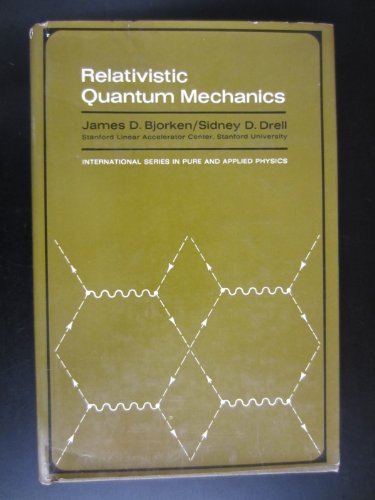
⭐Forty years latter, Relativistic Quantum Mechanics by Bjorken and Drell remains a classic for all those who want to introduce themselves into the basics of propagator theory. The book does a wonderful job, offering a very intuitive approach to quantum field phenomena, focusing on the applications rather than the formalism. A great choice for a very first text book.The one thing that is not very pleasant in this McGraw-Hill Science 1998 edition, is that the actual presentation has nothing to do with the image promoted by amazon as the paperback cover, which looks more than the old 1964 one. This customized edition comes in an awful cover that has an squared perforation designed to allow to see the book’s name printed on its very first page (there is one more on the back cover for the bar code). A terrible idea to save the work of designing a real cover, to me, deserved for a classic.The interior is as the College Custom Series products announces, just camera ready copy. No high quality at all.
⭐… try to find a bunch of used copies. The printing quality (including the cover) is so poor that you will need at least five (unread) copies if you actually intend to read the whole text. I am not joking!Contentwise – a good RQM book.
⭐The cover is too awful.
⭐Molto chiaroVery nice book and we’ll explained …
⭐Poor paper quality and printing.
⭐It is the awesome book ….but delivery was bit slow this time
Keywords
Free Download Relativistic Quantum Mechanics 1st Edition in PDF format
Relativistic Quantum Mechanics 1st Edition PDF Free Download
Download Relativistic Quantum Mechanics 1st Edition 1965 PDF Free
Relativistic Quantum Mechanics 1st Edition 1965 PDF Free Download
Download Relativistic Quantum Mechanics 1st Edition PDF
Free Download Ebook Relativistic Quantum Mechanics 1st Edition