

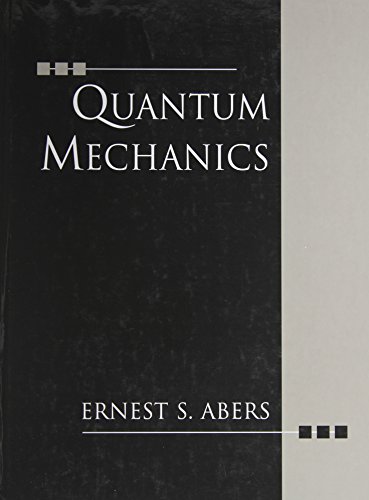
Ebook Info
- Published: 2003
- Number of pages: 544 pages
- Format: PDF
- File Size: 33.80 MB
- Authors: Ernest S. Abers
Description
With clear discussion and numerous problems, this text is the first to adequately and comprehensively cover all the subjects of quantum mechanics. It carefully and thoroughly discusses symmetries—especially rotation symmetry, transition theory, the theory of the quantized electromagnetic field, and relativistic wave equations. For physicists, engineers, and chemists.
User’s Reviews
Editorial Reviews: From the Back Cover With clear discussion and numerous problems, this text is the first to adequately and comprehensively cover all the subjects of quantum mechanics. It carefully and thoroughly discusses symmetries—especially rotation symmetry, transition theory, the theory of the quantized electromagnetic field, and relativistic wave equations. For physicists, engineers, and chemists. Excerpt. © Reprinted by permission. All rights reserved. The principles of quantum mechanics were formulated by many people during a short period of time at the beginning of the twentieth century. Max Planck wrote down his formula for the spectrum of blackbody radiation and introduced the constant that now bears his name in 1900. By 1924, through the work of Einstein, Rutherford and Bohr, Schrodinger and Heisenberg, Born, Dirac, and many others, the principles of quantum mechanics were discovered much as we know them today. They have become the framework for thinking about most of the phenomena that physicists study, from simple systems like atoms, molecules, and nuclei to more exotic ones like neutron stars, superfluids, and elementary particles. This book is a text for an advanced course in quantum mechanics and, indeed, started out as notes for a graduate course at UCLA. Usually students in any field of physics must study quantum mechanics at this level before undertaking more specialized subjects. The first part covers some of the formalism of quantum mechanics, especially the mathematics of rotations and other symmetries. It begins with a brief review of the Hamiltonian formulation of classical mechanics, which has become a trustworthy guide to finding the form of the quantum rules. The second chapter explains how the canonical quantum rules follow from the superposition principle and some form of the correspondence principle. It ends with the Schrodinger equation and the uncertainty principle. The third chapter is about stationary states and the energy eigenvalue problem, with particular emphasis on spherical symmetry. It includes the theory of orbital angular momentum and the famous hydrogen atom problem. The latter will serve as a wonderful example over and over again. The next two chapters are about the role of symmetry transformations in quantum mechanics, and how they restrict the possible values of some observables. There is a detailed discussion of three-dimensional rotations, the general theory of angular momentum, addition of angular momentum and selection rules. A good understanding of rotations in quantum mechanical systems is important for what follows. Rotations are an example for all sorts of other symmetries we have discovered or invented. The techniques learned in this context can be recycled many times. These first five chapters contain the mathematical foundation of our subject. I have tried to be fairly rigorous, understanding that this is the students’ second course in quantum mechanics. There follows a brief interlude containing a miscellany of short subjects: magnetic field interactions, measurement and probability, the density matrix, and a recently discovered example of a simple quantum system, neutrino oscillations. The rest is application. There is a section on bound-state perturbation theory, with the hydrogen atom as an example. There is a brief discussion of the variational principle, important in the theory of atomic and molecular structure, and of the WKB method. Transitions are introduced next in the context of potential scattering, with some applications to atoms and nuclei. Next I have chosen a topic that students seem to enjoy learning about but which is hard to find in much detail in most textbooks at this level. This is the theory of transitions in general and, in particular, decay rates for excited states. There is an introduction to path integration and a section on geometric phases. Then comes the theory of photons, the quantized electromagnetic field. Historically, this subject came first. The blackbody spectrum and the photoelectric effect were explained in terms of photons, quanta of the electromagnetic field, more than two decades before a real theory was available. Now, with the full power of the machinery of quantum mechanics in hand, we can understand completely those observations that puzzled Planck and his contemporaries. The quantum theory of the electromagnetic field is a useful subject to learn in its own right, and it is a good introduction to the methods used in both many body physics and elementary particle physics. Next there is a chapter on relativistic wave equations, developed in the spirit of the earlier discussion of rotational symmetry, but here the symmetry is Lorentz invariance. I conclude with the occupation number space description of systems of identical particles, with a few applications. I have tried to show the details of most mathematical calculations, and tried not to claim that one line follows easily from another unless my experience is that an average student will actually find this to be true. For the same reason I have included in the appendix derivations of many mathematical formulas even though most of them can be found in standard works. If you want to learn quantum mechanics from this book, you need some preparation. Only the most extraordinary student could be expected to get through this material without the benefit of an introductory course, though in principle it is possible. You should also have studied classical mechanics and some mathematical methods at an introductory level. The quantum mechanics “prerequisite” is to know what Schrodinger’s wave equation is and how to use it. That means knowing how to find the bound states of a given potential in one and three dimensions, about tunneling problems, transmission and reflection coefficients, momentum and energy eigenfunctions, the elementary theory of the harmonic oscillator and the hydrogen atom. You can learn about them in more detail in some of the books listed among the references at the back. The mathematical prerequisite is minimal. The quantum chapter of the book of nature is written in the language of linear algebra, which is the mathematical formulation of the superposition principle. I do not expect you to have studied Hilbert spaces or group theory previously. Pieces of the mathematics of linear vector spaces are presented as the need arises. But you should already know a little about vector calculus in curvilinear coordinates, and elementary concepts of vector space methods such as eigenvalues, Hermitean and unitary matrices, changes of basis, eigenfunction expansions, and so forth. I shall repeat the definitions of these tools, but this is not the place to learn them for the first time. A nodding acquaintance with complex numbers is also useful. More advanced parts of complex analysis, including the residue theorem, will be touched on only in the later parts. You should also know some undergraduate-level classical mechanics, in particular the central force problem and the Lagrangian and Hamiltonian formalisms. I avoid mentioning Poisson brackets in the body of the text, but as they provide an important insight into the structure of quantum mechanics, several problems are devoted to them. Over the years I have assembled a collection of problems for the graduate quantum mechanics course. Some of the problems fill in gaps in the exposition. Most are the way to learn the tools of our trade. Occasionally the problems develop some themes not explained thoroughly in the body of the text. For a few of the problems you need to have access to a computer and know how to use it. Most are to be done analytically. You must work out many of the problems if you want to understand what is going on. I have enjoyed collaborating with the many people at Prentice Hall and their associates who worked to turn the manuscript into this book. My thanks to Erik Fahlgren, my acquisitions editor, to Debra Wechsler, the production editor, to Daphne Hougham, who copyedited the manuscript, to Andrew Sobel, Bayani DeLeon, Adam Lewenberg, and many others whose names I do not know. I am indebted to those who read earlier drafts with care and made suggestions for improvement, almost all of which I have included in the final version. Many thanks especially to Mike Berger (Indiana University), John Donoghue (University of Massachusetts), Colin Gay (Yale University), Maarten Golterman (San Rancisco State University), Herbert Hamber (University of California, Irvine), Thomas Mehen (Duke University), Chandra Raman (Georgia Institute of Technology), Serge Rudaz (University of Minnesota), and several anonymous reviewers. I thank the Department of Physics and Astronomy at UCLA for granting me the time to complete this manuscript, and the very many students over the years who suggested improvements or corrections in earlier versions. Finally, I thank my colleagues at UCLA and elsewhere for their criticism, advice, encouragement, and conversations about quantum mechanics. I am particular grateful for the discussions I have had with Sudip Chakravarty, John M. Cornwall, Robert Cousins, Carlos A. A. de Carvalho, Eric d’Hoker, Robert Finkelstein, Graciela Gelmini, Noah Graham, Alex Kusenko, Richard Norton, Shmuel Nassinov, Silvia Pascoli, Hidenori Sonoda, and E. Terry Tomboulis. Ernest S. Abers Los Angeles
Reviews from Amazon users which were colected at the time this book was published on the website:
⭐Haven’t really ridden it yet, but here’s my initial experience and impressions. Notified by Amazon via Email that USPS had a problem delivering my package. Got home later that day and they left a slip saying it was oversized and I’d have to pick it up the next business day. (Saturday turned out to be a business day) Post office apologized for the issue and explained that they have a contract with Amazon to deliver packages under a certain size and weight but Amazon keeps sending them things way outside that limit like oak king sized beds with the mattresses. My bike was just a bit over their delivery size. (No worries it fit in the back of my jeep) So add an extra day and expect to go get it if Amazon uses USPS. Initial impression was that the box was thin for it’s size. There was slight damage to the box consistent with what has been shown on other reviews. The weight of the box was nice and light for being as big as it was. (I was starting to get a little excited because of how light it was.) Got it home and opened it up. No excessive packaging, no blocks of styrofoam, just some plastic and foam sheeting, some zip ties, and a couple of plastic disks to protect the ends of the axles. Inside was two kind of generic instruction books. One in german, one in english.General assembly wasn’t bad, just been a little bit since I’ve messed with a bike. Tuning the derailleurs was a little more time consuming. The generic instructions were slightly helpful though the pictures were only moderately close to what is actually on the bike, and I ended up having to change the install angle of the front derailleur and tighten the control cable to get it to work correctly. (Not even hinted at in the instructions.) Centering the front brake was also a bit of a challenge but I got it so it doesn’t rub on the disk when the wheel spins. (Again not much help from the instructions) The rear brake wasn’t as firm as the front and after a bit of exploration I figured out how to add more fluid. Just a tiny amount of D.O.T. 3 fixed the issue and now both sides are equally responsive. (Absolutely nothing in the instructions on how to do this or what fluid to use) The front shock has a nice lock out feature that keeps it from compressing, and has an adjustment knob on the other side. (Nothing in the instructions on what the adjustment knob is or how it works.) Shocks feel a little weak, even after messing with the adjustment knob, and I suspect that like the brakes they may be low on oil… I’ll have to research the shock assembly. A quick trip to get the tires aired up and my bike was ready to go… except for a seat change. I bought an after market seat for it since I was expecting the stock seat to be an unpleasant experience as seems to be the case with most mountain bikes from reviews I’ve read. Surprisingly the stock seat didn’t seam that bad. It had a surprising amount of cushion and flexibility. I might have been okay using that seat. Lastly the kickstand is adjustable (nothing in the instructions on it) Initial test ride wasn’t bad. Derailleurs worked well. Brakes were nicely responsive though I just went up and down the street (it’s a moderate hill) and made a few laps around the big tree in my yard. It handled the roots and rough ground well, the gearing made for an easy assent up the street. I unlocked the front shock and took it for another spin. Jumped the curb into the yard around the tree a few more times and dropped off the curb into the street (about a 6 inch drop) . The shocks handled it well and I didn’t get the sensation I was going to fall forward over the handlebars. (Bad shocks will do that.) So far, I’m happy with it. Total time to assemble, set everything and air up the tires about 1.5 hours. Instructions need to be better, and would really like a good breakdown on the components but I’m an aircraft mechanic and I’m a bit spoiled when it comes to having access to diagrams and specs. The matte black paint looks sharp but picks up and shows oils from your hands like crazy. The manufacturer finish on some of the smaller items shows a lack of quality and is on par with the cheaper stuff from china. Only shipping damage I noted was a small scratch on the left crank arm but realistically that could have been done during assembly. Will update after I take it on the trails, and compare it to the big name $1200+ bikes that my friends ride, I plan to do a complete tear down to examine bearings and other components soon as well. It’s been a few weeks, and have yet to ride it on a trail due to weather but have put several road miles on it. The fork lockout works well but with it off the shocks seem a bit weak even when adjusted to max. Contacted customer service trying to get a little information on what type of oil the brakes use and what type of fork I have and if it can be adjusted further. Customer service wanted my order number and a video of the problem. I explained to them it isn’t an issue of the bike being broken, that I just wanted servicing information. 4 rounds of emails later they told me mineral oil and take the fork to a bike shop. (They won’t give you anything without the order number) Not having better information on what equipment the bike has is frustrating. Eventually brake pads will need to be replaced, and the forks will need some attention. I’d rather do this service myself than take it to a shop and wish them luck on researching parts. Will probably end up replacing those components with aftermarket parts that actually provide service specs and part numbers. Dropping down to 3 stars for customer service being unable to provide me with specifications. Been out on a few trails now. The chain broke first day out, but a master link provided a quick fix. Handles the roots, rocks, hills and drops fairly well. First thing I replaced was the seat. Nothing really wrong with stock, I just wanted a little more cushion for my sensitive parts. Upgraded the tires to 27.5 x 2.3, I don’t think a 2.4 will fit. Did a gnarly endo at about 25 mph. Front tire cleared an obstacle but the rear didn’t, and the bike and I got some good airtime before the ground interrupted our flight. No damage to the bike, I had a some good bone bruising on my shoulder and collarbone. I was doing some minor adjustments at the house, and took it for a test ride when the rear brake line shot out of the hand lever. Looks like the pressure sleeve (called an olive in bike terms) wasn’t properly installed. I’m just glad it didn’t happen on a trail when critical failure would have been dangerous. No name or model number on the brakes, so no looking up replacement parts, and after my previous attempts with customer service I just bought a complete name brand replacement set.
⭐My 62yo husband is 6′. We live in the city. He is drooling over thoughts of a Gravel bike. Actually a $4k Gravel bike. The local bike shop told him he would only fit one that is 58″.Ii do my research. Read articles on Gravel vs Mountain bikes. No 58″ gravel on line. Thought this beginner Mountain bike was a good compromise since our terrain is so varried.Hubby would not consider it. Would not read about it or open the box. It went back same day that it arrived.Hope he saves his pennies for that 4k, 58″ Gravel Bike.Signed,Living with 3 other bikes in the Midwest (None of them mine)
⭐**UPDATE** 05/06/2022Though Hiland-US still has not responded to my web contact email, they did contact me through Amazon after receiving the below review. I am very satisfied that they made it right. They were responsive and easy to work with for an appropriate resolution/reimbursement. Now that the initial problems have been righted and the bike is back on track, I am relieved to say that I DO NOT regret this purchase. Hopefully they figure out improving their customer service from their web contact/email in the future, but they did take care of me here.(Initial review)I rarely write reviews, but I am irritated enough that I want to share my experience for a future prospective buyer to consider. I am not a professional cyclist. I do a good bit of recreational cycling, and in the warmer seasons will frequently take 15-20 mile rides, occasionally longer. My last bike wasn’t great and had really exhausted it’s life with me. I purchased this Hiland as what I hoped to be a budget friendly value upgrade. It wasn’t hard to assemble when I received it. However, this is where I encountered my first issue. There wasn’t enough fluid in the rear hydraulic break line. I could depress the break lever to the grip before it would even slightly engage the disk break. While mildly irritating, I liked the assembled bike and wanted to give it a chance. I had to order a bike hydraulic break kit to top the fluid off before I could even ride it. I got past that and had the bike out for a couple 10-12 mile rides. I seemed to really enjoy it. I thought it was a great value bike. Fit and finish were great, weight was reasonably light for the size and price, and the ride was enjoyable. Then my third ride on it within 10 days of purchasing… I was on a ride with my daughter and at mile 5.5 the chain snapped, not derailed, it broke! That was the first chain I’ve ever broken on a bike in my life, and it was on a 10-day old bike! Needless to say I was extremely disappointed on my 5.5 mile walk back. However, the disappointment didn’t end there. I emailed customer service at Hiland with a detailed account of what happened and asked for a response regarding any warranted replacement of the chain. As stated in my review title, I really wanted to like this bike. Five days have passed and no response from Hiland, so I am now chalking it up to their bike appears really nice for the price, but the materials are inferior and their customer service sucks. I won’t buy another Hiland bike. Good luck with your decision.
⭐Easy to assemble! I’ve taken it on a few rides now and it works like a charm! Gears are responsive and easy to use! Hydraulic brakes took some getting used to, but are sweet!
⭐Great light bike
⭐Ever since I got the bike the rim has been slightly bended, but I didn’t think about it much until I realized it wasn’t a good thing. If it didn’t come with a bent rim I would of rated 5 stars
⭐good book
Keywords
Free Download Quantum Mechanics 1st Edition in PDF format
Quantum Mechanics 1st Edition PDF Free Download
Download Quantum Mechanics 1st Edition 2003 PDF Free
Quantum Mechanics 1st Edition 2003 PDF Free Download
Download Quantum Mechanics 1st Edition PDF
Free Download Ebook Quantum Mechanics 1st Edition