Ebook Info
- Published: 1999
- Number of pages: 344 pages
- Format: PDF
- File Size: 2.95 MB
- Authors: Simon Blackburn
Description
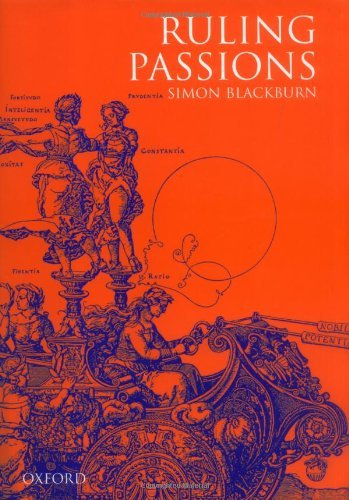
Why do we behave as we do? Can we improve? Is our ethics at war with our passions, or is it an upshot of those passions? Distinguished philosopher Simon Blackburn seeks the answers to such questions in this brilliant exploration of the nature of moral emotions and the structures of human motivation. Ruling Passions reveals how ethics can maintain its authority even though it is rooted in the very emotions and motivations that it exists to control.
User’s Reviews
Reviews from Amazon users which were colected at the time this book was published on the website:
⭐Writing in Ruling Passions, Simon Blackburn picks up and continues the sentimentalist tradition in ethics made famous by David Hume and which has, since Hume’s time, posed a serious challenge to all those seeking to find truth in moral claims, to treat moral beliefs as assertions of knowledge, of fact. The idea that moral judgments are objectively grounded seems to stick with us when we make such judgments but the sentimentalist account, which makes our moral claims about expressing feelings about things rather than asserting facts, runs counter to what seems to be part of the actual practice of moral valuing. This book aims to restore a sense of objectivity to moral judgments within the context of an expressivist (or, as Blackburn sometimes calls it, projectivist) account.In a nutshell, he proposes that all moral claims can be understood as part of the psychological dimension of our lives in terms of how we interact with others and how we feel in the process of such interactions. Moral judgment, on this view, is a matter of expressing our desires, preferences and so forth. Valuing, Blackburn seems to suggest, is just another activity-related mental state like these others although our mental states are not discreet things, nor are they reducible to any particular behavior or complex of behaviors of the actor. Rather, he suggests, they are elements in a “kind of web or field or force in which no single element has its own self-standing connection with action. Different beliefs and desires (and perhaps other states, such as emotions, attitudes, wishes, fantasies, fears and, of course, values) come together to issue in an action,” he writes. (p. 52) Valuing then is just another mental feature like its fellows and not anything apart from them.Thus, judgments of moral value are instances of our having a particular mindset associated with the other mental state(s) in which we happen to be. As such, he supposes that asserting moral value is about navigating between our various mental states with claims about the goodness or badness of some action or thing, or about its rightness or wrongness, being equivalent to claims expressing our feelings of the moment concerning current and longer term matters. Yet he wants to preserve the possibility of objectivity here. He does it by noting that words like “truth” play more than just the fact-descriptive role we encounter in the sciences and in our daily lives (when we talk about the things before us or that we may think about). He argues for a broader paradigm which allows for other uses of “truth” because calling something true “simply acknowledges that in many areas we signal our own commitments, and our endorsements of those of others, using the word ‘true'” (p. 318). Thus moral claims, while being expressive as he puts it, can also be true when we use “true” to “signal” to others that we have come to a point where we simply will not entertain other possibilities. He adds that the notion of knowledge, itself, allows for this way of understanding truth because the “primary function [of the term “knowledge”] . . . is to indicate that a judgment [which we have made] is beyond revision” (p.318). To make moral claims is to assert our commitments based on feelings and inclinations, i.e., our preferences. It is to “rule out any chance that an improvement [of one’s understanding or sensibility] might occur, that would properly lead to revision of the judgment.” (p. 318) In this fashion he suggests that the idea of moral belief as a form of objective knowledge, can be sustained without doing violence to the core Humean insight which makes moral judgment a function of our feelings. At the end of the book, in the appendix, he reports a challenge to this position by Colin McGinn:”Didn’t Moore show us that morality ‘stands above the flux of feelings and desires and tendencies, because you can ask of any of these whether it is morally good’? ‘Goodness cannot be a mere projection from human sentiment because it is always possible to ask of a given sentiment whether it is really good. Judgments of value are logically independent of the existence of patterns of desire. You cannot deduce an ought from an is — even at this late stage of the twentieth century’.”Blackburn’s response to McGinn pivots on the idea that we always judge our motivations, feelings, and inclinations according to other states of the same qualitative nature. We cannot, he says, step outside our own natures nor do we do that elsewhere for we don’t ask whether a perception is illusion without relying on other perceptions against which to measure it. He thinks we have no call to do so in the case of our moral sentiments either. Nor, he adds, is this to deduce ought from is for we judge ought claims, he says, “because of something that is true: because of the shape of our prescriptions and attitudes and stances, because of our desires, and because of our emotional natures.”(p. 319).In essence his thesis is that moral valuing claims are just to express our sensibilities, our sentiments, in their myriad forms — and that the value we suppose to inhere in the things valued is projected by us upon them. But this view hinges, at least in part, on the idea, expressed earlier by him, that instances of valuing are on a par with our other mental states, that valuing is just another instance of states like desiring, wanting, approving, etc., certain mental states which we express behaviorally. His account is somewhat cumbersome and repetitive though and does not yield a clean, easy to grasp picture of how the mechanism of valuing works in distinctly moral cases. He suggests that moral valuing is about our activity-related mental states, and no more than these, but is also, as he puts it, a distinctly different state. He is never clear on how different or why or how some moral valuing states may stand apart from other mental states.While he argues that truth and knowledge can be understood in more robust ways which depart from the traditional strict descriptive paradigm we encounter in science and empirical claims generally, this does not change the fundamental problem that an assertion of a moral judgment must finally remain, on his view, subjective in nature. However much we may feel our claims to have objective authority, they cannot have that if they are ultimately grounded in subjective experiences. And this means there is little to no room for adjudicating between conflicting moral claims when they are made under markedly different cultural circumstances. In the end, on this view, the moral claimant stands in his or her own cultural milieu and judges others from there. Yet this undermines the idea that moral valuing has a universal sense which transcends personal perspectives. To address this problem, Blackburn argues for reinterpreting what is meant by “universal,” too, and that taking “universal” in a broader sense, we can have enough to buttress our beliefs in the objectivity of what we hold to be the case morally. He argues, in fact, that the very notion of “objective” needs to be understood differently. There is the objectivity, he reminds us, of the courtroom (fairness and being evenhanded) as well as the objectivity of how the world works, and the former is a more suitable model in the moral case than the latter.I suspect that one big problem for Blackburn’s account lies in his approach to valuing, itself. To the extent that he thinks of valuing as on a par with our feelings, as just another activity-related mental feature, he is obliged to treat it as sentiment and nothing more. Yet he, himself, runs into trouble midway in the book based on this account when he tells us that, given that all value claims are expressive of our mental states (such as our desires), we cannot then hope to value mental states themselves because doing so would amount to our attempting to determine which mental state we should take up. But choosing our desires on the basis of whether we desired them or not would amount to using the thing as a basis for judging itself. In this vein he writes of a particular desire to act in a certain way that: “The fact that currently I admire and encourage [the desire for others to act with mutual respect and compassion, etc.] is not independent of my current wants and desires, for we recognize no interesting split between values and desires.” (p. 275)Yet this runs counter to his response to McGinn later on, that all moral judgments occur only as an expression of other sentiments we hold and so our desires can be judged in terms of other desires. He seems unaware of this implicit contradiction in his account. Indeed, how can we not suppose that we sometimes value our particular desires, though doing so by comparing one desire to some other seems inherently circular? Perhaps he just wants to have it both ways? If he were actually right, that we don’t value our desires because valuing and desiring have a kind of ontological parity, it would leave those cases in which we certainly do place values on desires, which we or others may have, unaccounted for. We may, for instance, think it a morally objectionable idea to desire to take an injection of heroin everyday or to desire our neighbor’s spouse. If desires aren’t themselves subject to valuation, as Blackburn maintains midway (but seems to disavow later in his response to McGinn), then what is moral valuation finally about?For desires to be subject to valuation in a fashion that avoids the circularity of construing this as a matter of judging our desires on the basis of whether we desire them or not, then valuing (whatever else it is) does seem to stand apart, in a logical sense, from mental states like desire but which is unaccounted for in Blackburn’s analysis. “Judgments of value,” writes McGinn, “are logically independent of the existence of patterns of desire” and that is hard to take issue with if we are to also conclude that, contrary to Blackburn’s own earlier claim, we do value or disvalue our particular desires in many perfectly standard cases of moral judgment. And if valuing is logically independent of mental states like desiring, then an account which equates giving and acting on value judgments with a bevy of other activity-related mental states cannot suffice to account for the valuational component in this picture — and we cannot assert any value judgment over particular desires.In the end, Blackburn’s effort, which includes some very good stuff on Adam Smith, Hume, Locke and Kant, and a very nice critique of R. M. Hare’s prescriptivism, once very popular as a solution to the problems presented by Hume’s non-cognitivist moral skepticism, fails because it doesn’t give us a fully coherent account of how moral valuing can be seen to work in the way we expect it to when we indulge in it. In thinking that valuing is just another mental state, Blackburn cannot bootstrap the sentimentalist tradition to the level of objectivity required to support our moral judgments in the way they require if they’re to do the work we set them to do.
⭐I highly recommend this text, especially for those interested in moral psychology, action, and practical reason. The first three chapters especially are written in thoughtful and elegant prose. Superb examples. Blackburn is careful to establish just what the normative issues are in ethics.The final chapters are most interesting in centering debate on relativism, subjectivism, and projectivism. Blackburn adopts a broadly Humean theory of moral motivation.This is one of the most interesting, creatively written, and masterful texts written on this subject in years.
⭐Blackburn is one of the main figures in contemporary metaethics, and this is his big book on the issues. He tries to lay out the general details of his approach to ethics here, so it’s a book that’s essential reading for anyone interesting in metaethics. And it’s a book that’s slowly grown on me as I’ve studied it.That said, it’s evasive and frustrating at places, and it’s longer than it needs to be. Blackburn spends too much time on extraneous stuff, and provides too little detail about the absolutely crucial material in the first, third, and ninth chapters. These are the chapters in which Blackburn lays out the fundamentals of his favored form of noncognitivism, explains the nature of the quasi-realist project, and attempts to answer the objection that his views lead to subjectivism or relativism. Furthermore, there’s just not enough engagement with the literature in large parts of this book–the obvious exception being chapter 4, which may be the book’s best chapter. (For those who’d like a better introduction to Blackburn’s views in ethics, I’d recommend chapters 5 and 6 in his earlier Spreading the Word; and the essays on metaethics in Essays in Quasi-Realism are probably provide a better account for the expert.)Here’s a recap of what goes on in the main chapters here. Not much of signal importance happens in chapter 1, but Blackburn very briefly explains why he thinks ethics is essentially practical and tries to say a bit about the sort of emotional and attitudinal states that are relevant to ethics. Chapter 3, which is the heart of the book, gives us the basics of Blackburn’s expressivism, introduces quasi-realism, and takes up some challenges to it (e.g. unasserted contexts, motivational externalism, moral truth and moral facts, etc.). Chapter 4 is Blackburn’s attack on all forms of cognitivism and moral realism; he argues against reductivist realisms, Cornell realism, and McDowell’s and Wiggins’s views. Chapters 7 and 8 are concerned with the respective places of reason and sentiment in ethics; Blackburn’s on the side of sentiment. Chapter 9 is his attempt to answer challenges to expressivism alleging that it leads to subjectivism or relativism. And there is a very helpful appendix that clarifies what Blackburn takes his quasi-realist project to be and why he thinks expressivism is preferable to other metaethical views.The remaining chapters are interesting, but inessential. The discussion of issues in normative ethics in chapter 2 is underdeveloped and largely unnecessary. Blackburn comes out in favor of consequentialism on the grounds that virtue theories and deontological theories need to appeal to consequentialist considerations in order to make sense of virtues and duties. The material about egoism and game theory in chapters 5 and 6 is true and important–though none of it is terribly original and it’s hard to see why it plays a crucial role here.With all that out of the way, I’ll try to put some philosophical meat on the bone by outlining what I take to be Blackburn’s central metaethical views. First, Blackburn’s expressivism. Blackburn’s expressivism is a noncognitivist account of moral language; it claims that moral language is (primarily) used to express attitudes. If theory is correct, our moral practice is guided by the aim of expressing our own attitudes about parts of the natural world and coordinating our attitudes with those of other people. Consequently, we do not need to posit moral facts, nor do we need to posit any special faculty for arriving at moral knowledge.The aim of Blackburn’s project is pretty straightforward: Blackburn’s is a project of naturalizing ethics. He wants to understand ethical thought and language as part of a naturalistic conception of human nature. The most obvious way to naturalize ethics would be to attempt a reduction of the moral to the natural. But this isn’t the route that Blackburn takes. Indeed, his expressivism is inconsistent with taking this approach to reconciling moralizing with his naturalism. Blackburn thinks we ought to “synthesize” moral propositions in order to understand moralizing naturalistically. And synthesizing the moral proposition is not a matter of reducing it to anything else; it is a matter of understanding its place within a broader naturalistic account of human beings and of moralizing as a human activity.For Blackburn, then, the emphasis is on explanation rather than reduction. In this explanation the expressivist starts with the activity of moralizing. Why do we have an activity like this? What naturalistic explanation do we have for the practice of moralizing and for the existence of moral language and thought? Starting with answers to these questions amounts to synthesizing the moral proposition rather than analyzing it. We don’t begin with ordinary moral claims and try to find some natural facts that make them true or false. Rather, we begin with a naturalistic account of the world and our place within it, and we try to explain why we think morally and why we use moral language in the way we do.Now, it’s not that those who aren’t expressivists cannot offer any explanation of moralizing. The problem for cognitivists is that there’s a central and essential element of morality they simply cannot explain. According to Blackburn, the cognitivist’s explanation cannot account for the practical dimension of morality. Moralizing is a practical activity: that is, it’s an activity that leads to and coordinates action in a group of people. There’s an essential tie between moralizing and acting, and the cognitivist’s explanation appears to leave this out of the picture. Why is it left out? It’s open to a person to simply not care about the moral facts. Some people might care about these moral facts but that turns out to be a contingent fact about human psychology.The fundamental virtue of expressivism, Blackburn thinks, is that it alone succeeds in explaining moralizing in a way that is consistent with naturalism, that it alone makes sense of why we moralize in a way that is consistent with the best account of the world and of human beings that is provided by the natural sciences. Expressivism accounts for the essential practicality of moralizing. For moralizing, if the expressivist is right, is primarily a matter of expressing one’s attitudes, and attitudes possess a necessary connection to action.
⭐Clearly and engagingly written on far from easy topics. If you have even a passing interest in philosophy this is a ‘must have’. Blackburn at his very best when writing for a lay audience.
Keywords
Free Download Ruling Passions: A Theory of Practical Reasoning 198th Edition in PDF format
Ruling Passions: A Theory of Practical Reasoning 198th Edition PDF Free Download
Download Ruling Passions: A Theory of Practical Reasoning 198th Edition 1999 PDF Free
Ruling Passions: A Theory of Practical Reasoning 198th Edition 1999 PDF Free Download
Download Ruling Passions: A Theory of Practical Reasoning 198th Edition PDF
Free Download Ebook Ruling Passions: A Theory of Practical Reasoning 198th Edition