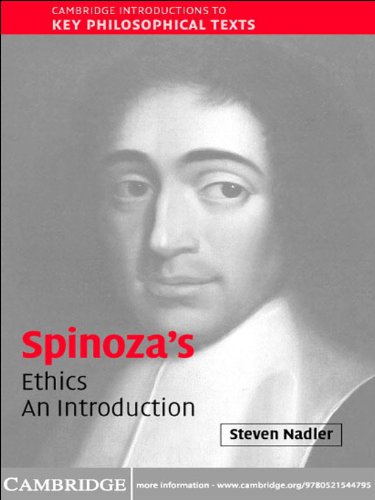
Ebook Info
- Published: 2006
- Number of pages: 301 pages
- Format: PDF
- File Size: 2.35 MB
- Authors: Steven Nadler
Description
Spinoza’s Ethics is one of the most remarkable, important, and difficult books in the history of philosophy: a treatise simultaneously on metaphysics, knowledge, philosophical psychology, moral philosophy, and political philosophy. It presents, in Spinoza’s famous ‘geometric method’, his radical views on God, Nature, the human being, and happiness. In this wide-ranging 2006 introduction to the work, Steven Nadler explains the doctrines and arguments of the Ethics, and shows why Spinoza’s endlessly fascinating ideas may have been so troubling to his contemporaries, as well as why they are still highly relevant today. He also examines the philosophical background to Spinoza’s thought and the dialogues in which Spinoza was engaged – with his contemporaries (including Descartes and Hobbes), with ancient thinkers (especially the Stoics), and with his Jewish rationalist forebears. His book is written for the student reader but will also be of interest to specialists in early modern philosophy.
User’s Reviews
Reviews from Amazon users which were colected at the time this book was published on the website:
⭐Rarely have I seen a philosophical commentary that exhibits such clarity, intelligence, and good judgment. This book is a superb introduction for students and at the same time there is sufficient quality analysis to benefit advanced readers. Spinoza’s Ethics is an extremely difficult text, and Professor Nadler’s explication is an outstanding contribution to the Spinoza literature. An added bonus is that the sparkling lucidity and subtle elegance of the prose does indeed make for pleasurable reading.I see no point in repeating what Nadler says about Spinoza. There are no obvious weak sections in the book, and the analyses of several themes are of very high quality. The discussion of Spinoza’s atheism (so-called atheism?) is the best I have read in my (admittedly limited) foray into Spinoza scholarship. I was also very impressed with the chapters on Spinoza’s theory of knowledge (Ch. 6) and virtue (Ch. 8). This is definitely first-rate philosophical commentary.I do believe that this book is the best introduction to Spinoza. My study recommendations are as follows: (l) When reading the Ethics for the first time, read Nadler’s book along side it. (2) On a second reading of the Ethics (and it should be read at least twice), read with it Bennett’s rigorous work, A Study of Spinoza’s Ethics. Upon completion of this demanding task one should have a working knowledge of one of the most difficult and important philosophers in the Western tradition.
⭐Thank you!
⭐My new creed – God is nature and Nature is God. To understand nature is to understand God.
⭐Spinoza is fascinating and his arguments powerfully persuasive and astonishingly relevant today. But he is tough, and at first glance, maybe crazy. Nadler is a Spinoza specialist who wrote a wonderful intellectual biography published by Cambridge. He does a great job here of introducing and clarifying the ideas and showing the precise historical antecedents in Descartes, etc. Really fine work and especially when compared to other introductions in this series (for instance, the Descartes’ Meditations and Aristotle’s Ethics intros are TERRIBLE). I’ve been studying Spinoza for years but this book still taught me a few things.Related readings: Jonathan Israel’s “Radical Enlightenment.” A huge history book but really really good and it shows how Spinoza was everywhere. The author also put out a recent translation of Spinoza’s Theological-Political Treatise available also by Cambridge U. Press, and which is a great companion to the ethics (maybe even a better place to start with Spinoza than the tricky ethics).If you want to go from Nadler’s fine intro to the next step, read H. A. (Harry Austryn) Wolfson’s canonical, authoritative, unparalleled historical study “The Philosophy of Spinoza.” It’s not in print but copies abound. There are two volumes (the unified edition is not worth it, it will crumble to pieces). Springing for hard-back is worth it, as you’ll read the book many times. It is a fantastic resource on Spinoza. If you read French then Martial Geurault is the standard. For contemporary continental takes on Spinoza, see “The New Spinoza.” Etienne Balibar’s “Spinoza and Politics” is great too. Many people like Deleuze’s reading of Spinoza – he has two books, a big one and a little one. They are indeed interesting, but they represent Deleuze: he works from Spinoza’s ideas in undoubtedly fascinating ways, but it’s not strictly Spinoza. The Cambridge Companion to Spinoza is not good. Ignore Bennett unless you are an analytic philosopher (in which case, what are you doing reading Spinoza? He’s crazy!)
⭐This is what Professor Nadler’s Introduction did for me.What Professor Nadler brought me to is Spinoza’s monism. In his monism—as opposed to Descartes dualism—the “mind is an idea of the body”: no body, no mind, no ‘me’. Enticing, no? And what is the mind but the idea-lized knowledge of the living me. And better yet, as all my knowledge that makes up my idea of me is all from the experience of life and living, at the last instant of cognizance (if such occurs), that’s the ‘me’ I’m taking with me into eternity. An instantaneous eternity, I guess. Granted, without the body. No after-life, no Super-natural beings or happenings; in fact, nothing outside the necessary, infinite, eternal Substance. And I thought, ‘I can live with that.’Now after about seven years of reading texts about Spinoza, including Professor Nadler’s A Book Forged in Hell I feel as though I’m maybe ready to read and perhaps understand the finer points of Spinoza’s thought. I admired Professor Nadler’s courage in taking a position on some of Spinoza’s more controversial ideas—particularly this doctrine of the eternity of the mind. I am eternally grateful.I hope I’m close enough to Professor Nadler’s explications; if not, I’m sure the further reading will straighten things out.
⭐Very good, really helped open up Spinoza’s philosophy for me.
⭐Awesome! Steven Nadler got going on Spinoza through a radio broadcast on the CBC, Ideas. Ever since I have been devouring and mulling over Spinoza’s life and thought. Nadler’s book on the Ethics is very helpful. Anyone who has tackled the Ethics without some guidance knows it is not an easy read. It’s frustrating, incomprehensible in places but glowing with that “something” you’ve always searched for but could never quite grasp, The Truth. Nadler’s book holds your intellectual hand and takes you ‘gently into that dark night’ until you see the dawn!
⭐Nadler summarizes aspects of Spinoza which are generally regarded as being clear, points out significant areas of dispute and summarizes some of the different opinions regarding them, puts them in a context in such a way that the reader can glimpse some of the background to his thinking, and does it all in a way which makes the thinking always interesting and often relevant to some present day concerns. A helpful feature of his writing is the way in which he presents Spinoza’s in Spinoza’s technical language and paraphrases it in modern, non-technical English. Spinoza is a difficult but very fascinating writer and has to be re-read several times and so it is not surprising that Nadler’s chapters must also be re-read, something which I have been doing with much pleasure.
Keywords
Free Download Spinoza’s ‘Ethics’: An Introduction (Cambridge Introductions to Key Philosophical Texts) 1st Edition in PDF format
Spinoza’s ‘Ethics’: An Introduction (Cambridge Introductions to Key Philosophical Texts) 1st Edition PDF Free Download
Download Spinoza’s ‘Ethics’: An Introduction (Cambridge Introductions to Key Philosophical Texts) 1st Edition 2006 PDF Free
Spinoza’s ‘Ethics’: An Introduction (Cambridge Introductions to Key Philosophical Texts) 1st Edition 2006 PDF Free Download
Download Spinoza’s ‘Ethics’: An Introduction (Cambridge Introductions to Key Philosophical Texts) 1st Edition PDF
Free Download Ebook Spinoza’s ‘Ethics’: An Introduction (Cambridge Introductions to Key Philosophical Texts) 1st Edition