Ebook Info
- Published: 2002
- Number of pages: 504 pages
- Format: PDF
- File Size: 49.44 MB
- Authors: Stephen M. Stigler
Description
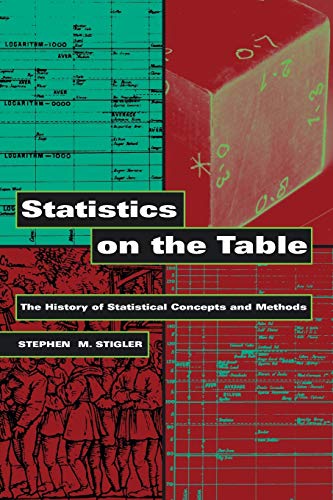
This lively collection of essays examines in witty detail the history of some of the concepts involved in bringing statistical argument “to the table,” and some of the pitfalls that have been encountered. The topics range from seventeenth-century medicine and the circulation of blood, to the cause of the Great Depression and the effect of the California gold discoveries of 1848 upon price levels, to the determinations of the shape of the Earth and the speed of light, to the meter of Virgil’s poetry and the prediction of the Second Coming of Christ. The title essay tells how the statistician Karl Pearson came to issue the challenge to put “statistics on the table” to the economists Marshall, Keynes, and Pigou in 1911. The 1911 dispute involved the effect of parental alcoholism upon children, but the challenge is general and timeless: important arguments require evidence, and quantitative evidence requires statistical evaluation. Some essays examine deep and subtle statistical ideas such as the aggregation and regression paradoxes; others tell of the origin of the Average Man and the evaluation of fingerprints as a forerunner of the use of DNA in forensic science. Several of the essays are entirely nontechnical; all examine statistical ideas with an ironic eye for their essence and what their history can tell us about current disputes.
User’s Reviews
Editorial Reviews: Review “In Statistics on the Table, statistician and historian of science Stephen M. Stigler collects and revises 22 of his scholarly and often witty essays from the past 25 years reflecting the combination of detective work and statistical thinking that characterize his research.”―Valerie M. Chase, American Scientist“Mainstream statistical topics (e.g. maximum likelihood, degrees of freedom, regression toward the mean) and various statistical writers (particularly Karl Pearson, Jevons, Edgeworth, Galton, Bayes, Gauss and Cauchy) are discussed, as well as some historical curiosities…Any biometrician should find plenty in it to fascinate, enlighten and entertain.”―D. A. Preece, Biometrics“Stigler’s useful, readable, and valuable book, with its numerous illuminating illustrations and plentiful insights, is an authoritative and definitive work in the early development of mathematical statistics, and a delightful examination in witty detail of the contributions of Gauss, Laplace, deMoivre, Bayes, Galton, Lexis, James Bernoulli, Quetelet, Edgeworth, and others. With humor and conviction, Stigler describes vividly the events leading to the emergence of statistical concepts and methods.”―D. V. Chopra, Choice“A well-selected collection of 22 essays–some involving major central mathematical ideas, others of a more popular nature–that vividly explore a number of interesting topics about a subject with so many diverse applications.”―Nestor Osorio, Library Journal“[This book’s] title comes from a letter written to the London Times in 1910 by the statistician Karl Pearson, exhorting critics of one of his studies to set aside mere opinions and put their ‘statistics on the table.’ Stigler uses this and other stories to relate the history of his subject, describing along the way the idiosyncratic individuals who have brought logic and mathematical rigor to a frequently confusing area of analysis. The reader who is not alarmed by the occasional graph or simple equation will find this a penetrating and entertaining account.”―Science News“[This is] a lively and controversial history…well captured in the second major book on the history of statistics by Stephen M. Stigler…In reading this collection, I was struck with the amount of scholarship and thought that went into each of the essays and with the liveliness and wit of the author’s writing style.”―Paul S. Levy, Perspectives in Biology and Medicine“It is great to have these essays collected in one volume . . . Irony and self-referencing humor abound in this book, making it entertaining; and clear exposition, thorough research, and insightful descriptions of key developments and personalities make it very much worth your time and money.”―Russell V. Lenth, American Statistician“Stephen Stigler’s 1986 book The History of Statistics: The Measurement of Uncertainty before 1900 was greeted with enthusiasm by both staticians and historians for its penetrating overview of developments in probabilistically oriented statistics before 1900. This new volume, too, will be of interest to both statisticians and historians What is the same in this book-or, indeed, even better-is the sparkling and witty style This book should without question have a place on the bookshelf of every person interested in the history of statistics.”―Ida H. Stamhuis, ISIS“If you have an interest in the history of statistics and also history in relationship to statistics, you will want this book. The standard for scholarship within the statistical community has never been any higher than it is here.”―Technometrics About the Author Stephen M. Stigler is Ernest DeWitt Burton Distinguished Service Professor in the Department of Statistics at the University of Chicago.
Reviews from Amazon users which were colected at the time this book was published on the website:
⭐The author is a well-known statistician who has also a gift as historian. The book is a collection of essays on the development of the main ideas in Statistics. These essays are not in chronological order and overlap on several points. That can create some confusion in the reader. The first essay is about the controversy on the effect of parents’ alcoholism on children between Karl Pearson and the Cambridge economists (A. Marshall, J.M. Keynes, A. Pigou). While Pearson expected harsh criticism from the medical profession he was unexpectedly broadsided by economists on the ground of logic instead of data. Pearson’s response was: statistics on the table, please. The book goes on clarifying the developments of the main ideas in the field: Central Limit Theorem, Normal distribution, least squares, degrees of freedom, regression, Bayes’s Theorem, and so on. It also provide the role of famous mathematicians like Gauss, Laplace, Legendre and others. However, Pearson, Galton and Edgeworth maintain a high visibility in the book. It is not a reference book of the historical development of ideas and intuitions in Statistics, and few chapters reflect more the interest of the author than the coherence with the title “Statistics on the Table. The History of Statistical Concepts and Methods” like in Statistics and Standards, and The Trial of the Pyx, or Apollo Mathematicus. Outstanding and funny is the chapter Stigler’s law of Eponymy, which states that no scientific discovery is named after its original discoverer. It is definitively an enjoyable reading and I strongly recommend it to whoever has an interest, weak or strong, in the subject.
⭐I am an applied statistician, nothing more than that; yet, understanding why and how statistical concepts emerged helps in better applying models to particular problems. Stigler consistently makes the point in each story that the concepts behind the statistic are as if not more important compared to the development of the mathematics behind the statistic. He is a great story teller.
⭐I purchased Dr. Stigler’s earlier book on the history of statistics. I wrote him to inquire about a follow-up. He said that this book was as close as he would get. If you want to understand why certain statistical techniques developed the way they did then Stigler’s two books are for you. In this modern world, we have every thing nice and neetly packaged for use. It is humbling to read about these pioneers who struggled to explain things with no adequate math to back them up…until they developed it themselves.
⭐This collection of essays is primarily aimed at the statistician or mathematician and includes numerous undefined statistical terms and equations. Nevertheless, its readable prose is sufficiently descriptive for even a non-statistician like me to follow and enjoy.I gave the book four stars only because of my lack of statistical training. I think a reader who has taken even a couple of beginning statistical courses would have no trouble with the concepts described.
⭐I’ve enjoyed learning some of the history behind the statistics. There are some amusing stories. If you’ve ever wondered where some of those tests came from, this a good read.
⭐Surprised I hadn’t come across the excellent writing this author before!
⭐Statistics on the Table might seem like a haphazard collection of essays on obscure parts of the history of statistics. And it must be admitted that some of the personages and statistical methods would be lucky to make it into the minutiae of a standard text. But underlying the essays is a surprising uniformity suggested by the title. That is the underlying theme of needing to put your statistics on the table.Taking a phrase from an essay by Karl Pearson, this theme needs repeating, even in the brave new world of the twenty-first century. What it means is that it is not enough to suggest plausible theories, maxims or even potential flaws in a model. Instead, one must argue by the methods of mathematical statistics. If there is an error in someone’s data or method that error must be shown by superior science. Simply speculating on potential missing variables or possible problems in applying a model is not sufficient.So while one is introduced to statistical models as bizarre as the structure of the hexameter in Virgil all of the theorizing is settled by correct data analysis.Given that we sometimes seem to be moving to an alternative facts world, it’s good to know that statisticians at the University of Chicago continue to insist on arguing as a result of data correctly understood.You do need some taste for statistical lore, however, to thoroughly enjoy this book. But the book is not just anecdotes and arcana. It is a useful polemic against intuitionists, hand-wavers and other peddlers of arguments which are not data driven. It’s a real pleasure to read as well, at least for those interested in poking in the side-alleys of history.
⭐Standard Buch das ich jedermann empfehle der Etwas mit Statistik macht! Die Geschichte der Statistik lest sich wie ein Roman
⭐
Keywords
Free Download Statistics on the Table: The History of Statistical Concepts and Methods in PDF format
Statistics on the Table: The History of Statistical Concepts and Methods PDF Free Download
Download Statistics on the Table: The History of Statistical Concepts and Methods 2002 PDF Free
Statistics on the Table: The History of Statistical Concepts and Methods 2002 PDF Free Download
Download Statistics on the Table: The History of Statistical Concepts and Methods PDF
Free Download Ebook Statistics on the Table: The History of Statistical Concepts and Methods