Ebook Info
- Published: 1990
- Number of pages: 557 pages
- Format: PDF
- File Size: 115.77 MB
- Authors: Stephen M. Stigler
Description
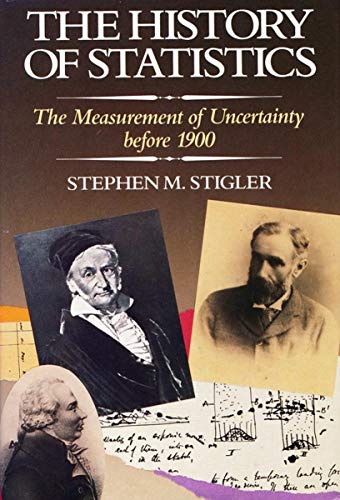
This magnificent book is the first comprehensive history of statistics from its beginnings around 1700 to its emergence as a distinct and mature discipline around 1900. Stephen M. Stigler shows how statistics arose from the interplay of mathematical concepts and the needs of several applied sciences including astronomy, geodesy, experimental psychology, genetics, and sociology. He addresses many intriguing questions: How did scientists learn to combine measurements made under different conditions? And how were they led to use probability theory to measure the accuracy of the result? Why were statistical methods used successfully in astronomy long before they began to play a significant role in the social sciences? How could the introduction of least squares predate the discovery of regression by more than eighty years? On what grounds can the major works of men such as Bernoulli, De Moivre, Bayes, Quetelet, and Lexis be considered partial failures, while those of Laplace, Galton, Edgeworth, Pearson, and Yule are counted as successes? How did Galton’s probability machine (the quincunx) provide him with the key to the major advance of the last half of the nineteenth century?Stigler’s emphasis is upon how, when, and where the methods of probability theory were developed for measuring uncertainty in experimental and observational science, for reducing uncertainty, and as a conceptual framework for quantitative studies in the social sciences. He describes with care the scientific context in which the different methods evolved and identifies the problems (conceptual or mathematical) that retarded the growth of mathematical statistics and the conceptual developments that permitted major breakthroughs.Statisticians, historians of science, and social and behavioral scientists will gain from this book a deeper understanding of the use of statistical methods and a better grasp of the promise and limitations of such techniques. The product of ten years of research, The History of Statistics will appeal to all who are interested in the humanistic study of science.
User’s Reviews
Reviews from Amazon users which were colected at the time this book was published on the website:
⭐This book is regarded, as it should be, as the authoritative text on the history of statistics before 1900. The only point I have to add to what has already been said is that the work is best viewed as a prehistory of statistics. From its beginning in handling astronomical measurement errors and games of chance to its birth as its own discipline with the development of linear regression, Dr. Stigler expertly handles the intellectual concepts and mathematics which led to this genesis.Why does he stop at 1900? Because, from approximately that time, statistics began as a subject one had to devote oneself to for an extended period to understand all the theory developed in the discipline. There will never be a history of statistics in the 20th century just as there will never be a history of physics in the 20th century. The amount of theory, driven by a massive effort of human ingenuity, now standard in these disciplines forbids a thorough historical narrative.Caveat Emptor. Dr. Stigler does not write armchair style, by providing vivid portraits of scientists or telling anecdotes. Instead, he delves right into the theory in all its mathematical complexity. For someone who uses these concepts everyday at work, it’s fascinating to see them in their original context. However, if you are looking for light reading, or a work of popular science, this is probably not the right choice of reading material.
⭐As my professor, Stigler is very good at provoking students. It is an honor to use his book in class.
⭐It is a good book for the history of statistics, until the 20th century.
⭐This is a very good book on the history of statistics. It presents the background for this complex topic in a very understandable way.
⭐Excellent book. To me, this book is not simply an exposition of the history of statistics, but a way to understand statistics better via the challenges which historically motivated its development. The writing is clear, precise, and insightful.
⭐This is an outstanding book. As a Statistics student, I can’t imagine reading anything better on this subject. The math in the book is in-depth enough such that I can relate historical developments of various statistical theory and technique to what I have done (and, for that matter, that which I have yet to do) and it was possible to reproduce some of the calculations on my own (which was quite enjoyable). Overall, this is an excellent book–I can’t recommend it enough.
⭐great
⭐Excellent!
⭐Superb. Excellent service too.
⭐Uma obra que inclui a discussão de algumas das passagens mais importantes da História da Estatística e que não aparecem na maioria absoluta dos livros disponíveis no mercado.
⭐
Keywords
Free Download The History of Statistics: The Measurement of Uncertainty before 1900 in PDF format
The History of Statistics: The Measurement of Uncertainty before 1900 PDF Free Download
Download The History of Statistics: The Measurement of Uncertainty before 1900 1990 PDF Free
The History of Statistics: The Measurement of Uncertainty before 1900 1990 PDF Free Download
Download The History of Statistics: The Measurement of Uncertainty before 1900 PDF
Free Download Ebook The History of Statistics: The Measurement of Uncertainty before 1900