

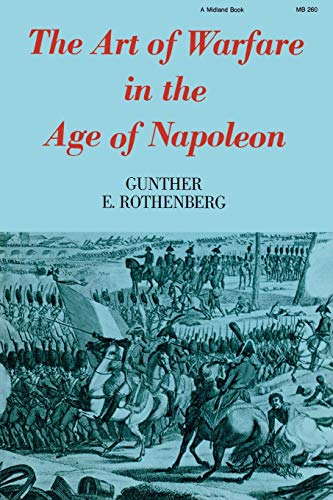
Ebook Info
- Published: 2026
- Number of pages: 272 pages
- Format: PDF
- File Size: 44.16 MB
- Authors: Gunther E. Rothenberg
Description
“… a most illuminating and readable general survey…. This book is well organized, well produced, and well written. It belongs among the ten most useful books on this period to the historian and… to the general reader.” — American Historical Review”This splendid volume fills a gap in the vast outpouring of literature on the military aspects of the era of the French Revolution and Napoleon by combining a description of the major changes and trends of warfare with a comparative discussion of the French military establishment and the armies of its major opponents…. As another contribution to ‘synthetic’ history, it is a very successful exercise.” — Military Affairs”… a splendid little study which will be of considerable interest both to the general student and specialist…. [it] fills a definite need for a survey of the military developments of the period and one can learn a great deal from a close reading of it.” — History”A clear, lively, and well-produced survey that relies upon the best scholarship of several languages…. ” — Library JournalIn a comprehensive study of a crucial era in warfare — from the last decades of the ancient régime to Napoleon’s defeat at Waterloo — Rothenberg describes the organization, training methods, equipment, tactics, and strategy of France and its adversaries. He also explores staff systems, logistics, fortifications, medical services, and insurgency and counterinsurgency.
User’s Reviews
Reviews from Amazon users which were colected at the time this book was published on the website:
⭐Gunther E. Rothenberg’s The Art of Warfare in the Age of Napoleon considers the evolution of armies in the Napoleonic era. The work examines this topic by considering various military aspects such as the constitution of Napoleon’s army and the armies of his adversaries: military reform, siege craft, medical services, staff work, soldiers’ daily lives, and other themes. While various authors have presented works about the French and British armies, Rothenberg’s work details this process for not only France and Britain, but also for Russia, Prussia, and Austria. Rothenberg’s service in the Second World War, with the Hagana, and in the Korean War provide him with an important understanding of warfare. He subsequently taught history at Purdue University and the Australian Defense Force Academy, and he has authored several works including The Napoleonic Wars and The Emperor’s Last Victory: Napoleon and the Battle of Wagram.Rothenberg first examines military questions toward the end of the ancien régime. He notes that eighteenth century conflicts revolved around the concept of limited war; wars “pursued with limited means for limited objectives.” Due to the limited nature of eighteenth century warfare and the high costs associated to train, equip, and supply a professional army, monarchs tended to avoid pitched battles which could potentially endanger their ultimate control of the armed forces. Most officers came from the aristocracy. The bourgeois provided a small number as well, usually in the technical arms of the service like artillery and the engineers. Officers of foreign birth were common. For the average soldier life was hard, consisting of low pay and rigid, harsh discipline. These factors reinforced the constraints of warfare, as many soldiers attempted escape from army life. Rothenberg asserts, “Fear of desertion, together with the restricted supply of manpower, imposed real restraints on the conduct of war. The most striking consequence was the reduction in fighting.” Rothenberg explores other themes as well, such as the Russian fascination with the bayonet and Jacques Antoine Hippolyte, Comte de Guibert and Jean-Baptiste Vaquette, Comte de Gribeauval’s military reforms in France.In Chapter Two, Rothenberg offers an overview of the Napoleonic Wars from the French victory at the 1792 Battle of Valmy until Napoleon’s final defeat at the 1815 Battle of Waterloo. He agrees with historian T. C. W. Blanning that the various European powers initially harbored no fear of the French Revolution. He comments, “At the outset, news of the Revolution in France had not caused undue concern in the various European capitals; rather the contrary.” Still, as the Revolution became more radical France soon became embroiled in armed conflict with most European powers. Rothenberg details the military evolution and reforms which were successively implemented in the Revolutionary and Napoleonic armies. The author highlights the changes which took place across the diverse European armies, while reinforcing this rupture from dynastic wars to much larger national wars that saw massive armies take the field. Rothenberg comments on the French efforts to amalgamate battle-hardened veterans with volunteers and conscripts. By doing this the French hoped to combine the veterans’ battlefield experience with the newcomers’ popular enthusiasm. He also notes that by 1813, the allies arrayed against Napoleon had finally learned to coordinate their efforts by targeting the armies of the French marshals, but falling back and refusing to give battle to the forces under Napoleon’s command. He asserts, “For once, the Coalition had a common strategic plan.”Rothenberg brings a sharp focus to the everyday officers and common soldiers that fought, bled, and died on the battlefields of Europe, rather than solely examining the highest strategic level of war, the habitual domain of kings and generals. He relates that the evolution from limited war to larger war significantly impacted these men. He maintains that, “Before 1792 commanders sought to avoid battle; the generals of the Revolutionary Armies and Napoleon pursued it eagerly.” Rothenberg’s book primarily considers the evolution of tactics, equipment and weapons utilized during the period. He goes into great detail to differentiate the different kinds of muskets, rifles, and other small arms weapons that the soldiers carried. Rothenberg analyzes the role of artillery on the battlefield, and comments on the various types of ammunition used, such as the common shell and the spherical case shot which sent dozens of musket balls toward the enemy at close range. He also mentions the debate over whether a gunner should keep firing until his position was overrun, or whether he should evacuate or disable the gun before it could fall into enemy hands. Likewise considered are more mundane aspects of army life, such as rations, camp life, fraternization with the enemy, and the role of women in the army.Rothenberg explores the nature of the French Revolutionary armies and their methods for conducting war. He observes that the dissolution of the Royal Army was a critical step in evolution of France’s military system, and that the renunciation of feudal privileges in August 1789 meant that the officer corps was now open to all segments of society. The influx of volunteers and the mass conscriptions also helped to radically change the nature of the army. Further, he asserts that because the Revolutionary armies grew so large, political indoctrination on a massive scale took the place of solid military training. The army began experimenting with the election of officers, which paid dividends even into the Napoleonic era. Rothenberg remarks, “Among the officers elected in 1791-2 there were no fewer than nine future marshals of the Empire and many senior commanders of the Republic.” The Revolution’s willingness to promote on merit distinguished it from the ancien régime’s class-driven officer corps. The republican political officers, the Representatives on Mission, further radicalized the army. These envoys from the Committee of Public Safety shared command with the army generals, who were often intimidated by them. Rothenberg reports that the radical Louis Antoine de Saint-Just often gave irrational orders, and that officers and soldiers feared the consequences of disobedience. For instance, Saint-Just ordered army doctors accompany the troops into battle. Executions for minor offenses were common. Saint-Just ordered an officer to be executed after he failed to have a gun battery placed in a timely manner. Rothenberg also comments on the revolutionaries’ enthusiasm for new scientific developments, such as the hot air balloon, although Napoleon eventually discarded the invention after deciding it was impractical.Much of the book focuses on issues unique to Napoleon’s army during the wars. Rothenberg details the constitution of the Grande Armée, and Napoleons’ institution of the corps system and later the army group system for the 1812 invasion of Russia. Napoleon’s army increased in size as the wars continued, and this ultimately proved as much a detriment as much as an advantage. Rothenberg explains, “The forces under his command grew from less than 50,000 to over 400,000 men, but he never changed his command system.” Such numbers made the army unwieldy and difficult to control. The fact that Napoleon’s system failed to create strong generals that could effectively lead the constituent parts of the Grande Armée only compounded French problems. Napoleon’s failure to adapt his command structure to the larger size and organization of his army meant that he could not replicate the stunning victories of his first campaigns. The more insulated Napoleon was from events on the battlefield, the less likely the army was to achieve victory. Rothenberg affirms that Marshal Louis-Nicholas Davout “served Napoleon better than his more flamboyant peers,” and was perhaps the only one of the marshals who could competently command a large portion of the army independently. Rothenberg observes that Napoleon’s insulation from the battlefield was part of a larger problem with the Napoleonic system, namely the extreme centralization of civil and military power in the emperor’s hands. He offers, “When Napoleon failed or when he was absent, difficulties arose that could not be compensated.” The book also explores Napoleon’s improvised logistical system, which depended largely on the army living off the land and delivering a knock-out blow to his enemies quickly, before the problems of supply became acute.Rothenberg likewise examines the great power armies fighting the French. Critically, the British, Austrians, Prussians, the Russians all had to introduce reforms into their own systems in order to meet the Napoleonic threat. Military reform often necessitated social and political reform, such as the Prussians and Austrians introducing Landwehr militia units, and the Russians conducting the 1812 campaign as a national, patriotic struggle. The work also explores unique problems within each army, such as the British practice of purchasing commissions and the Prussian failure to recruit more middle class and technically minded officers. However, despite these problems, the narrative presented here illustrates that the Allies slowly and often painfully adapted to Napoleon’s army. These reforms ultimately led to victory over the French.Primary sources are used frequently in this book. Rothenberg often cites first person accounts, such as those of E. Costello and Benjamin Harris, both of the 95th Rifles under General Sir Arthur Wellesley, the Duke of Wellington. Their observations and reports, along with those from other armies, offer credibility to Rothenberg’s analysis. The bulk of the work is based upon English and French language sources, while Rothenberg also uses German language sources to a lesser degree. The result is a seamless blend of first-hand accounts and published material that intelligently and convincingly supports Rothenberg’s arguments.The Art of Warfare in the Age of Napoleon is a wonderfully written and brilliantly argued monograph that demonstrates the changes in Europe’s militaries throughout the Napoleonic Wars. Although the work is less than 300 pages, Rothenberg includes a wealth of information and data that informs on a number of different aspects concerning warfare in the period. The book provides a grand overview of the Napoleonic Wars, while still offering a considerable amount of detail and nuance. Students of the period will no doubt take delight in the vast scope of the book’s arguments, as well as in the drama of its humanity.
⭐Gunther Rothenberg’s “The Art of Warfare in the Age of Napoleon” is a highly readable survey of the changes in the art of war during the 23-year conflict spawned by the French Revolution and the Wars of Napoleon. Despite its brevity, “The Art of Warfare” is remarkably comprehensive, addressing weapons, tactics, strategy, and supporting military services such as engineering and medical care. Rothenberg provides a short synopsis of the Revolutionary and Napoleonic Wars and commentary on the military establishments of the principal combatants.Rothenberg rightly devotes much of the book to the innovations of the French Army as it evolved under the necessity first of defending the Revolution and then under the hand of its martial Emperor, Napoleon I. The concept of the nation in arms made possible mass armies which often overwhelmed the small professional armies of its adversaries. Lack of training led to an emphasis on shock in battle, produced by fast moving infantry columns, massed artillery fire, and operational maneuver against the flanks and rear of opponents. Rothenberg notes the effects of a persistent French failure to build a robust supply system. French soldiers in the field were expected to forage to survive. The Army as a whole was forced to disperse to find food, and Napoleon had to rely on exquisite timing to mass his forces in time for battle. The lack of a supply train imparted operational mobility, but when foraging failed, as it did in Russia, or provoked guerrilla war, as it did in Spain, French soldiers starved or were picked off in ambush.The many success of the French Army prompted varying degrees of emulation by the Austrian, Prussian, Russian, and British armies. The Prussians sought most to copy the French methodology, while the British prefered to enhance the professionalism of their forces rather than build a mass army.Rothenberg wrote “The Art of Warfare” in 1978. Close students of the Napoleonic Wars will find a few mistakes, and the volume has a surprising number of misspellings. However, these imperfections really do not detract from what is an excellent work.This volume is highly recommended to the student looking for a manageable introduction to the Napoleonic Wars, and to the serious student as a superb companion volume to the longer operational-level histories. The casual reader with some background in military affairs may also find this book a worthwhile read.
⭐For 0.01$ + shipping can’t complain, the book has very few scratches.
⭐Excellent Napoleonic warfare book! Detailed and full of examples.
Keywords
Free Download The Art of Warfare in the Age of Napoleon in PDF format
The Art of Warfare in the Age of Napoleon PDF Free Download
Download The Art of Warfare in the Age of Napoleon 2026 PDF Free
The Art of Warfare in the Age of Napoleon 2026 PDF Free Download
Download The Art of Warfare in the Age of Napoleon PDF
Free Download Ebook The Art of Warfare in the Age of Napoleon