

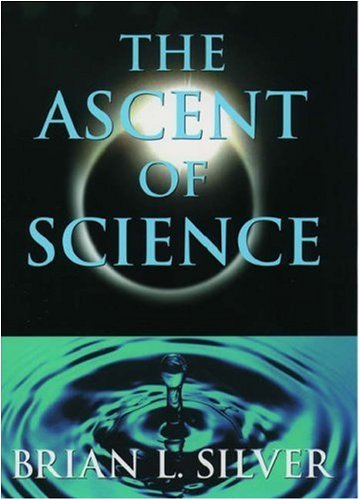
Ebook Info
- Published: 1990
- Number of pages: 552 pages
- Format: PDF
- File Size: 12.34 MB
- Authors: Brian L. Silver
Description
From the revolutionary discoveries of Galileo and Newton to the mind-bending theories of Einstein and Heisenberg, from plate tectonics to particle physics, from the origin of life to universal entropy, and from biology to cosmology, here is a sweeping, readable, and dynamic account of the whole of Western science. In the readable manner and method of Stephen Jay Gould and Carl Sagan, the late Brian L. Silver translates our most important, and often most obscure, scientific developments into a vernacular that is not only accessible and illuminating but also enjoyable. Silver makes his comprehensive case with much clarity and insight; he locates science as the apex of human reason, and reason as our best path to the truth. For all readers curious about–and especially those perhaps intimidated by–what Silver calls “the scientific campaign up to now” in his Preface, The Ascent of Science will be fresh, vivid, and fascinating reading.
User’s Reviews
Reviews from Amazon users which were colected at the time this book was published on the website:
⭐As my title suggests, to me this is one of the best books I’ve ever come across. I first read it 25 years ago when I came across a hard copy edition at my mother-in-law’s. Why she had it, I do not know, but I am grateful she did as I was hooked from the first page through the last. It has weighty scientific things discussed, but the discussion is never so dense as to be inaccessible. Indeed, the opposite is true: the scientific discussions are offered in so accessible a way that things I’d heard of but never understood became clearer upon my reading.This is a book that tracks the development of science *and* philosophy from about the 1600s to the present day, which was the late 1990s when the book was published. Philosophy is important because it shapes the worldview (the set of underlying assumptions that shape how other things are viewed, and the framework in which broader understandings are developed). To blend these two into a single book is brilliant.As another commenter noted, the book is wonderful, but the e-book formatting is quite bad. It’s readable, but at times just barely. I have to often close the book and restart the Kindle app to get the formatting to go back to normal. I have found that highlighting will appear to be moved from the text I actually highlighted, and following footnotes will take you away, but not give a path back, so be sure to bookmark the page so you can return to your bookmark after reading the footnote.
⭐I read this book a number of years ago, and really loved it – it’s a very good overview of “modern” science (up to a little before 2000, so there’s a lot of more recent stuff that’s missing).The Kindle version of this book, though, is very badly formatted. All of the italics and other special characters are missing, there are a *lot* of typographical errors, and quite a bit of the text (such as the footnotes) are images, which means you can’t search the text.
⭐I bought this book about 10 years ago as a softcover, and have either been re-reading it or meaning to re-read it ever since. It is the best book I’ve ever read. It blows me away still with the amount of knowledge it throws at me in one page, and I often have to put it down every couple of minutes just to compute what it says, but that’s a testament to how well it’s written that eveything he wants to say is absorbed and doesnt go over my head like some other ‘science books for beginners’. I find when I watch documentaries about theoretical physics etc aimed at the ‘common man’, I get bored and wish they would ‘get to the good stuff’, which still gives me a kick, it’s great. Of course he doesn’t just address physics, he addresses all the sciences, which gives a good well rounded education for the ‘very curious about science’ amongst us. Also he has a good sense of humour, and with illustrations, helps keep the book fresh as you read. All in all, this guy is extremely intelligent, accross a wide range of subjects (and he also had help of course), he is an excellent writer, has a great way of explaining things and obviously loved writing this book. It’s a must read.
⭐It is rare to find a science writer who can engage your mind and imagination as well as Brian Silver does in this book. As a scientist, the concepts in this book are generally familiar to me but the stories surrounding them are still fascinating. Our journey from cave painting to putting a man on the moon in so short a time is one of curiosity, inquiry, a new way of exploring and thinking. Written,I think, for the non-scientist, I still found it hard to put down.
⭐I picked this up used. Although two decades old, it really is just a great allaround science publication. It presents the history of science and philosophy, in a timeline format. It pieces together science and history, and how new science discoveries were made based upon a stepping stone process. Very comprehensive. If you like Brian Greene books, this will be rewarding to read.
⭐I really enjoyed reading the book and his insights. I gave a copy to a young person interested in science.
⭐Good enough for me.good to have for a class I took. A good read and a excellent form of information . I was able to pass my class and sale the book back for some money
⭐This isn’t something I would buy on my own, I bought it for a class I was taking in college.
⭐This must be one of the best accounts of the scientific world view in print. It covers most areas in a very acessible style, with flashes of humour.Sadly the author died just before publication in 1997, so there will be no more from his pen. This also means that some areas, such as particle physics and cosmology, where there have been significant discoveries since publication, are now out of date. However there are many more recent publications which cover these areas, and as long as the reader is aware of this, the quality of the book makes it an enjoyable and informative read.
⭐I love the way that Professor Silver blends his narrative on the science and discoveries that led the Ascent of Science. He also considers how these interact with the prevailing beliefs and philosophy of the times, illustrating the way in which the human mind can sometimes struggle to come to terms with challenging or provocative concepts. His style tends to wander from serious to frivolous but is always engaging, primarily because there is an enthusiasm about his unveiling of each new discovery. While some may disparage the way in which he only scratches the surface of his topics, seldom delving deep into the subjects considered, this is only to be expected when the stated objective is to reveal the path that science took in its ascendency. It also ensures that the lay reader doesn’t become mired in struggles with atomic processes or quantum concepts that undergraduate students can wrestle with for years.As a text which explores the evolution of science from its mystic origins to becoming the predominant force in the world today the Ascent of Science helps provide a foundation level of knowledge and serves to interest and stimulate the reader to search for more information on the topics explored. I thoroughly enjoyed it and it took me ten times longer to read as I searched the web for more detail of the people and discoveries mentioned.
⭐Excellent book.
⭐An excellent book for anyone interested in Science
Keywords
Free Download The Ascent of Science 1st Edition in PDF format
The Ascent of Science 1st Edition PDF Free Download
Download The Ascent of Science 1st Edition 1990 PDF Free
The Ascent of Science 1st Edition 1990 PDF Free Download
Download The Ascent of Science 1st Edition PDF
Free Download Ebook The Ascent of Science 1st Edition