Ebook Info
- Published: 2015
- Number of pages: 1340 pages
- Format: PDF
- File Size: 13.64 MB
- Authors: Thomas Pakenham
Description
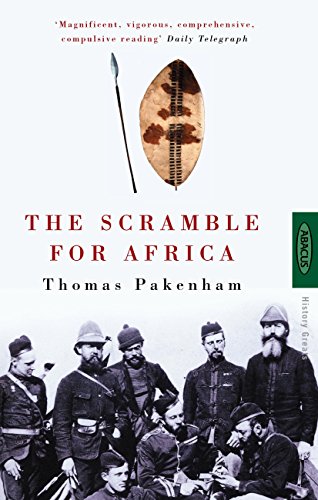
In 1880 the continent of Africa was largely unexplored by Europeans. Less than thirty years later, only Liberia and Ethiopia remained unconquered by them. The rest – 10 million square miles with 110 million bewildered new subjects – had been carved up by five European powers (and one extraordinary individual) in the name of Commerce, Christianity, ‘Civilization’ and Conquest. The Scramble for Africa is the first full-scale study of that extraordinary episode in history.
User’s Reviews
Reviews from Amazon users which were colected at the time this book was published on the website:
⭐Very informative and illuminating MJ
⭐Extremely ambitious read covering many regions of African continent in last 30 years of 19th century, focusing on European imperialism; what is commonly known as THE SCRAMBLE FOR AFRICA. This book has become one of the standard-bearers for historians and casual readers interested in that period. When I wrote BEFORE THE SCRAMBLE: A SCOTTISH MISSIONARY’S STORY I very much relied on several key chapters in this book. The book’s design is as follows: the chapters are independent from each other, each chapter covering a separate region of the continent, separate European powers and their respective military and political personalities involved in those respective areas. The research is impeccable, the detail of personalities and incidents are clear and richly portrayed. This book is one of those seminal documents that will withstand the test of the time. It will be an excellent source for researchers, teachers, and students. Again, I found it extremely useful when it came time for me to write about my distant relative who was a missionary in British Central Africa in the 1880s. What was really compelling was reading about individuals James Sutherland (my relative) met, who appear in THE SCRAMBLE FOR AFRICA. It helped me gain tremendous perspective on the personalities, historical forces, and individual events that molded African imperialism. I will always treasure this book.
⭐I read this good book, here in Brazil.This book has many excellent parts, such as:1-Page 433:”Their dominant themes were the threat to the lives of the Christian missionaries, the need to maintain the supression of the slave trade, and the damage to Britain’s honour if the country reneged on her pledges.It was an old familiar crusade, the one for wich Livingstone and Gordon and Bishop Hannington had died – the crusade against Mulslim slave traders.”2-Page 439:”Impressed by his exploits in battle, Tippu Tip gave him back his freedom.Then for several years he served as Tippu’s lieutenant in the upper Lomani, hunting slaves and ivory, like others loyal to the Arabs, with a pack of obedient cannibals.(Troublemakers were distributed as rations)”.Such as another reviewer wrote, the big problem of this book is to be very biased.It is very biased and focused in England’s imperialism.About Portugal and Spain imperialism in Africa, there’s almost nothing.As I show above, this book writes the true about XIX Century’s african slavery:an islamic business.At the same time, in one page, this book when talking about blacks in South Africa, describe they as “servants”, not slaves, the real condition of them.Even with these failures, this book is a good choice to learn, about the Scramble for Africa.
⭐I received a different edition (Abacus). The typeset is 8pt. Average Bible size print is 10pt. Time spent reading is reduced because of this. The subject & writing style is wonderful.
⭐This book fills in the foundations of what we are seeing being acted out in such places as Rwanda and the Sudan. These are results of European powers rolling into ancient lands, and grouping their peoples all together to form Western style entities in the form of colonies. Ancient tribal rivalries were damped down by European military power. With the independence movements which began between the World Wars, along with the inability of the Western countries to be able to commit the necessary manpower to hold command, the colonies were disbanded. The tribes are fighting each other again. However, this time they are armed with half learned lessons in finance, manipulated demoncracy and other unfortunate examples such as genocide. This book will show the reader how it all began and why it could never last. There is no way to know how the atrocities being committed in Africa will end, if the people of the former colonies will ever know ongoing peace or what direction the resolution of the bloodshed will finally take. However, at least after finishing this book, the reader will understand from whence the anger came.
⭐It was a gift for a student who seams to want to understand the importance and the facts that brought us to our history as we know it
⭐A must read book if you want to attempt to understand why Africa is where it is today. The effects of colonialism are still being felt today but the players are locked in a power and money game they don’t fully understand. Coming to grips with the past will help with finding new and better solutions to the future of a still underdeveloped powerhouse. This book shows the foibles and short sighted policies of the world powers a hundred and fifty years ago which set the pace for Africa today.
⭐It was a wonderful explanation of the history of Africa as it relates to the colonialism. Lots of details. This could easily be a college textbook.
⭐I read this colossus quite a few years ago and decided to re-read it as research for a book I am writing about Africa. Thomas Pakenham presents a lengthy and very detailed tome on the European colonisation of the African continent, from the 1870s, and then leading up to the First World War. He vividly describes how the 3 Cs … Commerce, Christianity and Civilisation, a triple alliance of Mammon, God and Social Progress would liberate Africa. Of course, there was the 4th C, Conquest, which with the aid of mechanised warfare devastated the continent. The five rival nations of Germany, Italy, Portugal, France and Britain treated the whole affair like a schoolboy’s brawl and Livingstone’s ‘Open Sore’ suppurated with more and more pus. At the centre of it all was the Belgian King Leopold with the Congo rubber trade, a slave driver if ever there was one, severing hands as punishment if quotas were unmet. The Germans were hardly any better with a policy of genocide against the Herero and Nama when they rebelled. Africans throughout the continent were treated as nothing more than Nyama (meat), with a beating by hippopotamus hide to keep them in place.Africa brought out the worst in humanity, crude and brutal tribalism on a massive scale. It is a wretched tale of savagery on almost every page, humans revealed for what they really are, from cannibal kings, despotic rulers, barbaric slave traders, psychotic and narcissistic colonial officials to the greedy and power-hungry politicians, generals and monarchs in Europe. There are plenty of tales too of famine, plague, malaria, dysentery and gangrenous ulcers the size of mushrooms filling the air with the stench of rotting flesh. Pakenham really packs in loads of history and entertains us with the death of Gordon, the escapades of Rhodes and of the terrible losses in the Boer War. Meanwhile, in the Tories’ club, the Carlton, it was ‘like the Zoological Gardens at feeding time.’ Hypocrisy, jingoism and imperialism unbound.In the 1950s and 60s, there was a scramble to get out as European Empires collapsed, just as Lord Lugard predicted. Pakenham says there has now been a return to the informal empire of trade and influence, with Europe giving Africa the aspirations for freedom and human dignity. Not too sure on that last point, I think a bit too generous, and with the Chinese arriving in ever greater numbers, the horror story of exploitation is far from over.With over 700 pages, it is quite a mammoth effort to read, and as others have mentioned difficult to retain all the facts, let alone the characters that contribute to the narrative. But if you persevere, you will be well rewarded with a story that is as much about the human condition, as it is to the historical details that Pakenham presents so lucidly.Finally, I am a travel writer myself and have spent many months travelling across Africa and visiting some 15 countries from Morocco down to South Africa. This book has certainly given me a great insight into why Africa is the way it is today, with the mishmash of old colonial borders and tribal conflict as ingrained as ever. It will definitely help when I get round to writing my book on Africa. (I’m currently writing about the Indian subcontinent). So get stuck in and while away those long hours as you’re waiting patiently in yet another airport departure lounge, just like me.Check out Terry’s Travels
⭐One of my favourite movies is ‘Zulu’ but what you don’t learn in that movie but will from this book is that the Zulus weren’t the aggressors – the Boers and British were. Like so much of history, the past has been rewritten by the victor and much of relevance has been left out or is barely known.The book describes how Britain, France and Germany raced to carve up the African continent to enrich themselves. Belgium and Italy also joined in. They justified their actions by the three ‘C’s: commerce, Christianity and civilisation. Some saw it as a way to end the slave trade perpetuated at that time by the Arabs kidnapping people in league with local African tribal leaders to be taken to the Middle East, an evil which continued long after the abolition of slavery in the West.At times the book reads like an adventure story but told from the colonisers point of view. At others the detailed politics can be quiet tedious. The immense suffering caused to the local population and the legacy we have left behind is largely ignored, apart from a couple of chapters at the end.Still western corporations, and and now China too, ruthlessly exploit Africa’s resources with locals working for a pittance under appalling conditions so we can have the materials needed to make our smart phones, etc. While a few corrupt officials at the top make a fortune, many Africans seek to escape the poverty and conflict and end up dying trying to cross the Mediterranean in search of a better life, and if they survive have to work illegally under awful conditions for European agricultural producers or end up in Saudi and other Middle Eastern states being beaten and abused, often unable to leave and often not paid. What Europe and Arab countries unleashed upon Africa continues, and this book describes how it started.
⭐I am always aware that my opinion is of little or no importance. Just because I could not get on with book does not mean the next reader will rate the book highly. As someone who was born in Africa I thought it might be a good read but unfortunately I just did not ‘click’ with this book. As a historical read into Europe’s rape of Africa, especially Belgium’s and England it should be read.
⭐The Scramble for Africa was a term coined to describe the great rush in the late 19tth Century by the European powers to claim a slice of the African continent. In a period of some 30 years the continent went from scattered European control (except at the Cape and on the North African coast) to be completely divided between Great Britain (receiving the Lion’s share), France (the runner up with the bulk of North West Africa), Germany, Portugal and surprisingly Belgium. The Europeans would hold onto their territories for only a short period (most were out of Africa by the early 1960s) yet in that time, they shaped the fate of the continent, which is being felt now and for many years to come.While over 20 years old, this book may be the definitive guide for the topic. Thomas Parkenham’s work goes into great detail, but not in a dry way, looking at the not just the scramble, but also at events leading up to it over different time periods. The book is broken into 4 parts, the situation in Africa before the scramble begins, the start of the actual scramble lading up to the Conference of Berlin of 1885 where rules were put into place to govern the allocation of territory from the African cake(though these rules were not enforced) and where Leopold of Belgium managed to manipulate the great powers and had his possessions in the Congo (over 1 million square miles!) ratified. The next section deals with the main land grab of Africa and then the last main part shows the resistance to the European powers and the reform efforts that were undertaken by said Powers.We look at the great figures like Livingstone (briefly), Stanley, the Englishman who became an America and who found Livingstone then continued his great exploration and ended up working for Leopold of Belgium and his great rival Brazza the Italian who became a passionate Frenchman who challenged Stanley in the face for the Congo in opening it up and adding to the sum of human knowledge We look at the great statesmen and the business men who led the charge into the continent and the reasons why, with exerts from their writings public and private in order to provide greater insight and humanize them. The book is crammed full of maps and illustrations which help us and bring this book to life.My only complaint with this and it is minor, is that the paperback version of this is written in small type, making it harder to read for those of us with weaker eyes, otherwise this is one great work.
⭐As an informal reader of history, I found this book to be absolutely brilliant. Having watched a few films, read a few things on wikipedia and realizing I knew nothing at all about those countries I’ve been staring at on a globe for so long, Google and Amazon told me that this was the book I had to read as an introduction to the history of Africa.The focus of the story is the approx 30 year period of history when Europe ended up grabbing virtually all the land of africa and divided it up into pretty much the boundaries that we see today when we look at the map. And for me – this was the main draw of the book. I was fascinated as to how and why africa looks the way it does today and in that respect the book is fantastic.It is a story with plenty of great characters – just to name a few – the politicans, Kings and Queens in the offices and palaces of Europe. Individual explorers cutting their way through the jungle, dragging themselves through the deserts and hauling themselves upstream on the great rivers. Money grabbing pioneers turning over the land, pure hearted missionaries looking to give redemption and last but not least the African tribes… well mainly being f****d over.Personally, my favourite chapters were that regarding today’s Democratic Republic of Congo. In King Leopold II, Henry Morton Stanley, the River Congo and its rainforest and the cannabalistic tribes there are surely some unforgettable episodes.Furthermore, the story of the Arab and Muslim world, and how its own seeds have been sewn into African history adds to the mix of stories told.As a reference to another comment which suggests that this story is told a two horse race between France and England, I do agree to some extent. However, almost from the title of the book itself, you have to go in understanding that to even try and provide a complete picture on the topic, from every perspective, would be nearly impossible. It is eurocentric, and ultimately I feel that the book’s focus on each of the European powers probably reflects the amount the proportion of land they ended up with. That is except Portugal (Angola, Mozambique and Guinea-Bisseau) about which there is virtually no mention either about the homeland politics or the annexation of the african land, which was dissapointing.Nonethless, I have still given the book 5 stars which says a lot about what is written. A period of history that comes between the Africa of today and the Africa that was is a story that is well worth the read and in this book has been told in an utterly compelling way.
Keywords
Free Download The Scramble For Africa in PDF format
The Scramble For Africa PDF Free Download
Download The Scramble For Africa 2015 PDF Free
The Scramble For Africa 2015 PDF Free Download
Download The Scramble For Africa PDF
Free Download Ebook The Scramble For Africa