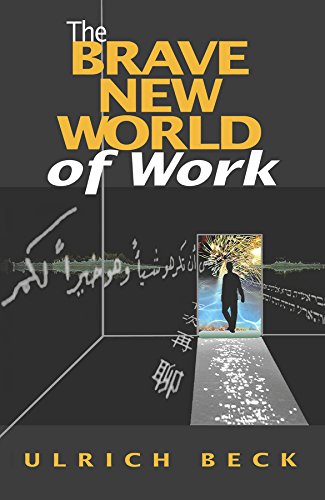
Ebook Info
- Published: 2000
- Number of pages: 202 pages
- Format: PDF
- File Size: 1.60 MB
- Authors: Ulrich Beck
Description
In this important book, Ulrich Beck – one of the leading social thinkers in Europe today – examines how work has become unstable in the modern world and presents a new vision for the future. Beck begins by describing how the traditional work society, with its life-long job paths, is giving way to a much less stable world in which skills can be suddenly devalued, jobs obliterated, welfare cover reduced or eliminated. The West would appear to be heading towards a social structure of ambiguity and multiple activity that has hitherto been more characteristic of the developing world. But what appears to be the end of traditional working practices can also be seen as an opportunity to develop new ideas and models for work in the twenty-first century. Beck’s alternative vision is centred on the concept of active citizens democratically organized in local, and increasingly also regional or transnational, networks. Against the threat of social exclusion, everyone can and must have a right to be included in a new definition and distribution of work. This will involve constant movement between formal employment (with a major reduction in working hours) and forms of self-organized artistic, cultural and political ‘civil labour’, providing equal access to comprehensive social protection. The aim must be to turn insecurity around, so that it becomes a positive and enriching discontinuity of life. Drawing on his earlier work on risk and reflexive modernization, The Brave New World of Work is also closely linked to his studies on globalization and individualization. These processes are part of the same challenge upon which a politics of modernity must now base itself. Not only the future of work, but also the very survival of democracy and the welfare state will depend on the development of a newly committed and ‘multi-active’ transnational citizenship. This book will be of great interest to second- and third-year students in sociology, politics, geography and the social sciences generally. It will also appeal to a broader audience interested in the issues and debates surrounding the changing nature of work.
User’s Reviews
Editorial Reviews: Review ‘With characteristic panache, Ulrich Beck has once again cut right through conventional economic and political language to make his point. There is enough work to do for all, but the “work society” is gone. In the “second modernity” individuals define the patterns of their lives themselves, and a “self-active civil society” has become possible. Ulrich Beck’s new book makes even New Labour look old and is thus bound to stimulate a lively debate.’ Lord Dahrendorf, formerly Director of the London School of Economics ‘Beck does it again – just as he challenged us in the 1990s to shift attention from capital to risk, now he calls on us to turn from paid work to civil labour in creating a postnational cosmopolitan society. This is the kind of pace-setting radical thinking necessary to keep up with the breakneck speed of change in the Global Age. Yet, another bravura performance.’ Martin Albrow, Woodrow Wilson International Center for Scholars,and University of Surrey Roehampton “Beck develops an intelligent andc well written alternative scenario to current models of work” Thomas Klikauer, University of western Sydney ‘In a brief but compelling book, Beck details the problems and prospects for societies that remain trapped by an ideology focused on work … This well-written book raises important questions and challenges dominant assumptions. It should be useful to a variety of levels and disciplines.’ Choice ‘There is no shortage of books about the future of work. This one is well worth reading. It greatly extends and devlops Beck’s discussion of the “destandardization of labour” in his Risk Society, and makes a contribution which is original, complex, subtle, wide-ranging … always stimulating.’ Work, Employment and Society ‘This book will be popular with non-academic audiences and will prove useful in getting students to think critically about the nature of society and the workplace’ Progress in Human Geography 26, 1 From the Inside Flap In this important book, Ulrich Beck – one of the leading social thinkers in Europe today – examines how work has become unstable in the modern world and presents a new vision for the future. Beck begins by describing how the traditional work society, with its life-long job paths, is giving way to a much less stable world in which skills can be suddenly devalued, jobs obliterated, welfare cover reduced or eliminated. The West would appear to be heading towards a social structure of ambiguity and multiple activity that has hitherto been more characteristic of the developing world. But what appears to be the end of traditional working practices can also be seen as an opportunity to develop new ideas and models for work in the twenty-first century. Beck’s alternative vision is centred on the concept of active citizens democratically organized in local, and increasingly also regional or transnational, networks. Against the threat of social exclusion, everyone can and must have a right to be included in a new definition and distribution of work. This will involve constant movement between formal employment (with a major reduction in working hours) and forms of self-organized artistic, cultural and political ‘civil labour’, providing equal access to comprehensive social protection. The aim must be to turn insecurity around, so that it becomes a positive and enriching discontinuity of life. Drawing on his earlier work on risk and reflexive modernization, The Brave New World of Work is also closely linked to his studies on globalization and individualization. These processes are part of the same challenge upon which a politics of modernity must now base itself. Not only the future of work, but also the very survival of democracy and the welfare state will depend on the development of a newly committed and ‘multi-active’ transnational citizenship. This book will be of great interest to second- and third-year students in sociology, politics, geography and the social sciences generally. It will also appeal to a broader audience interested in the issues and debates surrounding the changing nature of work. From the Back Cover In this important book, Ulrich Beck – one of the leading social thinkers in Europe today – examines how work has become unstable in the modern world and presents a new vision for the future. Beck begins by describing how the traditional work society, with its life-long job paths, is giving way to a much less stable world in which skills can be suddenly devalued, jobs obliterated, welfare cover reduced or eliminated. The West would appear to be heading towards a social structure of ambiguity and multiple activity that has hitherto been more characteristic of the developing world. But what appears to be the end of traditional working practices can also be seen as an opportunity to develop new ideas and models for work in the twenty-first century. Beck’s alternative vision is centred on the concept of active citizens democratically organized in local, and increasingly also regional or transnational, networks. Against the threat of social exclusion, everyone can and must have a right to be included in a new definition and distribution of work. This will involve constant movement between formal employment (with a major reduction in working hours) and forms of self-organized artistic, cultural and political ‘civil labour’, providing equal access to comprehensive social protection. The aim must be to turn insecurity around, so that it becomes a positive and enriching discontinuity of life. Drawing on his earlier work on risk and reflexive modernization, The Brave New World of Work is also closely linked to his studies on globalization and individualization. These processes are part of the same challenge upon which a politics of modernity must now base itself. Not only the future of work, but also the very survival of democracy and the welfare state will depend on the development of a newly committed and ‘multi-active’ transnational citizenship. This book will be of great interest to second- and third-year students in sociology, politics, geography and the social sciences generally. It will also appeal to a broader audience interested in the issues and debates surrounding the changing nature of work. About the Author Ulrich Beck is Professor of Sociology at the Ludwig Maximilian University in Munich Read more
Reviews from Amazon users which were colected at the time this book was published on the website:
⭐When he’s good, he’s great. Some passages in this book, especially those dealing with Beck’s idea of a new civil society that must be forged out of the remains of the social welfare contract, are inspiring. When he’s not so good, it’s because he’s repetitive, or because he’s speaking so generally about the effects of the global economy that he veers into vague abstraction at the expense of driving his thesis home. Because it’s a challenging thesis — the idea of paid civil work as a way to (re)create a truly democratic society — and because it’s articulation is at least partially supported through data, it’s easy to forgive the sometimes too-general perspective.Read as a companion “The Global Age” by Martin Albrow, which is quoted in The Brave New World of Work, and interestingly, has the same strengths and weaknesses: an interestingly theory (we’ve moved past the post-modern age into the “global age” wherein the interconnectedness of humanity belies old national boundaries and notions of class), and a sometimes too abstract style.
Keywords
Free Download The Brave New World of Work 1st Edition in PDF format
The Brave New World of Work 1st Edition PDF Free Download
Download The Brave New World of Work 1st Edition 2000 PDF Free
The Brave New World of Work 1st Edition 2000 PDF Free Download
Download The Brave New World of Work 1st Edition PDF
Free Download Ebook The Brave New World of Work 1st Edition