

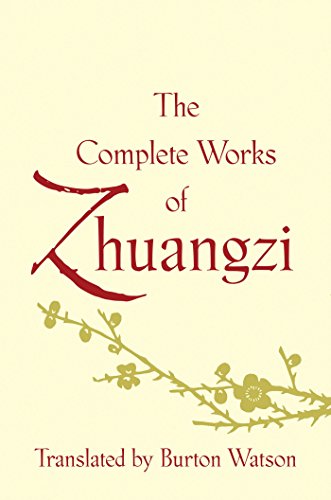
Ebook Info
- Published: 2013
- Number of pages: 319 pages
- Format: PDF
- File Size: 5.77 MB
- Authors: Zhuangzi
Description
Only by inhabiting Dao (the Way of Nature) and dwelling in its unity can humankind achieve true happiness and freedom, in both life and death. This is Daoist philosophy’s central tenet, espoused by the person—or group of people—known as Zhuangzi (369?-286? B.C.E.) in a text by the same name. To be free, individuals must discard rigid distinctions between good and bad, right and wrong, and follow a course of action not motivated by gain or striving. When one ceases to judge events as good or bad, man-made suffering disappears and natural suffering is embraced as part of life.Zhuangzi elucidates this mystical philosophy through humor, parable, and anecdote, deploying non sequitur and even nonsense to illuminate a truth beyond the boundaries of ordinary logic. Boldly imaginative and inventively worded, the Zhuangzi floats free of its historical period and society, addressing the spiritual nourishment of all people across time. One of the most justly celebrated texts of the Chinese tradition, the Zhuangzi is read by thousands of English-language scholars each year, yet only in the Wade-Giles romanization. Burton Watson’s pinyin romanization brings the text in line with how Chinese scholars, and an increasing number of other scholars, read it.
User’s Reviews
Reviews from Amazon users which were colected at the time this book was published on the website:
⭐Chuang-tzu’s butterfly dream anticipated by 2000 years the argument that Descartes reasoned through in reaching his Dictum, “Cogito ergo sum”.Along with the Baghavad-Gita as well as the Brihadaranyaka and Chandogya Upanishads (Paul Deussen’s magisterial German translations), and together with Dostoevsky’s entire work, the Chuang-tzu corpus forms the very philosophic framework for a spiritual, intellectual Way.This review is of the translation (Kindle) by Burton Watson of Columbia University (hardbound ISBN 978-0-231-03147-9).Unless one can read the original, ancient bamboo manuscripts (as can one of my own dear friends — who has a classical education from a major Taiwanese university), one should rely on both the translation of Columbia University’s Burton Watson and that of the magisterial Victor H. Mair (University of Pennsylvania), entitled, “Wandering the Way: Early Taoist Tales and Parables of Chuang-tzu” (ISBN: 978-0-8248-2038-1).Both Burton Watson and Victor H. Mair do a masterful job of rendering the entire remaining corpus of Chuang-zu. One gains the better insight by reading the entire corpus fully through with Watson or Mair, followed in tandem by reading the other clear through.If one has mastery of German, I would highly recommend adding a third reading to the tandem, namely, the classical translation from the early Sinologist, Richard Wilhelm, “Dschuang Dsi: Das wahre Buch vom südlichen Blütenland” (Anaconda Verlag GmbH Köln, ISBN 978-3-86647-597-7).There is no newer good German translation. In Germany, one relies upon the translation of Wilhelm accompanied by a German translation of the edition of Victor H. Mair, which underscores Mair’s international reputation.Chuang-tzu is an inexhaustable resource. One should advert to the entire work of Chuang-tzu repeatedly and often to clarify one’s own reasoning process.Often one sticks to the “Inner Chapters”. The more so that there is much dispute about additions and insertions, or even authenticity, in the Middle and Outer Chapters. If one skips the Middle and Outer Chapters, one misses some of the classic tales, parables and insights of the Chuang-tzu corpus. But there is no denying the uniqueness of the Inner Chapters, and they deserve their special status.The Inner Chapters begin with the mystery of the K’un and the P’eng and humorosly compares the Great bird’s majestic flight with the self-satisfied hops of the cicada and the dovelet. That parable– well to be pondered– sets the tone for what comes.But one is well advised to persevere through the entire work and to read the full translations in tandem (all three, if one has mastery of English and German — but at least read together the Watson and Mair translations).Watson and Mair translate with clarity, simplicity and project the dear humanity, cheer and humor of Chuang-tzu.The closest Western analogues that occur to me are the works of Epictetus and the Parmenides Dialogue of Plato.The sum of it is that Chuang-tzu is truly in the world’s classical, philosophical canon, and the reader is very well served by Watson and Mair.
⭐Bought the book, haven’t read it yet. Pretty cool stuff in it though. What? oh yea, I guess I sorta bought the book because I wanted to become more well acquainted with philosophy that it contained that I already had a good knowledge of. If memory serves me right, its pretty good, especially for a classicist like me. I can’t be the only one who can’t take this new self help tripe seriously, right. You can rest easy in the knowledge that Zhuangzi even if he was using buzz words at the time it wouldn’t have translated all the way to modern ears, so the only the wisdom remains depending on the translation, this book being a good one from what I have read. It is not like one of those crappy Tao Te ching new-age hippy translations.
⭐Item arrived promptly and was exactly as described
⭐Nice and readable translation.
⭐An excellent reading for mind and brain.Good translation.Easy to read.
⭐Bought this for a gift.
⭐Excellent
⭐This would’ve been such a slamdunk 5 stars. But unfortunately, this was written by more than one guy under the name “Zhuangzi.” One’s a really smart, brilliant cookie. The other is a dull partypooper.I really like Zhuangzi –he’s a thoughtful, funny, frustrating, and anarchic old guy who’s just tired of everyday BS. He tells confusing, entertaining nonsense stories and leaves it to the reader to figure out what the hell he’s talking about. Some of my favorite stories:* Zhuangzi uses a skull for a pillow. He talks to the skull in his dreams and asks the skull if it wants to come back to life and see his family and friends again. The skulls says to buzz off.* A doctor brags to Zhuangzi about how he serves the king and has hundreds of carriages. Zhuangzi says of course the king gave the doctor hundreds of carriages — he must have been licking the king’s hemorrhoids.* A cripple laughs at his condition. Who knows what new shapes his body will take? Maybe his hand will become a crossbow. Maybe his butt will become cartwheels and he can hook himself up to a horse!* Two kings visiting a formless blob want to do something nice for their blob friend. They notice he doesn’t have eyes, ears, nostrils, or a mouth. So they drill a new hole into him each day. On the seventh day, the blob dies. The end.But the other “Zhuangzi” is a boring, dry fart of a commentator. Bloated and long-winded, their biggest sin is they try to make SENSE of the good Zhuangzi. It’s like if right after Jesus told the parable of the Prodigal Son, St. Peter bellies up to the podium and explains God will love you even if you’re a dick. Like frogs, parables are a lot less fun when they’re dissected.So honestly, if you want to read Zhuangzi, read Watson’s Basic Writings of Zhuangzi, which snips out the weaker parts. Either way, for something over two thousand years old, it sure feels evergreen. The subversive power of Zhuangzi’s stories is they’re so innocuously silly that they’ll slip right underneath some people’s noses, but even a kid can understand the importance of a dude’s buttcheeks becoming cartwheels.
⭐I’ve read numerous translations of Chung tzu and this is the best. Captures the spirit of the Chung Tzu in its purest unadulterated form. A bit expensive but worth it considering you get all 33 chapters.
⭐As everybody tends to note, Burton Watson’s translation is just brilliant
⭐perhaps the best translation at moment in any european language
⭐This is my favourite translation of the book, pure poetry!
⭐A very helpful translation!
Keywords
Free Download The Complete Works of Zhuangzi (Translations from the Asian Classics) in PDF format
The Complete Works of Zhuangzi (Translations from the Asian Classics) PDF Free Download
Download The Complete Works of Zhuangzi (Translations from the Asian Classics) 2013 PDF Free
The Complete Works of Zhuangzi (Translations from the Asian Classics) 2013 PDF Free Download
Download The Complete Works of Zhuangzi (Translations from the Asian Classics) PDF
Free Download Ebook The Complete Works of Zhuangzi (Translations from the Asian Classics)