Ebook Info
- Published: 2017
- Number of pages: 336 pages
- Format: PDF
- File Size: 5.16 MB
- Authors: Lawrence M. Krauss
Description
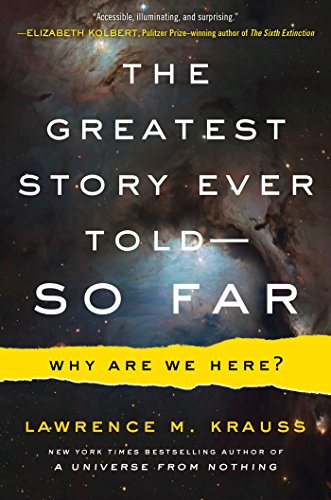
Internationally renowned, award-winning theoretical physicist, New York Times bestselling author of A Universe from Nothing, and passionate advocate for reason, Lawrence Krauss tells the dramatic story of the discovery of the hidden world of reality—a grand poetic vision of nature—and how we find our place within it.In the beginning there was light. But more than this, there was gravity. After that, all hell broke loose… In A Universe from Nothing, Krauss revealed how our entire universe could arise from nothing. Now, he reveals what that something—reality—is. And, reality is not what we think or sense—it’s weird, wild, and counterintuitive; it’s hidden beneath everyday experience; and its inner workings seem even stranger than the idea that something can come from nothing. In a landmark, unprecedented work of scientific history, Krauss leads us to the furthest reaches of space and time, to scales so small they are invisible to microscopes, to the birth and rebirth of light, and into the natural forces that govern our existence. His unique blend of rigorous research and engaging storytelling invites us into the lives and minds of the remarkable, creative scientists who have helped to unravel the unexpected fabric of reality—with reason rather than superstition and dogma. Krauss has himself been an active participant in this effort, and he knows many of them well. The Greatest Story challenges us to re-envision ourselves and our place within the universe, as it appears that “God” does play dice with the universe. In the incisive style of his scintillating essays for The New Yorker, Krauss celebrates the greatest intellectual adventure ever undertaken—to understand why we are here in a universe where fact is stranger than fiction.
User’s Reviews
Editorial Reviews: Review “Krauss beautifully explains how our refusal to believe that there are unknowable cosmic truths has rewarded humanity with brilliantly precise answers to puzzles previously obscured by the fog of dogmatic assurance… The scope of this book is truly impressive.” ― Science Magazine”The Greatest Story Ever Told—So Far ranges from Galileo to the LHC and beyond. It’s accessible, illuminating, and surprising—an ideal guide for anyone interested in understanding our accidental universe.” — Elizabeth Kolbert, Pulitzer Prize-winning author of The Sixth Extinction”As Bard of the Universe, physicist Lawrence Krauss may be uniquely qualified to give us the Greatest Story Ever Told — a masterful blend of history, modern physics, and cosmic perspective that empowers the reader to not only embrace our understanding of the universe, but also revel in what remains to be discovered.” — Neil deGrasse Tyson, American Museum of Natural History“College students, hippies, squares, christians, muslims, democrats, republicans, libertarians, theists, even atheists—all of us—sit around BS-ing like: ‘So, how did all this, I mean everything, all of us, the whole universe, you know, man, everything, how did this all get here?’ While we were doing that, Lawrence Krauss and people like him were doing the work to figure it out. Then Krauss wrote this great book about it. ‘Wow, man, you mean, like we’re getting closer to really knowing? I guess we’ll have to back to talking about politics and sex.’” — Penn Jillette, author of Presto!”In the span of a century, physics progressed from skepticism that atoms were real to equations so precise we can predict properties of subatomic particles to the tenth decimal place. Lawrence Krauss rightly places this achievement among the greatest of all stories, and his book—at once engaging, poetic and scholarly—tells the story with a scientist’s penetrating insight and a writer’s masterly craft.” — Brian Greene, author of The Elegant Universe, and Director, Center for Theoretical Physics, Columbia University”Unlike some very clever scientists, Lawrence Krauss is not content to bask on the Mount Olympus of modern physics. A great educator as well as a great physicist, he wants to pull others up the rarefied heights to join him. But unlike some science educators, he doesn’t dumb down. In Einstein’s words, he makes it ‘as simple as possible but no simpler.'” — Richard Dawkins, author of The Magic of Reality”A rich, definitely not-dumbed-down history of physics… An admirable complement to the author’s previous book and equally satisfying for those willing to read carefully.” ― Kirkus“This truly is the greatest story: how the universe arose, what it’s made of, how it works. Krauss is a warm and authoritative guide to what future generations will surely say is one of our species’ greatest accomplishments.” — Steven Pinker, Johnstone Professor of Psychology, Harvard University, and author of The Language Instinct and The Blank Slate”Discovering the bedrock nature of physical reality ranks as one of humanity’s greatest collective achievements. This book gives a fine account of the main ideas and how they emerged. Krauss is himself close to the field, and can offer insights into the personalities who have led the key advances. A practiced and skilled writer, he succeeds in making the physics ‘as simple as possible but no simpler.’ I don’t know a better book on this subject.” — Martin Rees, author of Just Six Numbers”I loved the fight scenes and the sex scenes were excellent.” — Eric Idle, comedian“In every debate I’ve done with theologians and religious believers their knock-out final argument always comes in the form of two questions: Why is there something rather than nothing? and Why are we here? The presumption is that if science provides no answers then there must be a God. But God or no, we still want answers. In A Universe From Nothing Lawrence Krauss, one of the biggest thinkers of our time, addressed the first question with verve, and in The Greatest Story Ever Told he tackles the second with elegance. Both volumes should be placed in hotel rooms across America, in the drawer next to the Gideon Bible.” — Michael Shermer, Publisher Skeptic magazine, columnist Scientific American, Presidential Fellow Chapman University, author The Moral Arc.”It is an exhilarating experience to be led through this fascinating story, from Galileo to the Standard Model and the Higgs boson and beyond, with lucid detail and insight, illuminating vividlynot only the achievements themselves but also the joy of creative thought and discovery, enriched with vignettes of the remarkable individuals who paved the way. It amply demonstrates that the discovery that ‘nature really follows the simple and elegant rules intuited by the 20th- and 21st-century versions of Plato’s philosophers’ is one of the most astonishing achievements of the human intellect.” — Noam Chomsky, Institute Professor & Professor of Linguistics (Emeritus), MIT”History of science with an edge — humorous, personal, passionate, yet intellectually serious and authoritative.” — Frank Wilczek, Nobel Laureate, Physics”A Homeric tale of science, history, and philosophy revealing how we learned so much about the universe and its tiniest parts.” — Sheldon Glashow, Nobel Laureate, 1979 in physics”Charming… Krauss has written an account with sweep and verve that shows the full development of our ideas about the makeup of the world around us… A great romp.” — Walter Gilbert, Nobel Award, Chemistry, 1980″In confident…prose, Krauss tells a story that both celebrates and explores science. Through it, he reminds readers why scientists build such complicated machinery and push the boundaries of the quantum world when nothing makes sense: “For no more practical reason than to celebrate and explore the beauty of nature.”” ― Publishers Weekly”Although no true believer, Krauss launches with ‘in the beginning there was light’ but adds that gravity deserves equal billing before proceeding with a rich, definitely not-dumbed-down history of physics… An admirable complement to the author’s previous book and equally satisfying for those willing to read carefully.” ― Kirkus Reviews”Reality is ‘weird, wild, and counterintuitive’ in this engaging scientific adventure from the author of A Universe from Nothing.” ― Goodreads”The story of reality—or at least as we understand it—this book is a testament to perseverance, a riveting account of dogged scientific effort to comprehend the fundamental forces of nature. Krauss (director, Origins Project, Arizona State Univ.; Fear of Physics) has a knack for making complex concepts accessible to lay readers who are willing to put in time and energy… A must-read for anyone who enjoyed Krauss’s previous titles, especially A Universe from Nothing, and those interested in delving into the history of science.” ― Library Journal (starred review)Praise for A Universe From Nothing “Lively and humorous as well as informative… As compelling as it is intriguing.” ― Publishers Weekly“[An] excellent guide to cutting-edge physics… Detailed but lucid, thorough but not stodgy… Insightful… Space and time can indeed come from nothing; nothing, as Krauss explains beautifully… A great book: readable, informative and topical.” — New Scientist”Krauss possesses a rare talent for making the hardest ideas in astrophysics accessible to the layman, due in part to his sly humor… Krauss is genuinely in awe of the “wondrously strange” nature of our physical world, and his enthusiasm is infectious.” — San Francisco Chronicle, Huffington Post, AP About the Author Lawrence Krauss, a renowned theoretical physicist, is the president of The Origins Project Foundation and host of the Origins Podcast. He is the author of more than 300 scientific publications and nine books—including the bestselling The Physics of Star Trek—and the recipient of numerous international awards for his research and writing. Hailed by Scientific American as a “rare scientific public intellectual,” he is also a regular columnist for newspapers and magazines and appears frequently on radio and television. Excerpt. © Reprinted by permission. All rights reserved. The Greatest Story Ever Told—So Far Chapter 1FROM THE ARMOIRE TO THE CAVE The simple inherit folly, but the prudent are crowned with knowledge. —PROVERBS 14:18 In my beginning there was light. Surely there was light at the beginning of time, but before we can get to the beginning of time, we will need to explore our own beginnings, which also means exploring the beginning of science. And that means returning to the ultimate motive for both science and religion: the longing for something else. Something beyond the universe of our experience. For many people, that longing translates into something that gives meaning and purpose to the universe and extends to a longing for some hidden place that is better than the world in which we live, where sins are forgiven, pain is absent, and death does not exist. Others, however, long for a hidden place of a very different sort, the physical world beyond our senses, the world that helps us understand how things behave the way they do, rather than why. This hidden world underlies what we experience, and the understanding of it gives us the power to change our lives, our environment, and our future. The contrast between these two worlds is reflected in two very different works of literature. The first, The Lion, the Witch and the Wardrobe, by C. S. Lewis, is a twentieth-century children’s fantasy with decidedly religious overtones. It captures a childhood experience most of us have had—looking under the bed or in the closet or in the attic for hidden treasure or evidence that there is more out there than what we normally experience. In the book, several schoolchildren discover a strange new world, Narnia, by climbing into a large wardrobe in the country house outside London where they have been sequestered for their protection during the Second World War. The children help save Narnia with the aid of a lion, who lets himself be humiliated and sacrificed, Christlike, at an altar in order to conquer evil in his world. While the religious allusion in Lewis’s story is clear, we can also interpret it in another way—as an allegory, not for the existence of God or the devil, but rather for the remarkable and potentially terrifying possibilities of the unknown, possibilities that lie just beyond the edge of our senses, just waiting for us to be brave enough to seek them out. Possibilities that, once revealed, may enrich our understanding of ourselves or, for some who feel a need, provide a sense of value and purpose. The portal to a hidden world inside the wardrobe is at once safe, with the familiar smell of oft-worn clothes, and mysterious. It implies the need to move beyond classical notions of space and time. For if nothing is revealed to an observer who is in front of or behind the wardrobe, and something is revealed only to someone inside, then the space experienced inside the wardrobe must be far larger than that seen from its outside. Such a concept is characteristic of a universe in which space and time can be dynamical, as in the General Theory of Relativity, where, for example, from outside the “event horizon” of a black hole—that radius inside of which there is no escape—a black hole might appear to comprise a small volume, but for an observer inside (who has not yet been crushed to smithereens by the gravitational forces present), the volume can look quite different. Indeed, it is possible, though beyond the domain where we can perform reliable calculations, that the space inside a black hole might provide a portal to another universe disconnected from our own. But the central point I want to return to is that the possibility of universes beyond our perception seems to be tied, in the literary and philosophical imagination, at least, to the possibility that space itself is not what it seems. The harbinger of this notion, the “ur” story if you will, was written twenty-three centuries before Lewis penned his fantasy. I refer to Plato’s Republic, and in particular to my favorite section, the Allegory of the Cave. But in spite of its early provenance, it illuminates more directly and more clearly both the potential necessity and the potential perils of searching for understanding beyond the reach of our immediate senses. In the allegory, Plato likens our experience of reality to that of a group of individuals who live their entire lives imprisoned inside a cave, forced to face a blank wall. Their only view of the real world is that wall, which is illuminated by a fire behind them, and on which they see shadows moving. The shadows come from objects located behind them that the light of the fire projects on the wall. I show the drawing below, which came from the high school text in which I first read this allegory, in a 1961 translation of Plato’s dialogues. The drawing is amusing because it clearly reflects as much about the time it was drawn as it does the configuration of the cave described in the dialogue. Why, for example, are the prisoners here all women, and scantily clad ones at that? In Plato’s day, any sexual allusion might easily have displayed young boys. Plato argues that the prisoners will view the shadows as reality and even give them names. This is not unreasonable, and it is, in one sense, as we shall soon see, a very modern view of what reality is, namely that which we can directly measure. My favorite definition of reality still is that given by the science fiction writer Philip K. Dick, who said, “Reality is that which, when you stop believing in it, doesn’t go away.” For the prisoners, the shadows are what they see. They are also likely to hear only the echoes of noises made behind them as the sounds bounce off the wall. Plato likened a philosopher to a prisoner who is freed from bondage and forced, almost against his will, to not only look at the fire, but to move past it, and out to the daylight beyond. First, the poor soul will be in distress, with the glare of the fire and the sunshine beyond the cave hurting his eyes. Objects will appear completely unfamiliar; they will not resemble their shadows. Plato argues that the new freeman may still imagine the shadows that he is used to as truer representations than the objects themselves that are casting the shadows. If the individual is reluctantly dragged out into the sunshine, ultimately all of these sensations of confusion and pain will be multiplied. But eventually, he will become accustomed to the real world, will see the stars and Moon and sky, and his soul and mind will be liberated of the illusions that had earlier governed his life. If the person returns to the cave, Plato argues, two things would happen. First, because his eyes would no longer be accustomed to the darkness, he would be less able to distinguish the shadows and recognize them, and his compatriots would view him as handicapped at best, and dim at worst. Second, he would no longer view the petty and myopic priorities of his former society, or the honors given to those who might best recognize the shadows and predict their future, as worthy of his respect. As Plato poetically put it, quoting from Homer: “Better to be the poor servant of a poor master, and to endure anything, rather than think as they do and live after their manner.” So much for those whose lives are lived entirely in illusion, which Plato suggests includes most of humanity. Then, the allegory states that the journey upward—into the light—is the ascent of the soul into the intellectual world. Clearly in Plato’s mind only a retreat to the purely “intellectual world,” a journey reserved for the few—aka philosophers—could replace illusion with reality. Happily, that journey is far more accessible today using the techniques of science, which combine reason and reflection with empirical inquiry. Nevertheless, the same challenge remains for scientists today: to see what is behind the shadows, to see that which, when you drop your preconceptions, doesn’t disappear. While Plato doesn’t explicitly mention it, not only would his fellow prisoners view the poor soul who had ventured out and returned as handicapped, but they would likely think he was crazy if he talked about the wonders that he had glimpsed: the Sun, the Moon, lakes, trees, and other people and their civilizations. This idea is strikingly modern. As the frontiers of science have moved further and further away from the world of the familiar and the world of common sense as inferred from our direct experience, our picture of the reality underlying our experience is getting increasingly difficult for us to comprehend or accept. Some find it more comforting to retreat to myth and superstition for guidance. But, we have every reason to expect that “common sense,” which first evolved to help us cope with predators in the savannas of Africa, might lead us astray when we attempt to think about nature on vastly different scales. We didn’t evolve to intuitively understand the world of the very small, the very big, or the very fast. We shouldn’t expect the rules we have come to rely on for our daily lives to be universal. While that myopia was useful from an evolutionary perspective, as thinking beings we can move beyond it. In this regard, I cannot resist quoting one last admonition in Plato’s allegory: “In the world of knowledge the idea of good appears last of all and is seen only with an effort; and, when seen, is also inferred to be the author of all things good and right, parent of light, and . . . the immediate source of reason and truth.” Plato further argues that this is what those who would act rationally should strive for, in both public and private life—seeking the “good” by focusing on reason and truth. He suggests that we can only do so by exploring the realities that underlie the world of our direct experience, rather than by exploring the illusions of a reality that we might want to exist. Only through rational examination of what is real, and not by faith alone, is rational action—or good—possible. Today, Plato’s vision of “pure thought” has been replaced by the scientific method, which, based on both reason and experiment, allows us to discover the underlying realities of the world. Rational action in public and private life now requires a basis in both reason and empirical investigation, and it often requires a departure from the solipsistic world of our direct experience. This principle is the source of most of my own public activism in opposition to government policies based on ideology rather than evidence, and it is also probably why I respond so negatively to the concept of the “sacred”—implying as it does some idea or admonition that is off-limits to public questioning, exploration, discussion, and sometimes ridicule. It is hard to state this view more strongly than I did in a New Yorker piece: “Whenever scientific claims are presented as unquestionable, they undermine science. Similarly, when religious actions or claims about sanctity can be made with impunity in our society, we undermine the basis of modern secular democracy. We owe it to ourselves and to our children not to give a free pass to governments—totalitarian, theocratic, or democratic—that endorse, encourage, enforce, or otherwise legitimize the suppression of open questioning in order to protect ideas that are considered ‘sacred.’ Five hundred years of science have liberated humanity from the shackles of enforced ignorance.” Philosophical reflections aside, the prime reason I am introducing Plato’s cave here is that it can provide a concrete example of the nature of the scientific discoveries at the heart of the story I want to tell. Imagine a shadow that our prisoners might see on the wall, displayed by an evil puppeteer located on a ledge in front of the fire: This shadow displays both length and directionality, two concepts that we, who are not confined to the cave, take for granted. However, as the prisoners watch, this shadow changes: Later it looks like this: And again later like this: And later still, like this: What would the prisoners infer from all of this? Presumably, that concepts such as length or direction have no absolute meaning. The objects in their world can change both length and directionality arbitrarily. In the reality of their direct experience, neither length nor directionality appears to have significance. What will the natural philosopher, who has escaped to the surface to explore the richer world beyond the shadows, discover? He will see that the shadow is first of all just a shadow: a two-dimensional image on the wall cast from a real, three-dimensional object located behind the prisoners. He will see that the object has a fixed length that never changes, and that it’s accompanied by an arrow that is always on the same side of the object. From a vantage point slightly above the object, he sees that the series of images results from the projection of a rotating weather vane onto the wall: When he returns to join his former colleagues, the philosopher-scientist can explain that an absolute quantity called length doesn’t change over time, and that directionality can be assigned unambiguously to certain objects as well. He will tell his friends that the real world is three-dimensional, not two-dimensional, and that once they understand, all of their confusion about the seemingly arbitrary changes will disappear. Would they believe him? It would be a tough sell because they won’t have an intuitive idea of what a rotation is (after all, with an intuition based purely on two-dimensional experience, it would likely be difficult to “picture” mentally any rotations in a third dimension). Blank stares? Probably. The loony bin? Maybe. However, he might win over the community by stressing attractive characteristics associated with his claim: behavior that on the surface appears to be complex and arbitrary can be shown to result from a much simpler underlying picture of nature, and seemingly disparate phenomena are actually connected and can be part of a unified whole. Better still, he could make predictions that his friends could test. First, he could argue that, if the apparent change in length of the shadows measured by the group is really due to a rotation in a third dimension, whenever the length of the object briefly vanishes, it will immediately reemerge with the arrow pointing in the opposite direction. Second, he could argue that as the length oscillates, the maximum length of the shadow when the arrow is pointing in one direction will always be exactly the same as the maximum length of the shadow when it is pointing in the other direction. Plato’s cave thus becomes an allegory for far more than he may have intended. Plato’s freed man discovers the hallmarks of the remarkable true story of our own struggle to understand nature on its most fundamental scales of space, time, and matter. We too have had to escape the shackles of our prior experience to uncover profound and beautiful simplifications and predictions that can be as terrifying as they are wonderful. But just as the light beyond Plato’s cave is painful to the eyes at first, with time it becomes mesmerizing. And once witnessed, there is no going back. Read more
Reviews from Amazon users which were colected at the time this book was published on the website:
⭐Experts in art, religion, and science sometimes complement one another, ofttimes misrepresent one another, and now and then flat out war with one another. For reading on a recent trip to the Middle East, I purchased The Greatest Story Ever Told –So Far: Why Are We Here?, a new book by Lawrence M. Krauss. According to jacket notes, this book follows up the author’s best-selling book A Universe from Nothing, which I have not read. I highly recommend Krauss’s Greatest Story as both enlightening and challenging reading for anyone interested in actual physics and irritated by unsound spiritual spins on quantum fields by the likes of Deepak Chopra, Fritjof Capra, J.Z. Knight, or Gary Zukav. Krauss mentions Chopra as his “Twitter combatant” on page 86: “(Chopra) in his various ramblings, somehow seems to think the universe wouldn’t exist if our consciousness weren’t here to measure and frame its properties.”Chopra, a physician with Western training, is also a product of an Indian pseudo-tradition since his early devotion to the Maharishi Mahesh Yogi who founded the Transcendental Meditation business. Yes, ancient sacred mantras were for sale in the 1960s through TM and still are. TM along with Scientology was one of the primary models for the burgeoning self-help spiritual enlightenment movements that employ a hefty pay scale for graduated courses masked as spirituality. At least the wealthy can get to heaven this way. Chopra’s spiritual services are not cheap, but you can always read his books to get a dose of his quantum consciousness preparations.Happily, Krauss did not dwell on Chopra’s inane (to me) tweets beyond the brief mention above, but I did find it curious that Krauss repurposed religious ideas to frame the story of physics and its great scientists. Complementing the obvious book title reference to Jesus from “The Greatest Story Ever Told” by Fulton Oursler (1949), Krauss introduced nearly every chapter with a quote from the Bible. For example, Chapter 15: “Living Inside a Superconductor” is introduced with Everyone lies to their neighbor: they flatter with their lips but harbor deception in their hearts. – Psalms 12:2. With scripture, Krauss cleverly indicates how quantum behavior can be deceptive and contrary like people but with properties we do not fully comprehend. “…the apparent differences [in gauge theory] are illusions that do not reflect the underlying physics that determines the measured values of all physically observable quantities.” (p. 205) To grasp what that means, you will have to read the book. I am not sure that the general reader will—it helps to have a solid familiarity with physics to properly appreciate this book, although much of the narrative is about the scientists and their lives, not just their ideas.On my flight home from Dubai, I took advantage of the movie selection and watched Finding Altamira, a 2016 film about amateur archeologist Marcelino Sanz de Sautuola who in 1879 was led by his eight-year-old daughter Maria to discover the now famous cave’s Paleolithic renderings of bison, hand silhouettes, and various creatures. Lauded as the Sistine Chapel of the cave man era, Altamira has fascinated artists, scientists, and religious scholars for more than a century. Picasso, who is quoted at the end of the film, stated:“After Altamira, all is decadence. We have discovered nothing.”I am not certain what Picasso meant by that beyond being his provocative self, but the artist may have a point. The Altamira paintings have a high level of sophistication for art created 35,000 years ago with primitive materials and on uneven surfaces. In other words, these are not extraordinary monkey scrawls—far from it—the average artist today would have difficulty matching that skill.The significance of the cave art is yet unclear. Were they merely a form of graffiti executed by a bored Neanderthal virtuoso during a long winter? Did they have magical, ceremonial, or religious functions? Was this a way of honoring or living with the souls of the animals killed and eaten? Or were they illustrations to teach anatomy to youngsters? We can analyze the aesthetics, comparing Altamira to other cave paintings of that era to get a clearer idea of early human capacity for perception. It appears that the art at Altamira was not a one-off act of genius but a shared talent by many people in that culture at several locations. If that is the case, then there must have been a kind of school or training, but where are the practice images? We do not know. As an artist, I can see the cave art as scientific studies of how animals behave as well as renderings that serve as shrines to their very being that sacrificed its life to sustain human life. Pondering that exchange is at the core of many primitive religious movements or cults and not making a god in our image.This brings me to the point of my commentary on Krauss’s book. Why is religion tied to physics in the book? Krauss throws a bone to religious people by cherry picking scriptures relevant to his narrative though taken out of context. In other words, it appears to me that he made little effort to respect the religious tradition. When he quotes Genesis 3:19 before his Epilogue, “Cosmic Humility,” (For dust thou art, and to dust shalt thou return), Krauss merely echoes the secular side of the Old Testament. Many practicing Jews were secularists. Consider the Sadducees who believed that this life is all there is with no hope of resurrection in a heaven. In that view, God, like the universe, interacts with His creation in enigmatic and often indefatigable ways. All I am pointing out here is that belief in the religions of the Bible is not of one kind, and it does not necessarily exclude a scientific perspective. But does aesthetics provide a key to resolve the dichotomy between science and religion?The day after I wrote this question, I was reading Robert Frost and came upon this quote from his talk “On Extravagance” from an address he gave at Dartmouth College in 1962:“And my extravagance would go on from there to say that people think that life is a result of certain atoms coming together, see, instead of being the cause that brings the atoms together.”Frost, who was baptized a Swedenborgian but remained anxious about belief in God, harkens back to Aristotle’s idea of a final cause. For example, the idea of building a boat brings a series of events together starting from a tree growing in the forest to an illustration on a sheet of paper and a way to mill logs from the tree to match the illustration. The finished boat fulfills the final cause that attracted it into being. Aristotle did not call this final cause God, but St. Thomas Aquinas did.Boats are human creations, but what about nature? Do natural phenomena emerge as if attracted to a final cause? Krauss tends to endorse the Darwinian model of chance events leading to zebras which have remained quite the same species for millennia. In other words, the Earthy muck that led to life and the emergence of species relied fundamentally on the inscrutable activities of subatomic particles and the forces that they are and that surround them. The rich flora and fauna on our precious planet are the result of this cosmic playground in the quantum world since the Big Bang. Intelligent Design and Creationist folks point to the apparently fixed and reliable aspects of complexities in nature as proof that something intelligent must be holding all this together—a lawgiver or a maker that controls order and chaos. The chances that two zebras mating will produce another zebra for the next thousand years or so is predictable, we think, whether we are careful scientists or Southern Baptists. One says that the probability is high; the other, that God wills it that way.The notion of a final cause is also a religious belief that an uber being we call God has all of creation through eternity somewhere in His head, then goes about designing the universe to fit His plan. Krauss mentions that Einstein said, God does not play dice with the universe, but he shows that Einstein’s theories contradicted this: “It is ironic that Einstein, who started the quantum revolution but never joined it, was also perhaps the first to use probabilistic arguments to describe the nature of matter—a strategy that the subsequent physicists who turned quantum mechanics into a full theory would place front and center. As a result, Einstein was one of the first physicists to demonstrate that God does play dice with the universe” (p. 81). No argument from me there.From my perspective, philosophers of science, scientists, and many theologians surmise that the cosmos operates under a complex interaction of probabilities. We have not been able to reduce reality to something tangible and testable, thus Krauss’s earlier book, A Universe from Nothing. Fundamentalism in science (reductionism) as in religion relies more on a pipe dream than on reality. However, the need to some certainty in science as in religion is necessary. Science has to trust that nature and natural forces are consistent enough to plan return trips to the moon. Religion has to trust revelation and moral codes enough to sustain social cohesion.Krauss’s title fascinates me in a way that he probably did not intend. The Christian religion, with some similarities to other major faith groups, relies on a core belief that the source (Father) of all that is sacrifices Himself to sustain all that is. In other words, God has to become nothing through eternity for anything material to exist and for life to go on. This is a principle among many mystics including Jakob Boehme who called it that nothing the Ungrund:”For out of nature is God a Mysterium, i.e. the Nothing; for from out of nature is the Nothing, which is an eye of eternity, a groundless eye, which stands nowhere nor sees, for it is the Ungrund and the selfsame eye is a will, i.e. a longing for manifestation, to discern the Nothing.”This mystery appears to be consistent with the thesis of The Greatest Story Ever Told—So Far: Why Are We Here? But the “nothing” that Krauss relies on is not a personal nothing. You might find the language I am using contradictory, but physicists have resorted to that same language when describing where quarks come from. Neutrons are particles that make up “most of the mass of our bodies” but they are “unstable, with a mean lifetime of about ten minutes” (p. 113). Krauss wrote, “This may surprise you too,” but he goes on to show the beauty of the resolution of this paradox by persistent physicists working toward a Grand Unified Theory and a Standard Model. The latter, Krauss tells us“…results in the remarkable good fortune of an expanding universe with stars and planets and life that can evolve a consciousness, is also a simple accident made possible because the Higgs field condensed in just the way it did as the universe evolved early on.”So, the why we are here answer in this book is not to honor and serve a deity. We are here because we are, as if by accident, no more significant than a world evolved in an ice crystal on a window pane (a metaphor offered by Krauss), a world that might easily disappear as a “Sun” (sic) rises. The contract of an atheist or purely scientific man with existence is to flourish as best he can because in the end he perishes: “If our future is similarly fleeting, we can at least enjoy the wild ride we have taken and relish every aspect of the greatest story ever told…so far.” (Krauss, p. 300)Krauss did a good job describing the God problem for scientists and he did a noble job to avoid the God-of-the-gaps that too many naïve believers use to claim there must be a God because science cannot explain something. An example occurs on page 296:“…the fact that current fundamental theory does not make a first-principles prediction that explains something as fundamental as the energy of empty space implies nothing mystical. As I have said, lack of understanding is not evidence for God. It is merely evidence of lack of understanding.”This brings me back to Altamira and the Paleolithic cave paintings of bison. Are they about art, science, or religion? Could they be about all three? Did primitive man grasp reality better than we do, as Picasso suggested? Was the cave artist contemplating his existence by illustrating his food and clothing sources that kept him alive and warm?Krauss wrote, “Faced with the mystery of our existence, we have two choices.1. “We can assume that we have special significance and that the universe was made for us. For many, this is the most comfortable choice made by early human tribes, who anthropomorphized nature because it provided them some hope of understanding what otherwise seemed to be a hostile world often centered on suffering and death. It is the choice made by almost all the world’s religions…”2. “The second choice when addressing these transcendental mysteries is to make no assumption in advance about the answer…In this story we evolve in a universe whose laws exist independently of our own being. In this story we check the details to see if they might be wrong. In this story we are going to be surprised at every turn.” (302-303)Okay, we could overlook the false dichotomy of two choices, but should not. These are false because these are poorly framed choices and because there are more than two. I want to know what Krauss meant by “almost all the world’s religions.” I could give a reasonable argument that non-fundamentalist Christianity does not anthropomorphize God any more than science does. The finer interpretations of a deity in Christianity, Buddhism, Islam, Judaism, and Hinduism avoid humanizing God to maintain the mystery of the infinite, the ineffable, and the unknowable—the “nothing” mentioned above entertained by Boehme’s mysticism and the No-Self of Zen Buddhism. Jews typically and reverently will not speak the name YHWH respecting that we not only have no words but we cannot properly grasp intellectually what we mean by that concept. Hindu tradition has taken to calling the deity Tat Tvam Asi or thou art that. At the most refined understanding, the gods or God as personality disappears in Advaita, one of the largest and most enduring Hindu traditions. I hope you get the idea. Choice one is way too simple.As to the second choice, I want to know how science avoids anthropomorphizing nature. I mean, we do not experience and test nature from the skill set of a bee or a virus. I am not merely being cute here or relativistic. Bees construct amazing homes using specific engineering skills and have the science to support those skills. Bees analyze in bee ways how the universe works and apply their skills to survive. Bees have a culture in which they communicate through dance-like movements to indicate where the blooms are for nectar. Bees do this whether we observe them or not. Viruses seem to have a bizarre life of their own. They can kill and they might initiate newer, more complex life forms. We may be in a universe that evolves independently of Deepak Chopra and Lawrence Krauss, a universe that could care less than a wit about either of them, but that has no bearing on complex creatures like Deepak and Lawrence caring in their own ways about the universe. How they care may be wrong-headed or spot on, but the question Krauss does not answer is why do we care at all?The obvious fact is that the universe has created creatures that care—a fact of reality, just as real as electrons with negative spin or the lately confirmed Higgs Boson. The greatest story ever told as Jesus teaches us to care because something he called “the Father” cared about him and us enough to empty Himself totally to sustain life as we know it. Jesus interpreted this insight as a mandate if he was to be the Christ anointed by God to be the sacrificial lamb.After reading Krauss’s version of the greatest story, I do not see the suggested dichotomy or two choices. Krauss inadvertently reinforced in spades exactly what I see in the New Testament, albeit heretically. For some reason, neutrons care to decay and arise every ten minutes to keep us alive for a life time. If neutrons did not “care” or carry on the way they do, we would not be here. His book reminded me that we humans are cultivated at least metaphorically if not in fact by the subatomic worlds. Krauss insists that we grew out of subatomic particles and their interactions. Cult means to care for. Human beings might be one of the many cults attended to by the subatomic worlds. Why? Well, because they care to, or so it seems to me. Creating conscious life while caring for it at the expense of self-annihilation is a beautiful thing, even for a neutron. We all cry when the hero appears to sacrifice his life to save the heroine. We all cheer when the hero miraculously comes back to life.
⭐The Greatest Story Ever Told – So Far: Why Are We Here? by Lawrence M. Krauss“The Greatest Story Ever Told – So Far” tells the story of our hidden world. Award-winning theoretical physicist and iconic defender of reason, Lawrence M. Krauss takes the reader on a five hundred year journey of progressive scientific understanding of our reality. This interesting 337-page book includes twenty-three chapters broken out by the following three parts: 1. Genesis, 2. Exodus, and 3. Revelation.Positives:1. A well-written, well-researched book.2. A fascinating topic in the masterful hands of Lawrence M. Krauss, revealing our hidden reality. “We cannot understand that hidden world with intuitions based solely on direct sensation.”3. Makes use of a clever analogy between the once “greatest story ever told” the Bible, to what truly is the greatest story, the one told by science. The book is broken out into three parts: Genesis, Exodus, and Revelation. Each chapter begins with a chapter-appropriate Bible verse.4. Good use of diagrams to complement the narrative.5. Dr. Krauss may be a great scientist but he also has flair with words. “Surely that is the greatest contribution of science to civilization: to ensure that the greatest books are not those of the past, but of the future.”6. So is there a plan or purpose to the world we find ourselves in? Find out.7. The value of the scientific method. “Today, Plato’s vision of “pure thought” has been replaced by the scientific method, which, based on both reason and experiment, allows us to discover the underlying realities of the world.”8. This is also a book of the greatest scientists that ever lived. “I don’t believe in hero worship, but if I did, Faraday would be up there with the best. Perhaps more than any other scientist of the nineteenth century, he is responsible for the technology that powers our current civilization.”9. The contributions of Maxwell. “After Maxwell, electricity and magnetism were no longer viewed as separate forces of nature. They were different manifestations of one and the same force.”10. The great Albert Einstein. “Thus, on the surface, Einstein’s Special Theory of Relativity appears to make physical reality subjective and observer dependent, but relativity is in this sense a misnomer. The Theory of Relativity is instead a theory of absolutes. Space and time measurements may be subjective, but “space-time” measurements are universal and absolute. The speed of light is universal and absolute.”11. An interesting look at light. “In fact, light also behaves like both a particle and a wave, depending on the circumstances under which you choose to measure it.”12. The Heisenberg uncertainty principle. “The Heisenberg uncertainty principle epitomizes in many ways the complete demise of our classical worldview of nature. Independent of any technology we might someday develop, nature puts an absolute limit on our ability to know, with any degree of certainty, both the momentum and position of any particle.”13. An interesting look at quantum electrodynamics. “The theory in which these virtual particles are incorporated, along with the electromagnetic interactions of electrons and positrons, called quantum electrodynamics, is the best scientific theory we have so far. Predictions based on the theory have been compared with observations, and they agree to more than ten decimal places. In no other area of science can this level of accuracy be obtained in the comparison between observation and prediction, based on the direct applications of fundamental principles on the most basic scales we can describe.”14. Provocative facts of science. “The entire stability of the nuclei that make up everything we see, including most of the atoms in our body, is an accidental consequence of the fact that the neutron and proton differ in mass by only 0.1 percent, so that a small shift in the mass of the former, when embedded in nuclei, means it can no longer decay into the latter.”15. The basis of atomic physics. “In 1925, Wolfgang Pauli proposed the “exclusion principle,” which disclosed that two electrons could not occupy exactly the same quantum state at the same time and place, and which laid the basis of all of atomic physics.”16. Particle physics. “Over the 1950s, Gell-Mann would produce many of the most important and lasting ideas in particle physics from that time. He was one of two physicists to propose that protons and neutrons were made of more fundamental particles, which he called quarks.”17. Superconductors. “In other words, Anderson’s nonrelativistic argument in superconductors did carry over to relativistic quantum fields. The universe could behave like a superconductor after all.”18. Throughout the book, Dr. Krauss namedrops Nobel Prize winners and their discoveries. “But a mere year later, in October 1979, Sheldon Glashow, Abdus Salam, and Steven Weinberg were awarded the Nobel Prize for their electroweak theory, now validated by experiment, that unified two of the four forces of nature based on a single fundamental symmetry, gauge invariance.”19. The importance of gauge symmetry. “And at the heart of all of the forces governing the dynamical behavior of everything we can observe is a beautiful mathematical framework called gauge symmetry. All of the known forces, strong, weak, electromagnetic, and even gravity, possess this mathematical property, and for the three former examples, it is precisely this property that ensures that the theories make mathematical sense and that nasty quantum infinities disappear from all calculations of quantities that can be compared to experiment.”20. Discusses key characteristics of the CERN machine.21. The Standard Model discussed.Negatives:1. No formal notes or bibliography!2. The layperson will have difficulty following this book. There is no kind way to put it, topics like particle physics even at its most basic are very hard to follow.3. A step down from the masterpiece that was “A Universe From Nothing”.In summary, this is a very good though more scientifically demanding book. Even at its most basic, the layperson will struggle to follow the scientific progression that Dr. Krauss lays out. Readers with science aptitude will obtain more enjoyment from reading this excellent book than your average person. It’s not the masterpiece that “A Universe From Nothing” was but it’s a solid sequel worth reading. I recommend it!Further recommendations: “A Universe From Nothing” by Lawrence M. Krauss, “Farewell to Reality: How Modern Physics Has Betrayed the Search for Scientific Truth” by Jim Baggott, “Spectrums” by David Blatner, “The Elegant Universe” and “Hidden Reality” by Brian Greene, “About Time” by Adam Frank, “Higgs Discovery” and “Warped Passages” by Lisa Randall, “The Grand Design” by Stephen Hawking, “The Quantum Universe” by Brian Cox, “The Blind Spot” by William Byers, and “The Fallacy of Fine-Tuning” by Victor Stenger.
⭐The author clearly knows his physics, but either he or his publisher (I suspect the latter) are unfamiliar with the Trade Descriptions Act! This book does NOT address the issue promised in the title, but instead summarizes the various breakthroughs in theoretical physics, quantum mechanics and related fields over the past 100 years or so and in a dry, dense and impenetrable fashion. It was almost enough to kill off my interest in physics and cosmology so be warned. Instead read ‘Parallel Worlds’ by Michio Kaku and ‘Seven Brief Lessons On Physics’ by Carlo Rovelli or anything by Richard P. Feynman and give this a miss – even if you see dozens of cheap copies in your local charity shop.
⭐A brilliant book overall. I found some of the topics, gauge theory for example, left me feeling very ignorant for not comprehending them. I say this having an honours degree in physics.
⭐Ram Dass ( Richard Alpert) was asked by Bernard Levin a long time ago, “you seem to be suggesting that we are (in life) just going around in circles, surely that negates the whole point of us!” He replied…… “Ah Bernard, it is the going around in circles that has the point to it!”At the cosmic and the atomic / sub atomic scale the universe beggars belief; what an incredible stroke of fortune to live, somehow, to be part of not understanding it.My awareness of my ignorance is my enlightenment!
⭐Stunning. Slow burn, so stick with it, but it unfolds magnificently and takes you on a journey that really will widen your horizons and blow your mind. The universe is VAST and we are minor molecular ciphers making our way to who knows where? The book airs some interesting questions and posits some lucid answers, predicated on experimental evidence and historical progress. In many ways, it reads as a personal polemic, filled with interesting anecdotes and peopled with physicists who should have been household names who never got their due, or who did much later in life. Yes, there’s some heavy science in there, but it is a wonderful story, beautifully told.
⭐Not being a particle physicist, I struggled at times to follow some of. the detail set out so precisely. However in the end it was well worth the effort because although not fully understanding everything, the whole made sense . I certainly have a much better grip of quantum theory than I had before which wasn’t great so for that I am really glad I read this book. The writing is brilliant and the humour is really good. Thoroughly recommended. Keith Cowley
Keywords
Free Download The Greatest Story Ever Told–So Far: Why Are We Here? in PDF format
The Greatest Story Ever Told–So Far: Why Are We Here? PDF Free Download
Download The Greatest Story Ever Told–So Far: Why Are We Here? 2017 PDF Free
The Greatest Story Ever Told–So Far: Why Are We Here? 2017 PDF Free Download
Download The Greatest Story Ever Told–So Far: Why Are We Here? PDF
Free Download Ebook The Greatest Story Ever Told–So Far: Why Are We Here?