Ebook Info
- Published: 2009
- Number of pages: 370 pages
- Format: PDF
- File Size: 5.14 MB
- Authors: Alexander Waugh
Description
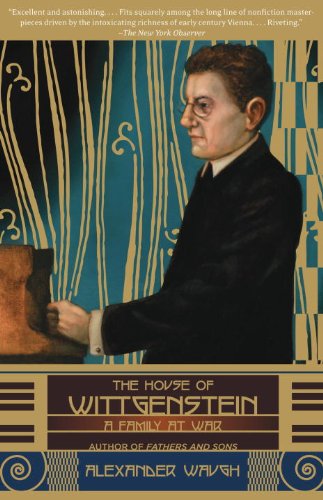
The House of Wittgenstein is the grand saga of a brilliant and tragic Viennese family whose members included a famous philosopher and the world’s greatest one-handed classical pianist.The Wittgenstein family was one of the wealthiest, most talented, and most eccentric in European history, held together by a fanatical love of music yet torn apart by money, madness, conflicts of loyalty, and the upheaval of two world wars. Of the eight children, three committed suicide; Paul lost an arm in the war and yet stubbornly pursued a musical career; and Ludwig, the odd youngest son, is now regarded as one of the greatest philosophers of the twentieth century. Alexander Waugh, author of the acclaimed memoir Fathers and Sons and himself the offspring of a famous and eccentric family, tells their baroque tale with a novelistic richness to rival Thomas Mann’s Buddenbrooks.
User’s Reviews
Reviews from Amazon users which were colected at the time this book was published on the website:
⭐This book examines the Wittgenstein family, a fabulously rich Austrian dynasty, through three generations. The elder Wittgenstein, Karl, cornered the steel market in the Austro-Hungarian empire in the latter part of the 19th century and became one of the richest men in the world.The family was headquartered in a lavish Vienna palace and often hosted personalities like Brahms and Mahler for musical evenings. One of the daughters, Gretl, was painted by Gustav Klimt. They were scions of artistic life in the Austrian capital even though three of the four grandparents were Jews who converted to Christianity. Later, this was to be the cause of great trouble when the occupying Nazis classified them as Jews.Of Karl’s eight children, three committed suicide and two achieved fame: Ludwig has been hailed as one of the most important philosophers of the 20th century while Paul, who lost an arm fighting in World War I, became a well-known left-handed virtuoso who commissioned works from Richard Strauss, Prokofiev, Benjamin Britten, Hindemith and most notably the great left-handed concerto of Maurice Ravel.This breezily-written book goes into great detail about the strained relations between various family members but is overbalanced in favor of Paul, who emerges clearly as the book’s hero.Paul behaved with great courage when captured by the Russians in World War I. He underwent awful suffering in squalid prison camps. The cruelty with which the Russians treated their prisoners of war should not I suppose have come as any surprise, but I was not previously aware of it.The main shortcoming of the book is the relatively cursory treatment it affords to Ludwig, who was certainly the family member with the best lasting claim to fame. I think I learned more from the Wikipedia pages on Ludwig ([…]) than from this book. The author makes little attempt to grapple with the meaning of his philosophy or analyze his lasting influence. He basically suggests that Wittgenstein was hailed as a genuis because his work was so incomprehensible. I had the impression that for this author, the emperor had no clothes. But there must have been more to it than that.Instead, we get pages and pages about Paul, whose limited historical importance today rests on the piano music he commissioned. Paul quarreled with most of the composers he patronized, always insisting on a more prominent piano part and less orchestra. He never played the Prokofiev concerto and drove Ravel crazy by insisting on changes.The vast Wittgenstein fortune was lost through a combination of poor investments, the stock market crash of 1929 and the Nazis who fought tooth and nail to get their hands on what was left. The chapter on the Wittgensteins’ frantic efforts to have themselves declassified as Jews or escape from Austria makes harrowing reading. With all their money and influence, they succeeded. Others were not so fortunate.In the end, I wondered what this book added up to. It was interesting but most of the characters were so mediocre, petty and pathetic that I eventually tired of them.
⭐Karl Wittgenstein left his many children a fortune practically unparalleled among the commoners of the Austro-Hunagrian empire through his enormous diversified wealthy holdings; he also left them his love of classical music (Mahler, Strauss, and Schoenberg all played in his salon), and unfortunately his incredibly fastidious temperament that brought them each much misery and made it difficult for them to stand one another (or other people). Alexander Waugh’s THE HOUSE OF WITTGENSTEIN is a biography of his children, three of whom committed suicide (all for very different reasons and in mysterious circumstances), and two of whom left indelible marks on the twentieth century: the one-armed pianist Paul, one of the foremost classical artists of his era, and his youngest brother Ludwig, the great philosopher. Given that Alexander Waugh (himself from a famously talented, and famously unhappy, family) is a classical music critic, the primary focus of this story is Paul, a man perhaps not of the highest talents but who used his family fortune to commission piano pieces for the left hand from Korngold, Britten, and Ravel that ensured him fame and greatly enriched the piano repertoire; but the biography also focuses a great deal on Paul, and on two of their sisters, Gretl and Hermine, who were important figures within the family.Waugh really is exciting when he tells us about the news of the family’s love of music and Paul’s career as both a pianist and as a patron of great composers; unfortunately, he is less exciting when it comes to describing Ludwig’s philosophy, which he clearly does not understand and views mostly as mere chicanery. And though portraits of both Hermine and Gretl emerge from the biography, most of their other siblings remain mysteries. So too do the Wittgensteins’ parents, Karl and Leopoldine–though Waugh tells us much about how Karl left home very early, we learn little about how he became one of the greatest industrialists the Austro-Hungarian Empire had ever seen. Taking the long view of the entire family rather than just focusing on Paul necessitated that Waugh should have learned more than he did, and that he also should have written a bigger book. But the underlying story of how the Wittgensteins lost their fortune, through their own muddled generosity, through the devastation of the Austrian economy after WWII, and through the Reichsbank draining them dry to get out of Austria after the Anschluss, is a compelling story.
⭐This book is a journalistic account of Vienna’s famous Wittgenstein family over three generations, focused primarily on the generation of philosopher Ludwig Wittgenstein and his eight siblings. While I learned a lot about this wealthy, accomplished, dysfunctional family, overall it was a rather superficial, not particularly satisfying read.The Wittgensteins certainly had some extraordinary characters, most notably: industrialist Karl Wittgenstein, “the Austrian Andrew Carnegie” who dominated the Habsburg empire’s iron, steel and railroad industries to become one of the richest men in Europe; sometimes-philosopher Ludwig; and one-armed concert pianist Paul. Frustratingly, Waugh makes little effort to explain how Karl arose from nowhere to become the empire’s premier tycoon, and even less of an attempt to explain Ludwig’s extraordinary impact on 20th century philosophy. Rather, he prefers to focus on the often dysfunctional sibling rivalries within the family, Paul’s extraordinary efforts to remain a concert pianist despite the loss of his right arm in the First World War, and the travails of the family after the Anschluss.
⭐This book is interesting in that it depicts the two sides of great wealth in the course of each family member’s life.The negotiations with the Nazi government is interesting. That each member of the family escaped the lawless and brutal physical tactics of the Nazi is amazing.
⭐I knew that Ravel Piano Concerto for Left hand was written for pianist Paul Wittgenstein but no other detail about his life. This is a tough read, as any illusions one might harbour about the birthpangs and provenance of newly commissioned music are shattered by the bile and bickering between performer and composer, (not so much Labours of Love as the Locking of Horns.) These issues aside, the entire Wittgenstein family saga is a difficult twentieth century story spanning two world wars, with the inevitable anguish of those who were discovered to be secretly harboring a Jewish heritge in 1930’s Vienna.
⭐A niggle first: I know there are difficulties in writing a multiple biography which is the history of a very large family; but even so, there seems to be no rhyme or reason in the way the early chapters are arranged. They dart back and forth from one member of the family to another in a perversely unchronological manner.That said, this is a vivid account, rich in incident and anecdote, of a most unhappy family: the self-made millionaire Karl was a frightening father, his wife an intimidated and cold mother; two or perhaps three of their five sons committed suicide and a fourth, Ludwig, frequently toyed with the idea of doing likewise. Only Paul, as will be seen, had a tough fighting quality under the most unpromising circumstances. Of the four daughters, one died in infancy; Hermine remained unhappily unmarried; the formidable Gretl, was unhappily married to a man who later also committed suicide; and Helene, though apparently “the most relaxed and settled of her siblings”, “suffered from tensions of a pathological and neurotic kind”. The siblings constantly got badly on each other’s nerves, all pretty intolerant and highly critical of, though concerned for, each other. The only warm bond in the family was their playing music together; and even then the father disapproved of Paul becoming a professional pianist.But only a year after Paul’s debut the war broke out; he enlisted in the Austrian army, and within a month he had lost his right arm on the Russian front and became a prisoner of war. The Danish consul in Omsk got him moved from the hospital there to a hotel in which there was a piano; and Paul, fiercely determined to resume his career as a pianist, immediately started practising and transcribing piano pieces for the left hand only. Indeed, in 1916, thirteen months after he had reached home as the result of an exchange of wounded prisoners, he gave his first performance in a public concert. He then insisted on rejoining the army, and the end of the war saw the three surviving brothers on the Italian front, where Paul was invalided out (probably with Spanish flu), Kurt shot himself, and Ludwig was taken prisoner.It was from prison that Ludwig via the Red Cross sent to Bertrand Russell the manuscript of the Tractatus, the philosophical treatise which, in due course, was to make him by far the most famous of the Wittgenstein brothers. His career and eccentricities are rather sketchily described here. Waugh, in contrast to the attention he pays to Paul’s achievements in music, makes no attempt to explain those of Ludwig, altogether devoting to him a fraction of the space he devotes to Paul. Although Ludwig’s career is amply chronicled elsewhere (notably in Ray Monk’s biography – see my review), some readers will find Waugh’s treatment of Ludwig distinctly cavalier.That Ravel composed a concerto especially for Paul (and a fraught birth it was) is well-known; less well known that there were several other composers (including Hindemith, Prokofiev, Britten and others who were famous in their time though less well-known today) who did the same; and Paul performed to great acclaim and under the most distinguished conductors all over the world, from Los Angeles to Moscow. In his personal behaviour he was as wildly eccentric and as liable to lose his temper as was Ludwig.In 1938 the Nazis took over Austria. Three of the siblings’ grandparents, though converts to Catholicism, were Jewish-born; according to the Nazi racial laws, that made the whole family, with its antisemitic prejudices, `full Jews’. Paul, who was an ardent and right-wing Austrian patriot, vainly claimed that he was `only’ a half-Jew (who were at that time spared the full rigours of the treatment accorded to `full Jews’) on the grounds that his Wittgenstein grandfather, born in 1802, was reputed to be the illegitimate offspring of a German princeling. When the Nazis discovered that he had a non-Jewish mistress who has born him two children, he was liable to additional penalties for miscegenation. The saga of Paul’s subsequent escape to America via Switzerland, of the Nazi discovery of the attempt by his elderly sisters Hermine and Helene to escape with forged passports (Gretl had become an American citizen), and of the fraught negotiations with the Germans but also within the family – not to allow them to emigrate, but to have them classified as `half-Jews’ – in exchange for huge sums of money, is told in heart-stopping detail. Everything depended on the agreement of Paul (and, for that matter, of Hitler personally). Paul eventually gave in to family pressure, and Hermine and Helene lived unmolested in Vienna all through the war. Paul never spoke to Gretl or Ludwig again, nor did he visit the dying Hermine or Helene when he was in Vienna in 1949 to play in a concert.
⭐There is a great deal of new material in this, from my point of view. It is very interesting and illuminating and based on extensive research and remarkable, even personal, knowledge of members of this extensive family.There is not very much about Ludwig, the chief interest for me; but a great deal about Paul, the left handed pianist, because the author’s background is music.But even with Ludwig there are useful things. On p104 we have the explanation of Ludwig’s giving away to his sublings (3 of them) all his wealth, inherited from his father. The connexion between ‘The Tractatus’ and Tolstoy’s ‘Gospel in Brief’ is very clear: Ludwig was simply obeying the Christian principle.The two homosexual experiences with Francis Skinner seem to settle the issue often debated: the shame of these prevented any recurrence in this paragon of moral purity, his struggle for perfection. The information given by WWBartley about meetings in the Prater with homosexual men is still not justified in any way.The actions of the Nazis in trying to get the family money are very well explained. 125 kilogramme bars of gold in a Swiss bank were handed over so that the sisters could continue to live in Vienna as non jews. Otherwise, they would have been sent to the concentration camp. There is almost no mention of Ludwig’s part in this, which other recent writings have given.The author is a journalist and, for the most part, the writing is very accessible. There is, perhaps, too much detail that is tedious about Paul.
⭐I enjoyed this book, partly because I’ve read a lot about and am interested in Ludwig Wittgenstein (the philosopher), but because the family drama was of a very rich group of people centered initially in Vienna who encountered WW1, post-WW1 hyperinflation, the 1929 crash and the devastation wrought by fascism and WW2. Of course it’s critical that the family was judged to be Jewish following the 1938 Anschluss (union of Austria and Germany).I agree with another reviewer who found the story hard to follow in the early chapters, e.g., because there were lots of relatives, … but as the narrative settled down and focused on Paul and Gretl, and particularly on the 1930’s as WW2 approached, the story became fascinating. Paul is the leading figure in the story, and he (one handed after a WW1 injury) built a career as a pianist, philanthropist and music sponsor.The coverage of Ludwig Wittgenstein is limited. One would hardly guess that he was putatively one of the leading philosophers of the twentieth century, and the comments made seem to support the idea of his active homosexuality and the force of his temper (eg problems when school-teaching). I had not realised that Ludwig was so influenced by Tolstoys thought about the Gospel.
⭐As someone who loves the social aspect of history – this book very enjoyable. As with most paperbacks these days paper quality could be better – but for the price can’t complain. Packaging and delivery all good. Only complaint is Amazon’s tendency to suddenly announce (by email) at 7am they are changing delivery date and that its the same day. Has caught me out several times. We don’t all live with iphones/ blackberrys next to the pillow!!!
Keywords
Free Download The House of Wittgenstein: A Family at War in PDF format
The House of Wittgenstein: A Family at War PDF Free Download
Download The House of Wittgenstein: A Family at War 2009 PDF Free
The House of Wittgenstein: A Family at War 2009 PDF Free Download
Download The House of Wittgenstein: A Family at War PDF
Free Download Ebook The House of Wittgenstein: A Family at War