

Ebook Info
- Published: 2008
- Number of pages: 544 pages
- Format: PDF
- File Size: 16.53 MB
- Authors: Jonathan Rose
Description
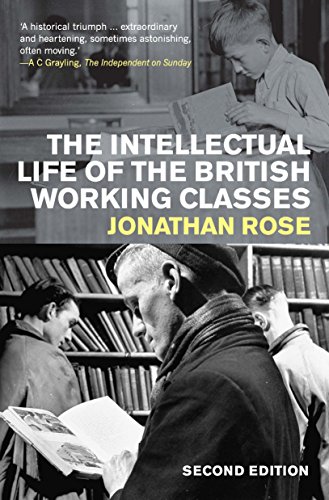
Which books did the British working classes read–and how did they read them? How did they respond to canonical authors, penny dreadfuls, classical music, school stories, Shakespeare, Marx, Hollywood movies, imperialist propaganda, the Bible, the BBC, the Bloomsbury Group? What was the quality of their classroom education? How did they educate themselves? What was their level of cultural literacy: how much did they know about politics, science, history, philosophy, poetry, and sexuality? Who were the proletarian intellectuals, and why did they pursue the life of the mind?These intriguing questions, which until recently historians considered unanswerable, are addressed in this book. Using innovative research techniques and a vast range of unexpected sources, The Intellectual Life of the British Working Classes tracks the rise and decline of the British autodidact from the pre-industrial era to the twentieth century. It offers a new method for cultural historians–an “audience history” that recovers the responses of readers, students, theatergoers, filmgoers, and radio listeners. Jonathan Rose provides an intellectual history of people who were not expected to think for themselves, told from their perspective. He draws on workers’ memoirs, oral history, social surveys, opinion polls, school records, library registers, and newspapers. Through its novel and challenging approach to literary history, the book gains access to politics, ideology, popular culture, and social relationships across two centuries of British working-class experience.
User’s Reviews
Reviews from Amazon users which were colected at the time this book was published on the website:
⭐this book came quickly and in perfect condition. I couldn’t be happier with the service and the product. Good price as well.
⭐I didn’t know about this book, but Noam Chomsky recommended it in a video on the internet, so I ordered it. I was amassed that the book arrived in perfect shape in less than 2 weeks, instead of the estimated time of 2-3 months.I am only beginning to read this book as I have only had it for two days now. So far I have read through Chapter 3.
⭐Recommended by Noam Chomsky, great read, but be prepared: it’s not easy!
⭐The spread of literacy to the masses is arguably the most far reaching cultural change of the last two centuries. One of the first countries where this took place was Great Britain. Jonathan Rose’s The Intellectual Life of the British Working Classes uses much autobiographical material to tell us how the workers experienced their quest into written knowledge, roughly from 1760 to 1960. It is a historians’ history, packed with information and references. It transforms our understanding of a driving force behind intellectual history.The urge to read literature did not come from the invisible hand of the market, from the pressure of government or even from education, but from the urge of working people themselves to understand where they stood in the world, and, most importantly, to become an individual. It started as an autodidact movement.Initially, individual workers, often wretchedly poor, had to make do with religious tracts, old newspapers and second hand books. First they had to develop an understanding of literary conventions, like the distinction between a factual and a fictional account. From about the middle of the nineteenth century mutual help became the norm. In clubs and production sites workers discussed often amazingly sophisticated literature, even when they also read what we now would call pulp fiction.The Education Act of 1870 was followed by universal compulsory education. In historiography schools often have been put down, but many children liked their heated and clean school buildings, a far cry from conditions at home. As teaching materials were out of date, being an autodidact continued to make sense. The highpoint of autodidact culture and the mutual help societies was in the years leading up to the first world war. It encompassed about 25% of the working population. The classics came in its reach in series of cheap editions. The working classes seemed to be catching up.In retrospect all though this period there was a 20 year gap between the latest developments in literature and what the workers got into their hands.In that light, the way in which Rose treats Bloomsbury is surprising. Coming to the fore after the First World War, Bloomsbury’s writing could not be grasped by working people who were used to Victorian modes of expression. Rose has little good to say about the Bloomsbury group and his nemesis Virginia Woolf. Bloomsbury, while professing to be Bohemian, looked down upon the workers, and, even more revealing, was dead set against the shallow intellectual and literary life in the new suburbs to which socially climbing workers went. However, autobiographies and interviews show that intellectual life there was not dull, and that people read a lot. Even those who entered office life could find there a great deal of discussions. Thus, by the 1930’s- 1940s, there were two rival intelligentsia, the middle class, modernist and elitist; and the working class more classical in outlook, and politically leaning towards labour.Domestically, cultural conservatism could go together with political radicalism. Marxism did not catch on in the UK. Working people often saw Marxists as condescending and engaged in irrelevant discussions. It did not fit in with the Practical Christianity that was the norm. International developments did not mean much to them, either. Schools transmitted only hazy notions about the world outside Britain, and even about the Empire.After World War II, especially in the 1960s Bohemian culture bounced back, and got a mass following, also among the working classes. Even though they might like movies, radio and TV more, all of these people were literate.Instead of stopping at this change of medium, Rose moves on to make political statements about the present. He has no good words for university intellectuals who spread the idea that `all subcultures are equally valuable’. He has a point with sociology, a branch of academia which with its jargon has painted itself into a corner. But he misses the point with his equally loathed Bohemian mass culture of the 1960s and later. The last fifty years Bohemia offers people expression of what goes on in their lives, a burning need in a vastly expanding world. Here literature has been overtaken, even though it is by no means dead.Rose’s book poses shows popular demand and action as the engines of the intellectual life of the workig classes of Britain. A like demand and action, but of course under different circumstances, can be witnessed in the countries of the south. Rose gives us much to read and much to ponder. The spread of intellectual life among the working classes is by no means over.
⭐I wish I had read this book years ago when I first noted down the title. I would have understood so much more where my dad (a Grammar School scholarship boy born 1924) was coming from. Its given me lots of really valuable perspectives and facts on all kinds of things. One of those rare books that has completely altered my perspective on life and history. Highly recommended.
⭐I can’t add much more to the praise that other reviewers have rightly bestowed on this book. It is both a hugely important piece of work and a brilliantly executed one. The key to this is Rose’s methodology. At all times, whenever possible, he goes to the voices of working class readers for his central data. This gives him the authority to legitimately and roundly debunk a whole swathe of ‘top-down’ theories about working class intellectual life. Only occasionally does this lead him into potential error, such as his benign view – based on a somewhat unrepresentative autodidact sample – of the impact of modern popular and consumer culture on working class life. There’s also one chapter, on the WEA, where he gets slightly carried away with his use of quotations.However, make no mistake, this is an enormously accomplished piece of work. Rose writes well, too. Theorising is stronger at the end than during the main narrative but Rose is regularly challenging received wisdom throughout the book. The more narrow-minded communists and Marxists won’t like it but one hopes that those with some insight might learn from it. For most readers, though, it will simply be a deep well of nourishing historical knowledge of the intellectual ambitions of our forebears and the struggles that they engaged in to wrest learning from the hands of the high and mighty and spread it amongst their own kind. If Rose hasn’t won an award for this book then someone should create one especially. There are few social science books these days that one can describe as being of genuine significance. This is one. It is hard to imagine it being bettered and it will certainly be the first port of call for anyone interested in this subject.
⭐The spread of literacy to the masses is arguably the most far reaching cultural change of the last two centuries. One of the first countries where this took place was Great Britain. Jonathan Rose’s The Intellectual Life of the British Working Classes uses much autobiographical material to tell us how the workers experienced their quest into written knowledge, roughly from 1760 to 1960. It is a historians’ history, packed with information and references. It transforms our understanding of a driving force behind intellectual history.The urge to read literature did not come from the invisible hand of the market, from the pressure of government or even from education, but from the urge of working people themselves to understand where they stood in the world, and, most importantly, to become an individual. It started as an autodidact movement.Initially, individual workers, often wretchedly poor, had to make do with religious tracts, old newspapers and second hand books. First they had to develop an understanding of literary conventions, like the distinction between a factual and a fictional account. From about the middle of the nineteenth century mutual help became the norm. In clubs and production sites workers discussed often amazingly sophisticated literature, even when they also read what we now would call pulp fiction.The Education Act of 1870 was followed by universal compulsory education. In historiography schools often have been put down, but many children liked their heated and clean school buildings, a far cry from conditions at home. As teaching materials were out of date, being an autodidact continued to make sense. The highpoint of autodidact culture and the mutual help societies was in the years leading up to the first world war. It encompassed about 25% of the working population. The classics came in its reach in series of cheap editions. The working classes seemed to be catching up.In retrospect all though this period there was a 20 year gap between the latest developments in literature and what the workers got into their hands.In that light, the way in which Rose treats Bloomsbury is surprising. Coming to the fore after the First World War, Bloomsbury’s writing could not be grasped by working people who were used to Victorian modes of expression. Rose has little good to say about the Bloomsbury group and his nemesis Virginia Woolf. Bloomsbury, while professing to be Bohemian, looked down upon the workers, and, even more revealing, was dead set against the shallow intellectual and literary life in the new suburbs to which socially climbing workers went. However, autobiographies and interviews show that intellectual life there was not dull, and that people read a lot. Even those who entered office life could find there a great deal of discussions. Thus, by the 1930’s- 1940s, there were two rival intelligentsia, the middle class, modernist and elitist; and the working class more classical in outlook, and politically leaning towards labour.Domestically, cultural conservatism could go together with political radicalism. Marxism did not catch on in the UK. Working people often saw Marxists as condescending and engaged in irrelevant discussions. It did not fit in with the Practical Christianity that was the norm. International developments did not mean much to them, either. Schools transmitted only hazy notions about the world outside Britain, and even about the Empire.After World War II, especially in the 1960s Bohemian culture bounced back, and got a mass following, also among the working classes. Even though they might like movies, radio and TV more, all of these people were literate.Instead of stopping at this change of medium, Rose moves on to make political statements about the present. He has no good words for university intellectuals who spread the idea that `all subcultures are equally valuable’. He has a point with sociology, a branch of academia that with its jargon has painted itself into a corner. But he misses the point with his equally loathed Bohemian mass culture of the 1960s and later. The last fifty years Bohemia offers people expression of what goes on in their lives, a burning need in a vastly expanding world. Here literature has been overtaken, even though it is by no means dead.Rose’s book shows popular demand and action as the engines of intellectual life of the working classes of Britain. A like demand and action, but of course under different circumstances, can be witnessed in the countries of the south. Rose gives us much to read and much to ponder. The spread of intellectual life among the working classes is by no means over.
⭐Educational and rather too densely packed for my taste. Not a light read but great for a dedicated reader.
⭐Wonderful!
Keywords
Free Download The Intellectual Life of the British Working Classes in PDF format
The Intellectual Life of the British Working Classes PDF Free Download
Download The Intellectual Life of the British Working Classes 2008 PDF Free
The Intellectual Life of the British Working Classes 2008 PDF Free Download
Download The Intellectual Life of the British Working Classes PDF
Free Download Ebook The Intellectual Life of the British Working Classes