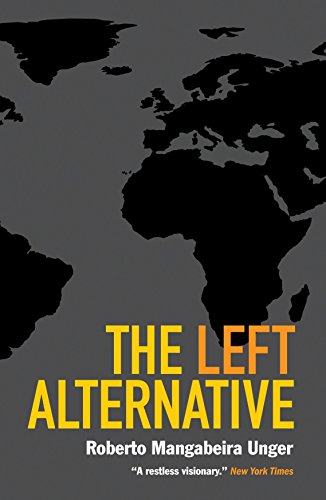
Ebook Info
- Published: 2009
- Number of pages: 197 pages
- Format: PDF
- File Size: 3.53 MB
- Authors: Roberto Mangabeira Unger
Description
Confronting the major debates in the world today—about national alternatives and alternative globalizations—Unger shows that there is a set of initiatives that we can begin to develop with the materials at hand. Fully updated with a new preface, The Left Alternative equips the Left with the ideas that it needs to overthrow the dictatorship of no alternatives.
User’s Reviews
Editorial Reviews: Review “A good book to stir up leftists.”—Tyler Cowen, Bloomberg Business Week“Roberto Mangabeira Unger’s book may someday make possible a new national romance … a hitherto undreamt-of national future.”—Richard Rorty“A restless visionary.”—New York Times“A philosophical mind out of the Third World turning tables, to become a synoptist and seer of the First.”—Perry Anderson“Brazil’s answer to John Stuart Mill … a political philosopher extraordinaire.”—Chronicle of Higher Education“This book has influenced how I think and what I do. It sets out the principles for a future Left and crucially challenges us to think not just about how we spend revenues but how we might create them.”—Neal Lawson, Chair of Compass About the Author Roberto Mangabeira Unger is one of the leading social and political thinkers in the world today. He is also active in Brazilian politics. Verso has published much of his work: False Necessity: Antinecessitarian Social Theory in the Service of Radical Democracy, What Should Legal Analysis Become?, Democracy Realized: The Progressive Alternative, Politics, and The Left Alternative.
Reviews from Amazon users which were colected at the time this book was published on the website:
⭐I only recently came across Roberto Unger – thanks to a BBC Radio 4 Analysis documentary entitled ‘Vulgar Keynsianism’ (3rd March 2013). It appears that he is having quite an impact on thinkers of the ‘left of centre’ which, of course, includes the Labour Party.The book was first published in 2005, but this edition has been updated and revised; in part to take account of the current crisis of global capitalism. The original hope was to present left alternatives in the face of an all-conquering neoliberalism without the need for one of these regular crises. However, since 2008, the left seems determined to let this crisis go to waste, so to speak, and so Unger’s ideas take on rather more urgency as neoliberalism seems still to hold sway, as
⭐, amongst many others, has pointed out.Unger suggests that, in Europe, the Left:’…has retreated to the last ditch defence of a high level of social entitlements giving up one by one many of its most distinctive traits, both good and bad. The ideologists of this retreat have tried to disguise it as a synthesis between European-style social protection and American-style economic flexibility.’ (P172)The growing split between high- and low- or no-skill jobs has resulted in the Left relying on compensatory measures to soften the economic polarisation of society. And as we have seen, this ‘compensatory culture’, for want of a better term, is increasingly under severe attack, even as the gap between rich and poor continues to widen. We have what Unger refers to as ‘the dictatorship of no alternatives’ (P1), or, as Thatcher put it ‘There Is No Alternative’.Unger does not want to ‘humanize society’. This, he suggests, is what ‘compensatory measures’ have tried and increasingly failed to do, simply trying to lessen the egregious extremes of capitalism. Unger’s aim is:’…less to humanize society than it is to divinize humanity: to bring us to ourselves by making ourselves more godlike.” (P 153)The aim is, then, to develop the individual, to diminish ‘the contrast between the intensity of our longings and the paltriness in which we waste our lives’ (P 153), and to remove the sense of alienation and disempowerment felt by the vast majority of people.Unger is a Christian and clearly draws much inspiration from his beliefs. While extremely critical of consumer capitalism, he is also rejects Marx and Marxism, on one page dismissing them as historicist, on another as shallowly structuralist and deterministic. This is, in my opinion, a pretty superficial view as even a quick read of, for example,
⭐would show.So – what does Unger see as ‘the way forward’? Well, for a start, his desire to ‘divinize the individual’ inevitably leads to an emphasis on education. But more than that, Unger wants to: ‘…anchor social inclusion and individual empowerment in the institutions of political, economic and social life.’ (P 20)He wants to put in place mechanisms to allow a huge variety of experimentation to take place. He cannot predict which particular forms will be the most liberating and empowering for the individual, but he recognises that the individual is nothing outside of ‘political, economic and social life’ and thus for individuals to be able to develop to their fullest and most ‘divine’ extent, many alternatives must be given fertile soil in which to grow, develop and evolve. This is far more than simply regulating the existing capitalism, this is about trying to provide a multiplicity of opportunities where before there only appeared to be the dreaded T.I.N.A.:’It means to radicalise the experimental logic of the market by radicalising the economic logic of free recombination of the factors of production within an unchallenged framework of market transactions. The goal is a deeper freedom to renew and recombine the arrangements that compose the institutional setting of production and exchange, allowing alternative regimes of property and contract to coexist experimentally within the same economy.’ (P 21)He goes on to consider this aim with reference to class (‘…the working class, the small business class, and even the rank and file of the class of professionals…are safeguarded from destitution and excluded from power.’ P 45), developing countries, Europe, America, the so-called BRICS and globalization. But at core, Unger’s aim is always, as already stated, the ‘divization of the individual’.It sounds inspirational, it sounds idealistic and when faced with a ‘lost Left’, it sounds hopeful. But it does not sound realistic. As Zizek points out:’…the politics advocated by many a leftist today, that of countering the devastating world-dissolving effect of capitalist modernization by inventing new fictions, imagining “new worlds” (like the Porto Alegre slogan “Another world is possible!”), is inadequate or, at least, profoundly ambiguous; it all depends on how these fictions relate to the underlying Real of capitalism – do they just supplement it with the imaginary multitude, as the postmodern “local narratives” do, or do they disturb its functioning?’ (
⭐- Zizek, P 33).I do not believe that Unger’s ideas will truly ‘disturb its functioning’. Capitalism has shown again and again its ability to co-opt, absorb and re-interpret oppositional elements, to even turn a profit from them. Like
⭐, Unger seems to look towards a religious impulse to transform economic relations. But, as Cyndi Lauper once pointed out, ‘
⭐.
⭐This book is quite disappointing on a number of levels. Carefully sifted, it reveals a few good ideas although none of them are particularly original. Beyond a lot of rhetoric about ‘energy’ and ‘innovation’ it’s hard to find much substance here or to see what, if anything, is particularly ‘Left’ or ‘alternative’ in the ideas under consideration. Criticisms of modern social-democracy as conservative and left behind by events are valid to a large extent, yet nonsensical arguments that we are all now ‘middle-class’, a horribly mutable, non-specific and questionable category in itself (moreover,this gentleman is Brazilian, mind!), and vague, half-baked assumptions about the nature of modern capitalism mute the force of the critique. Indeed it is true that, in order to regain relevance, socialists and social-democrats have to find a way to extend the, historically national, struggles for social-justice that achieved so much between 1945 and the late 1970’s and adopt pro-active, democratic approaches to global governance, which are becoming increasingly urgent, not just for the Left, but for the meaningful survival of democracy as a whole. Little of what Mangabeira-Unger offers however carries much more than rhetorical weight with regard to practical, programmatic steps on how to proceed. The Left is the Left because it actually stands for something and that ‘something’, crudely reduced, is bridging the gap between ‘what is and what ought to be’. It’s not easy and not many politicians on the Left seem totally up for the job it’s true, but this book seems a rather poor overall contribution to the debate. Indeed, it seems more than a little infected by the neo-liberalism the ‘conservative’ Left is struggling to resist. For certain, it is not sufficient to merely resist an illness without seeking a cure but it makes even less sense to sneer at the resistance and embrace the disease, however much you seek to cause its mutation in the process.
⭐This is a good magazine article disguised as a book by stating each argument and insight 4 times over.Too bad it keeps saying the same thing over and over, because this tends to encourage brain death by the 50th page.The ideas buried within are pretty simple and not completely unworthy of consideration — the so-called Left, if there still is one, should spend its energies expanding small and varied ways of experimenting in the marketplace, should encourage more democratic participation and activity, should develope a caring economy to parallel the market economy, and so on.Perhaps someone will have the energy to take this from the repeated abstractions of this dreamy thinker, and concretize with some real specifics.
⭐I only recently came across Roberto Unger – thanks to a BBC Radio 4 Analysis documentary entitled ‘Vulgar Keynsianism’ (3rd March 2013). It appears that he is having quite an impact on thinkers of the ‘left of centre’ which, of course, includes the Labour Party.The book was first published in 2005, but this edition has been updated and revised; in part to take account of the current crisis of global capitalism. The original hope was to present left alternatives in the face of an all-conquering neoliberalism without the need for one of these regular crises. However, since 2008, the left seems determined to let this crisis go to waste, so to speak, and so Unger’s ideas take on rather more urgency as neoliberalism seems still to hold sway, as
⭐Colin Crouch
⭐, amongst many others, has pointed out.Unger suggests that, in Europe, the Left:’…has retreated to the last ditch defence of a high level of social entitlements giving up one by one many of its most distinctive traits, both good and bad. The ideologists of this retreat have tried to disguise it as a synthesis between European-style social protection and American-style economic flexibility.’ (P172)The growing split between high- and low- or no-skill jobs has resulted in the Left relying on compensatory measures to soften the economic polarisation of society. And as we have seen, this ‘compensatory culture’, for want of a better term, is increasingly under severe attack, even as the gap between rich and poor continues to widen. We have what Unger refers to as ‘the dictatorship of no alternatives’ (P1), or, as Thatcher put it ‘There Is No Alternative’.Unger does not want to ‘humanize society’. This, he suggests, is what ‘compensatory measures’ have tried and increasingly failed to do, simply trying to lessen the egregious extremes of capitalism. Unger’s aim is:’…less to humanize society than it is to divinize humanity: to bring us to ourselves by making ourselves more godlike.” (P 153)The aim is, then, to develop the individual, to diminish ‘the contrast between the intensity of our longings and the paltriness in which we waste our lives’ (P 153), and to remove the sense of alienation and disempowerment felt by the vast majority of people.Unger is a Christian and clearly draws much inspiration from his beliefs. While extremely critical of consumer capitalism, he also rejects Marx and Marxism, on one page dismissing them as historicist, on another as shallowly structuralist and deterministic. This is, in my opinion, a pretty superficial view as even a quick read of, for example,
⭐David Harvey
⭐would show.So – what does Unger see as ‘the way forward’? Well, for a start, his desire to ‘divinize the individual’ inevitably leads to an emphasis on education. But more than that, Unger wants to: ‘…anchor social inclusion and individual empowerment in the institutions of political, economic and social life.’ (P 20)He wants to put in place mechanisms to allow a huge variety of experimentation to take place. He cannot predict which particular forms will be the most liberating and empowering for the individual, but he recognises that the individual is nothing outside of ‘political, economic and social life’ and thus for individuals to be able to develop to their fullest and most ‘divine’ extent, many alternatives must be given fertile soil in which to grow, develop and evolve. This is far more than simply regulating the existing capitalism, this is about trying to provide a multiplicity of opportunities where before there only appeared to be the dreaded T.I.N.A.:’It means to radicalise the experimental logic of the market by radicalising the economic logic of free recombination of the factors of production within an unchallenged framework of market transactions. The goal is a deeper freedom to renew and recombine the arrangements that compose the institutional setting of production and exchange, allowing alternative regimes of property and contract to coexist experimentally within the same economy.’ (P 21)He goes on to consider this aim with reference to class (‘…the working class, the small business class, and even the rank and file of the class of professionals…are safeguarded from destitution and excluded from power.’ P 45), developing countries, Europe, America, the so-called BRICS and globalization. But at core, Unger’s aim is always, as already stated, the ‘divinization of the individual’.It sounds inspirational, it sounds idealistic and when faced with a ‘lost Left’, it sounds hopeful. But it does not sound realistic. As Zizek points out:’…the politics advocated by many a leftist today, that of countering the devastating world-dissolving effect of capitalist modernization by inventing new fictions, imagining “new worlds” (like the Porto Alegre slogan “Another world is possible!”), is inadequate or, at least, profoundly ambiguous; it all depends on how these fictions relate to the underlying Real of capitalism – do they just supplement it with the imaginary multitude, as the postmodern “local narratives” do, or do they disturb its functioning?’ (
⭐In Defense of Lost Causes
⭐- Zizek, P 33).I do not believe that Unger’s ideas will truly ‘disturb its functioning’. Capitalism has shown again and again its ability to co-opt, absorb and re-interpret oppositional elements, to even turn a profit from them. Like
⭐Skidelsky père et fils
⭐, Unger seems to look towards a religious impulse to transform economic relations. But, as Cyndi Lauper once pointed out, ‘
⭐Money Changes Everything
⭐.
Keywords
Free Download The Left Alternative in PDF format
The Left Alternative PDF Free Download
Download The Left Alternative 2009 PDF Free
The Left Alternative 2009 PDF Free Download
Download The Left Alternative PDF
Free Download Ebook The Left Alternative