Ebook Info
- Published: 2009
- Number of pages: 315 pages
- Format: PDF
- File Size: 1.72 MB
- Authors: Philip Jenkins
Description
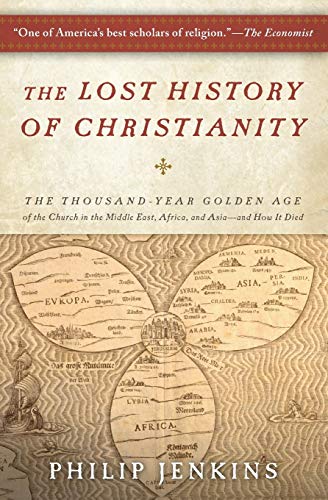
“Jenkins is one of America’s top religious scholars.” —Forbes magazineThe Lost History of Christianity by Philip Jenkins offers a revolutionary view of the history of the Christian church. Subtitled “The Thousand-Year Golden Age of the Church in the Middle East, Africa, and Asia—and How It Died,” it explores the extinction of the earliest, most influential Christian churches of China, India, and the Middle East, which held the closest historical links to Jesus and were the dominant expression of Christianity throughout its first millennium. The remarkable true story of the demise of the institution that shaped both Asia and Christianity as we know them today, The Lost History of Christianity is a controversial and important work of religious scholarship that sounds a warning that must be heeded.
User’s Reviews
Editorial Reviews: Review “Jenkins is one of America’s top religious scholars.” — Forbes“. . . persuasively and cogently argued . . . marvelously accessible for the lay reader and replete with fascinating details to help personalize the ambitious sweep of global history Jenkins undertakes. This is an important counterweight to previous histories that have focused almost exclusively on Christianity in the West.” — Publishers Weekly, starred review“In leaner, clearer prose than ever before, Jenkins outlines and analyzes this history, which few present-day Christians have even heard of. This may be the most eye-opening history book of the year.” — Booklist“Philip Jenkins’ book is a tour de force in historical retrieval and reconstruction, a work of scholarly restoration that strikes an overdue balance in the story of Christianity. It is studded with insight, with the story presented in a lively and lucid style.” — Lamin Sanneh, Professor of World Christianity and Professor of History, Yale University“Philip Jenkins always writes well on very interesting topics. This time his topic is more than interesting-it is essential reading for anyone with any interest in the history of Christianity.” — Rodney Stark, author of The Rise of Christianity“…an exceptionally fine study of a great swathe of Christian history, hugely important in the Christian story but very little known. This thoughtful, elegant and learned survey will remedy the neglect of a subject which students of religion absolutely need to know about.” — Diarmaid MacCulloch, Professor of the History of the Church, University of Oxford and author of The Reformation“In this highly readable and sobering exploration of how religions – including our own – grow, falter and sometimes die, Jenkins adds a unique dimension to present day religious studies in a voice and style that non-specialists can also appreciate.” — Harvey Cox, Hollis Professor of Divinity, Harvard University“[Jenkins’] depiction of the long Christian history of Asia, Mesopotamia, and the greater Middle East is both a much-needed education and a spiritually fruitful provocation.” — Books & Culture“The Lost History of Christianity is a fascinating study of the first thousand-plus years of the Church–a Church rooted in the Middle East, Africa, and Asia. We have much to learn from the tale of its reach, its particular way of being Christian, and its eventual decomposition ” — Beliefnet.com (One of the Best Religious Books of 2008)“Using his skill to discredit murky thinking and propose new understandings where the old no longer serve a good purpose, Jenkins offers yet another jewel in what is becoming a crown of paradigm-shattering studies. [This book] will amply reward your investment of time and attention.” — America“Philip Jenkins’s marvelous new book…tells the largely forgotten story of Nisibis, and thousands of sites like it, which stretch from Morocco to Kenya to India to China, and which were, deep into the second millennium, the heart of the church.” — The Weekly Standard“Jenkins’s well-crafted new volume…is not only a welcome addition to the literature on Christianity as a truly global religion, to which he has already made substantial contributions, but also an invitation to retrieve a forgotten chapter of history that has not inconsiderable relevance to current events.” — Religion & Ethics Newsweekly From the Back Cover The Untold Story of the Church’s First Thousand YearsIn this groundbreaking book, renowned religion scholar Philip Jenkins offers a lost history, revealing that for centuries Christianity’s center existed to the east of the Roman Empire. About the Author Philip Jenkins, the author of The Lost History of Christianity, Jesus Wars, and The Next Christendom, is a Distinguished Professor of History at Baylor University’s Institute for Studies of Religion. He has published articles and op-ed pieces in The Wall Street Journal, The New Republic, The Atlantic Monthly, and The Washington Post and has been a guest on top national radio shows across the country. Read more
Reviews from Amazon users which were colected at the time this book was published on the website:
⭐The Middle East is a blind spot for most Americans. With the exception of the crusades and 20th century events surrounding the Arab-Israeli conflict, most Americans and Europeans know little of the region’s history. Few today are aware of the Middle East’s diverse, pre-Islamic culture or the religious, political and ethnic environment that birthed a Christian heresy called Islam, a heresy that became a movement with a worldview and dogma that eventually dominated the region. Yes, the Middle East had a pre-Islamic history and for a thousand years after the death and resurrection of Christ, that history was largely Christian. Jenkins has provided a real service to the church in tracking the growth, dominance and eventual decline of the Asian church, including forgotten sects and sub-groups like the Jacobites, Nestorians, Arians and Syriacs. Eastern missions to places like China and Central Asia are narrated here. And the strengths of surviving sects such as the Copts of Egypt are studied alongside neighboring churches such as the one in Tunisia that simply disappeared during the advent of Islam. Finally, Jenkins also shows how Islam was able to co-opt Christianity in it’s once glorious strongholds through a mixture of cunning intimidation and outright brutality, as fit the times. The Lost History of Christianity is of interest to students of religion (Christian and Muslim), Middle Eastern and Church history, and Christian ministry. It would also help students of prophecy better grasp the issues captured by John in the Revelation — a Bible book that was written to and for the Middle Eastern Church. This is by far the most interesting, informative and enjoyable history book I’ve read all year. Highly, highly recommended.
⭐The Lost History of Christianity covers an area of Christian History that is sorely lacking attention. Jenkins reminds us that the so called “dark ages” were actually a time of flourishing and progress in the Eastern church. He also lines up arguments against modern criticism that Christianity is simply a white Eurocentric religion, by recognizing the roots and influence the Eastern Church had up till 1500. I was struck by the seeming evidence that we have romanticized that the Church is built on the blood of the martyrs. While this may be true in some or even many forms of Christianity, it is also evident that there are places where Christianity was crushed, burned, and persecuted almost entirely out of existence.The overall tone is generally charitable, recognizing that while there is nothing inherent in Islam to cause it to be more brutal or persecutory, than Christianity or Judaism, there have certainly been mass exterminations in the name of Allah, perhaps the most brutal during the Armenian Genocide in the early 1900’s. Jenkins, however, is an equal opportunist and shows where the Catholic Church was at times less tolerant, and more prejudice towards the Eastern Church than the Islamic movement was.My greatest critique would be Jenkins seeming distaste for Catholic Orthodoxy. He takes random potshots, and at times goes to great lengths to show how problematic Catholic rule was. He seems to revel in the idea that groups left the church early on and still flourished, and also enjoys pointing out how the Eastern Church preferred Islamic rule over Catholic subjection. (After starting this review I did some research and found out that Jenkins is a former Catholic who has converted to Anglicanism. Perhaps this is part of the issue.) Within this critique I was moderately frustrated with his treatment of general orthodoxy which he shrugs off as European and Catholic. The councils, while perhaps imperfect, must be seen with at least some sense of authoritative Spirit involvement, if not we lose a large portion of what most if not all would call orthodoxy. (He does agree that the Nestorians were not as far removed from Christianity as the gnostic heresy, which I appreciated).My second critique is the pace. At times Jenkins seems to bog down into every possible (and at times un-needed) detail, then at others times he will gloss over from so high it’s difficult to see the major themes.All things considered “The Lost History” pays attention to a part of Christianity that is rarely considered. It looks charitably at the major players involved, and it pieces together a backstory that helps frame much of the turmoil we are still seeing in the Middle East.
⭐Undoubtedly, well versed theologists/historians are more than familiar with the threads of ancient Christian and Islamic history that Philip Jenkins draws together in THE LOST HISTORY OF CHRISTIANITY, in which he weaves a thoroughly riveting and not infrequently ironic story. Stating early on that “much of what we today call the Islamic world was once Christian,” he tells the tale of the Syriates of Edessa ca. the second century, the ancient metropolitan of Merv, the Jacobites and Nestorians and bishop Timothy the catholicos of Seleucia and those who spread Christianity as far as China, only for it to be eradicated between 1000 and 1400. Jenkins makes a great case that much of what was considered Islamic science and math actually originated elsewhere (e.g. India). Yes, Islam was tolerant early on, until influenced by the Mongols and Turks. But despite the conviction of many scholars that European crusades were at the root of mid-east hatred, he lays much of the blame to Christian alliances with the Mongols, for the sake of Christian survival. When Mongol rulers switched to being devout Islamists, the Christians were caught flat-footed. Overpopulation, then abrupt climate change in the middle ages, plus the plague, led to scapegoating of minorities on all sides, and it was downhill from there.Meanwhile, western Europeans knew little or nothing of this “other Christianity,” and proceeded to develop their own quite slowly.Jenkins also has an interesting take on Lebanon, as originally a Christian refuge in the region, as well as Christian influence in modern Palestine, which he sees as an opportunity wasted. He sees the US-USSR rivalry of the ’70s and ’80s as instrumental in our backing the wrong horse (Saudi Arabia). Given current events, this 2008 text seems remarkably prescient.For the well educated, I doubt there is anything startlingly new in this book except the way in which it is organized and put together. New to me, however, is much of what was going on in early Christianity, east of the Mediterranean, prior to Constantine and Chalcedon.There are some 35 pages of notes (bibliography and footnotes combined).
⭐This is very competent coverage of the history of Christianity in the East: scholarly, but easy to read, full of detail, but the larger canvas is never lost.It’s also spiky, in that the author has opinions and gives them. He has many telling points. Here are three examples. The idea the church after Constantine suppressed controversial gospels is nonsense when one considers that the Eastern Church, with no obligation to Rome, likewise refused to give credibility to these alternative gospels. He contrasts the disappearance of the church in North Africa with the survival of the Coptic Church in Egypt and gives this sensible assessment: ‘Egyptian Christianity became native; its African counterpart was colonial’. And in terms of which Christians survived and which perished the answer often came down to geography, the higher up a mountain you lived, the better your chances of survival.Competent and spiky – but sometimes irritating. The most irritating was the constant referencing to the unproven assumption that most Christians were unaware of the history of the Eastern churches. Indeed that irritant is in the title, which is wrong. It’s not a ‘Lost History’, it’s been there for anyone who has wanted to find out. Given that most of the author’s readers will have some interest in church history the assumption is unlikely. Many Christians are aware that there was a great church in the East. However, even if the assumption contains some truth, we the reader s have bought the book to be told the story – not to be reminded that there are people who don’t know the story. The section at the end was brave, but it was over ambitious. The author knocked the idea that the suffering of the church in the East was God’s punishment (though that is a biblical idea), but was unable to really follow this up except to say we need a ‘theology of extinction’. That really means a way of understanding suffering. That is over ambitious, best left for the theologians.And Islam. Full marks to the author for not treating Islam as some great organised force; full marks for underlining the political and ethnic aspects of how Muslims treated Christians; and full marks for levelling an appropriate amount of blame at the feet of Muslims for what happened to the Christians. This was spiky.But there was an irritating aspect to the author’s approach to Islam. First there was the general statement that there is nothing in the Muslim teachings that would make Muslims more violent than other religions. That is tosh. The teaching of the founder of Islam on violence, both in practice and action, is very different to that of the founder of Christianity. So, human nature being what it is, it is fair to say that there is less restraint in Islam than in Christianity. And then there was this attempt at the end of the book to try and see Islam as a part of God’s divine plan. As with the author’s attempt to give some theology to the fate of the Eastern churches, this was also over ambitious, and so irritating.The author has done a fine job making the history of the Eastern churches more accessible. A suggestion if the book is revised: a more thorough look at the impact of modern Christian mission on the Muslim world. The usual story has been converts from Christianity to Islam, but the script is changing in our generation and deserves the attention of scholars such as Professor Jenkins.
⭐This book is well researched and highly readable.It tells the tragic story of Christianity in the East that was destroyed by the jihadis of Timur e Lang.The book starts off with the little known facts of Jewish and Christian Yemen — how Jewish Kings ruled over large parts of the land and how there were wars between these Jewish kings and with the Christian kingdom of Axum (present-day Ethiopia).A very poignant part of the book is when the Catholicos of Ctesiphon (the “Pope” of the Ancient Assyrian Church of the East) in the 8th century is thinking — these are thoughts put in by the author but ring true — in the 8th century the Assyrian Church of the East (which now is a pitiful number, massacred by the Islamic state in Iraq) was 1/3rd of Christianity and stretched from Iraq to India (the Syrian Christians in Kerala) to China and to Mongolia (the Naiman tribe to which Genghis Khan married later was Christian as were the Uighurs).the Catholicos looks at Europe which was then under seige by Saracens in the south, pagan Vikings in the north and pagan Magyars and Slavic groups in the East and it definitely did seem that Christianity would die out there — after all the Church of the East had its liturgical language in the language of Christ – Aramaic and was the heartland of Christendom.From this high point, it goes down like a Greek tragedy — massacres by Moslems, whether Arabs or Turkic peoples and persecutions, persecutions. The fact that any Assyrian Christians survive is a miracle.
⭐Whenever I hear a Christian or Muslim fundamentalist talking about their religion and its origins I am tempted to upset them by showing them this history. Until well after the Mongol invasions and conquests of the East, Christianity was thriving in the Middle East, India and the across the Russian steppes into China. In fact it has left its imprint on Islam in almost every aspect. This History should be taught in every school in the western world as it is hugely important for understanding our own society as well.It is a very readable book, and the wealth of cultural, theological and historical insights and formation it contains is invaluable. I highly commend it!
⭐An amazing and initiated piece of scholarship, and a fascinating (and sobering) reminder of the tumultuous history of the various Christian churches in West Asia.
⭐Good book
Keywords
Free Download The Lost History of Christianity: The Thousand-Year Golden Age of the Church in the Middle East, Africa, and Asia–and How It Died in PDF format
The Lost History of Christianity: The Thousand-Year Golden Age of the Church in the Middle East, Africa, and Asia–and How It Died PDF Free Download
Download The Lost History of Christianity: The Thousand-Year Golden Age of the Church in the Middle East, Africa, and Asia–and How It Died 2009 PDF Free
The Lost History of Christianity: The Thousand-Year Golden Age of the Church in the Middle East, Africa, and Asia–and How It Died 2009 PDF Free Download
Download The Lost History of Christianity: The Thousand-Year Golden Age of the Church in the Middle East, Africa, and Asia–and How It Died PDF
Free Download Ebook The Lost History of Christianity: The Thousand-Year Golden Age of the Church in the Middle East, Africa, and Asia–and How It Died