

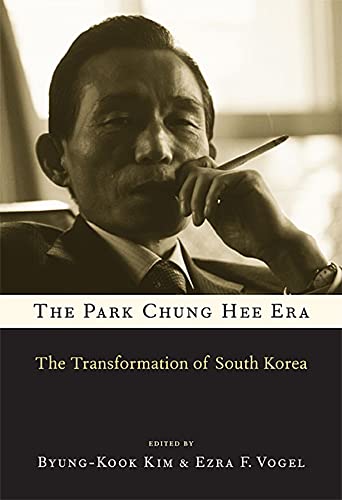
Ebook Info
- Published: 2013
- Number of pages: 744 pages
- Format: PDF
- File Size: 2.13 MB
- Authors: Byung-Kook Kim
Description
In 1961 South Korea was mired in poverty. By 1979 it had a powerful industrial economy and a vibrant civil society in the making, which would lead to a democratic breakthrough eight years later. The transformation took place during the years of Park Chung Hee’s presidency. Park seized power in a coup in 1961 and ruled as a virtual dictator until his assassination in October 1979. He is credited with modernizing South Korea, but at a huge political and social cost.South Korea’s political landscape under Park defies easy categorization. The state was predatory yet technocratic, reform-minded yet quick to crack down on dissidents in the name of political order. The nation was balanced uneasily between opposition forces calling for democratic reforms and the Park government’s obsession with economic growth. The chaebol (a powerful conglomerate of multinationals based in South Korea) received massive government support to pioneer new growth industries, even as a nationwide campaign of economic shock therapy-interest hikes, devaluation, and wage cuts-met strong public resistance and caused considerable hardship.This landmark volume examines South Korea’s era of development as a study in the complex politics of modernization. Drawing on an extraordinary range of sources in both English and Korean, these essays recover and contextualize many of the ambiguities in South Korea’s trajectory from poverty to a sustainable high rate of economic growth.
User’s Reviews
Editorial Reviews: Review “This remarkable book will establish itself as the most significant work on the Park period.”―Stephan Haggard, Graduate School of International Relations and Pacific Studies, University of California San Diego“Park emerges in these essays as a remarkably skillful politician, and the political dimensions of almost all economic policies were foremost in his calculations…This excellent collection of essays convincingly argues that any examination of South Korea as a model of how a poor country can climb out of poverty needs to factor in the personality of Park Chung Hee and the domestic and international politics of the time.”―Michael J. Seth, The Historian“This significant work on the Park Chung Hee era is composed of 21 chapters by as many Korean specialists…The work provides an enhanced understanding of the political and economic goals of Park Chung Hee (i.e., rich country and strong military) and the forceful means he was willing to use to achieve these goals. The scope and insightfulness of this collection of essays on this critical period in South Korean history make it a must for undergraduate and graduate library collections on Korea. It is strongly recommended for private collections on Korea as well.”―J. M. Peek, Choice“Somehow [this] escaped the notice of much of the broader world…This [collection] is superb, as it offers a very detailed and also fairly comprehensive look at the seminal years for South Korean economic growth…Not everyone will want 650 pp. on economic (and other) policy under South Korean autocracy, but if you do this is the book for you.”―Tyler Cowen, Marginal Revolution About the Author Byung-Kook Kim is Professor of Political Science and International Relations at Korea University.Ezra F. Vogel is the author of Deng Xiaoping and the Transformation of China, a finalist for the National Book Critics Circle Award and winner of the Lionel Gelber Prize, and of the international bestseller Japan as Number One. He was Henry Ford II Professor of the Social Sciences Emeritus at Harvard University.Jorge I. Domínguez is Antonio Medero Professor of Mexican and Latin American Politics and Economics at Harvard University.
Reviews from Amazon users which were colected at the time this book was published on the website:
⭐This book consists of the following chapters which illuminate various aspects of the Park Jun Hee era.Introduction: “The Case for Political History” by Byung-Kook KimCh.1 “The May Sixteenth Military Coup” by Yong-Sup HanCh.2 “Taming and Tamed by the United States” by Taehyun Kim and Chang Jae BaikCh.3 “State Building: The Military Junta’s Path to Modernity through Administrative Reforms” by Hyung-A KimCh.4 “Modernization Strategy: Ideas and Influences” by Chung-in Moon and Byung-joon JunCh.5 “The Labyrinth of Solitude: Park and the Exercise of Presidential Power” by Byung-Kook KimCh.6 “The Armed Forces” by Joo-Hong KimCh.7 “The Leviathan: Economic Bureaucracy under Park” by Byung-Kook KimCh.8 “The origins of Yushin Regime: Machiavelli Unveiled” by Hyung Baeg ImCh.9 “The Chaebol” by Eun Mee Kim and Gil-Sung ParkCh.10 “The Automobile Industry” by Nae-Young LeeCh.11 “Pohang Iron & Steel Company” by Sang-young Rhyu and Seok-jin LewCh.12 “The Countryside” by Young Jo LeeCh.13 “The Chaeya” by Myung-Lim ParkCh.14 “The Vietnam War: South Korea’s Search for National Security” by Min Yong LeeCh.15 “Normalization of relations with Japan: Toward a New Partnership” by Jung-Hoon LeeCh.16 “The Security, Political, and Human Rights Conundrum, 1974-1979” by Yong-Jick KimCh.17 “The Search for Deterrence: Park’s Nuclear Option” by Sung Gul HongCh.18 “Nation Rebuilders: Mustafa Kemal Ataturk, Lee Kuan Yew, Deng Xiaoping, and Park Jung Hee” by Ezra F. VogelCh.19 “Reflections on a Reverse image: South Korea under Park Jung Hee and the Philippines under Ferdinad Marcos” by Paul D. HutchcroftCh.20 “The Perfect Dictatorship? South Korea versus Argentina, Brazil, Chile, and Mexico” by Horge I. DominguezCh.21 “Industrial Policy in Key Developmental Sectors: South Korea versus Japan and Taiwan” by Gregory W. NobleConclusions: “The Post-Park Era” by Byung-Kook KimA ruthless tyrant or a visionary leader, an insatiable power-monger or an incorruptible statesman, many Koreans still hate him while also many regard him as one of the most outstanding figures in the whole history of Korea. This book gives you voluminous and arguably objective knowledge to understand his good, bad, and ugly. Though I feel that this book is generally more focused on his positive side, you may have an opposite impression. After finishing this book, you may feel like spitting on his grave as he notoriously predicted.Because each chapter was written by a different author, there are inevitably redundancies in this rather lengthy book. You read about the same subjects repeatedly in different chapters.The kindle edition has some shortcomings in its handling. Its footnote numbers are not linked to their contents. You can jump from a chapter to neither next nor previous one.
⭐The title of this book is strikingly similar to Vogel’s another book “Deng Xiaoping and the Transformation of China” published in the same year 2011. As a Korean person, I actually lived through his era during my childhood and witnessed a sudden national funeral followed by a group of military riflemen guarding my school (was a primary school attached to a university, and of couse the military was placed to surpress any potential student demonstration calling for democracy).I know a lot of people who really hates him, but also a lot of people who admires him so much. However, I always had this feeling that their hatred/respect makes them to become blind-sighted of some aspects of his legacy, like it or not, that we’re still living in. Understanding how those were implemented from the first place is a crucial step required to be able to understand how to fix/improve. Hence I bought this book right after it was published, was reading it from time to time, but still far from completing (about 20% into it; will update the review when I finish).It’s not entirely written by Vogel, but a joint editorship by Vogel and Kim Byung-Kook. A wide range of political scientists participated by contributing a chapter or two. Thus far, I think this is one of the most authoritative book with a lot of cross references. Highly recommended to anyone wanting to learn more details of what really happened during the era. Reading it in English allows me to distance myself from emotions, which I believe it could have been the case for the authors.Hopefully I can finish before the election in Korea in December. His daughter is running for the presidency this time. I wish this book can be published in Korean language sometime in the future…
⭐A very well organized book. You do not only learn how S.Korea became a developed country only within two decades but also enjoy the stories of similar countries like South American, China, Singapour, Taiwan even Japan in the same book. If for S.Korea, a country which has got quite a big financial and technological support from the USA and Japan, catching up developed countries was so diffucult, god really should help the others.Thanks to the producers.
⭐This is for serious students of Korean history and politics. It is a series of tightly written but mostly featureless essays on the inner workings of Parks government and the man himself. It is a valuable historical reference.Personally however I was looking for a book with a more general appeal, ie more cultural detail from the era; personal perspectives, photos, memorabilia. Something that would give more insight into how this important time has moulded the people themselves.
⭐It is a pleasure to read a work written in such a clear and pleasant manner. The book is long and comprehensive; it gives a detailed view of what Park Chung Hee did. I especially enjoyed comparison between successful leaders of Korea, Singapore, China and Turkey. Not a book for a tourist, but would be of interest for people looking deep into how South Korea was able to quickly lift up standard of leaving.
⭐Too difficult to read
⭐Great reference to understand his period in power.
⭐Good product
Keywords
Free Download The Park Chung Hee Era: The Transformation of South Korea in PDF format
The Park Chung Hee Era: The Transformation of South Korea PDF Free Download
Download The Park Chung Hee Era: The Transformation of South Korea 2013 PDF Free
The Park Chung Hee Era: The Transformation of South Korea 2013 PDF Free Download
Download The Park Chung Hee Era: The Transformation of South Korea PDF
Free Download Ebook The Park Chung Hee Era: The Transformation of South Korea