

Ebook Info
- Published: 2008
- Number of pages: 384 pages
- Format: PDF
- File Size: 1.06 MB
- Authors: Edward A. McCord
Description
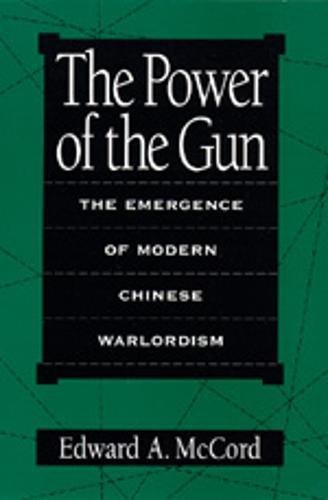
This detailed study offers a new interpretation of the emergence of warlordism in early twentieth-century China. Focusing on the provinces of Hunan and Hubei, Edward McCord shows how the repeated use of the military to settle disputes over the structure and allocation of political power in the early Republic ultimately thwarted the consolidation of civil authority. Warlordism flourished as military commanders took advantage of the growing militarization of politics to establish their dominance over early Republican government.McCord’s study brings into sharp focus the social and political context of warlordism and is an essential bridge completing the narrative of events between two revolutionary eras. With the role of the military in modern Chinese politics receiving renewed attention today, this work is especially timely.
User’s Reviews
Editorial Reviews: About the Author Edward A. McCord is Assistant Professor of History at the University of Florida.
Reviews from Amazon users which were colected at the time this book was published on the website:
⭐Edward A. McCord’s book examines the development of warlordism in Republican China in the period of 1911 to 1921. In this detailed case study of the two central provinces of Hubei and Hunan the author argues that warlordism erupted when military commanders took advantage of the steadily increasing militarization of politics. According to McCord, these commanders became personally ambitious by establishing their own autonomous control over politics as the central government in Beijing was enfeebled after nearly ten years of struggle.Over the course of eight chronologically structured chapters, McCord describes this process and seeks to demonstrate that the rise of warlordism was primarily a consequence of failed civil politics. He writes about the major military and political events during that decade which led to warlordism – namely the four civil wars: Firstly, he depicts the successfull 1911 Revolution which was accompanied by a large-scale expansion of armed forces” (p. 120) and enabled the use of the military in political disputes. Secondly, McCord focusses on the failed Second Revolution in 1913, which temporarily strengthend Yuan Shikai’s central rule but extended military power in Chinese politics even further. Unlike the revolution two years earlier, it was a conflict among self-interested politicians” (p. 171). Thirdly, according to the author, the newly gained self-confidence led Yuan to the reintroduction of monarchy and the ascending of the throne by himself. This provoked a new stage of political instability an resulted in the decisive Anti-Monarchical War” in 1915-16 wich opend the way for the field marshals in the political arena: Thus the path to warlordism was defined” (p. 207). What followed, fourthly, writes McCord, was the North-South War between the competing governments in Beijing an Guangzhou. Its result was a splintered Beiyang Army and an even further divided and oppressed country.There are some minor problems with the book. First of all, it takes McCord a good deal of the volume to describe the causes of the emergence of warlordism, so that the reader might be disappointed to learn only in the very end of the study a little about the warlord rule and the warlord regimes in Hunan and Hubei.Although Professor McCord has good reasons to choose Hunan and Hubei for his case study (because for instance the two provinces were economically and politically linked, there was less foreign influence than in the coastal regions and one has to keep in mind that this was Ground Zero of the 1911 Revolution) he fails to emphasize the inadequacies of an analysis of such geographical limit. McCord could have easily avoided weaknesses like the disregarding of events or political figures like Sun Yat-sen if he had called his monograph simply Warlordism in Hunan and Hubei.Finally, the author uses mostly newspapers, memoirs and American consular reports in Wuhan as sources for his study. By considering more extensive primary sources – such as documents issued by the political and military authorities of that time – this work would have become more persuasive.However, McCord is right to emphasize the political as well as the social context and not only military aspects of the emergence of warlordism – which distinguishes his monograph from earlier works, including Hsi-sheng Chi’s Warlord Politics in China, 1916-1928 [1976]. The author shows that warlordism was not an imminent consequence of the end of Qing Dynasty but a result of the social and political circumstances of the armed forces and (but not only) the prevalent involvement of military by politicians to remain in or seize political power. In that sense McCord’s new approach, defying the widespread understanding of warlordism as a component of a larger process of disintegrating central authority in China, makes – apart from the sketchy conclusion – a serious contribution to our evolving understanding of early Republican China’s turbulent politics and the chaos of warlordism.
⭐The editorial above pretty much says it all about the strength of Power of the Gun: It describes the militarization of Chinese politics in the Republican period, a problem that remains relevant today.Even more importantly, the book is written very, very clearly. Too often in academia, historical studies become an obscure vocabulary contest between professors trying to demonstrate their intellectual credentials, reducing their books to pedantic rambling. Even worse, they use complicated language to veil arguments that are not new or enlightening.Not so Power of the Gun. McCord is as good a writer as he is a historian, and whether the reader knows a lot or nothing about the subject, he or she will gain a strong understanding of the material and a firm sense of the various schools of thought on warlords. Highly recommended.
Keywords
Free Download The Power of the Gun: The Emergence of Modern Chinese Warlordism 1st Edition in PDF format
The Power of the Gun: The Emergence of Modern Chinese Warlordism 1st Edition PDF Free Download
Download The Power of the Gun: The Emergence of Modern Chinese Warlordism 1st Edition 2008 PDF Free
The Power of the Gun: The Emergence of Modern Chinese Warlordism 1st Edition 2008 PDF Free Download
Download The Power of the Gun: The Emergence of Modern Chinese Warlordism 1st Edition PDF
Free Download Ebook The Power of the Gun: The Emergence of Modern Chinese Warlordism 1st Edition