

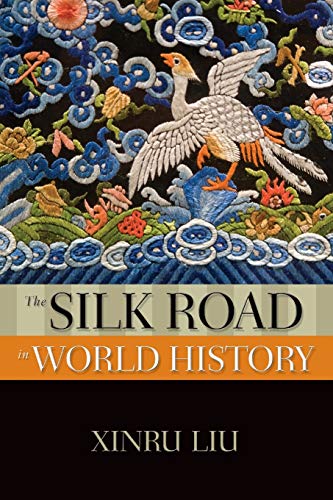
Ebook Info
- Published: 2010
- Number of pages: 176 pages
- Format: PDF
- File Size: 3.26 MB
- Authors: Xinru Liu
Description
The Silk Road was the contemporary name for a complex of ancient trade routes linking East Asia with Central Asia, South Asia, and the Mediterranean world. This network of exchange emerged along the borders between agricultural China and the steppe nomads during the Han Dynasty (206BCE-220CE), in consequence of the inter-dependence and the conflicts of these two distinctive societies. In their quest for horses, fragrances, spices, gems, glassware, and other exotics from the lands to their west, the Han Empire extended its dominion over the oases around the Takla Makan Desert and sent silk all the way to the Mediterranean, either through the land routes leading to the caravan city of Palmyra in Syria desert, or by way of northwest India, the Arabian Sea and the Red Sea, landing at Alexandria. The Silk Road survived the turmoil of the demise of the Han and Roman Empires, reached its golden age during the early middle age, when the Byzantine Empire and the Tang Empire becamecenters of silk culture and established the models for high culture of the Eurasian world. The coming of Islam extended silk culture to an even larger area and paved the way for an expanded market for textiles and other commodities. By the 11th century, however, the Silk Road was in decline because of intense competition from the sea routes of the Indian Ocean.Using supply and demand as the framework for analyzing the formation and development of the Silk Road, the book examines the dynamics of the interactions of the nomadic pastoralists with sedentary agriculturalists, and the spread of new ideas, religions, and values into the world of commerce, thus illustrating the cultural forces underlying material transactions. This effort at tracing the interconnections of the diverse participants in the transcontinental Silk Road exchange will demonstrate that the world had been linked through economic and ideological forces long before the modern era.
User’s Reviews
Editorial Reviews: Review “A welcome addition to the New Oxford World History series…Any general reader interested in silk or textiles will enjoy this book, but so too will one who is captivated by any other aspect of the Silk Road, for it provides a quick but fascinating historical narrative. As a textbook for a world history class, its appeal lies not only in the romance of the Silk Road but also in its use of material culture to write world history by connecting economic and political activities with the religious values of various traditions.”–Journal of Asian Studies”A carefully constructed narrative and analysis…This is an excellent text that will be useful for orientating students and introducing them to the sources and interpretive problems of ancient and medieval Central Asian history.”–World History Bulletin About the Author Xinru Liu teaches in the Department of History at The College of New Jersey and was formerly Senior Researcher at the Institute of World History, Chinese Academy of Social Sciences.
Reviews from Amazon users which were colected at the time this book was published on the website:
⭐This book, being part of the New Oxford World History from the Oxford University Press and by a Chinese author, I had high hopes of it being a well written in-depth scholarly book. Unfortunately, it turned out to be of superficial quality for beginners. The long history and the many cultures the route covers could have been a rich exciting read. Unfortunately, it was just a basic introduction of the history of various cultures along the Silk Road.Even though the traditionally accepted designation of the Silk Road is the northern and southern land routes from China to Central Asia to Mesopotamia to Asia Minor to Europe, and there are plenty to discuss, because the author is an expert in early Indian history, she wanted to bring in India somehow. So she included the sea route that connected Europe to Egypt to Arabia to India, which specialized in spice trades, and took up many pages talking about it. She was so fixated on India, she took every opportunity to talk about Indian culture and expound on its connection to Central Asia. In addition, the “Tea and Horse Road” from Yunnan to Tibet to northern India, to trade tea for horses, was never part of the Silk Road because not every trade route that had anything to do with China was Silk Road.Some “modern historians” try to bring “new history” to the populace and try to emphasize the experience of the common people and their daily lives. This demagogue approach may seem appropriate for our time of democracy, but it misses the point. History is a summation and review of the past. It must not be swayed by the wind of change and cater to the present. Chinese had learned early on that a true historian never flinches at telling the truth no matter how politically incorrect and never cringes even at the threat of death. That’s how history maintains its integrity.Ordinary people live ordinary lives. Their concerns are their family and their decisions rarely affect events beyond their immediate circle. They may live in history but they don’t make history. Traditional historians, “old history”, focus on kings and movers and shakers because their concerns and their decisions affect events that shape history. A good plan from the king-maker could bring peace to a warring nation and a bad decision from the king could bring down a dynasty and plunge the country into chaos and ruin. These are the people who make history.Even though the preface of the book said it tries to bring in new aspects of human history, such as economic and social patterns and interactions among different peoples, it failed to do so. Instead, it followed the traditional path of reciting what the emperors and chiefs and officials and generals did and how their decisions changed the world and created the cultures along the Silk Road. The broad stroke discussions on economic and religion did not go beyond the general concerns of the ruling houses and the effects of their policies.Furthermore, in this modern era when every tribe demands the right of self-rule, when all rebels are good guys and all governments are bad guys, we forget that a large cohesive empire brings many benefits to humanity that small fragmented states cannot. War and strife always disrupts commerce, peace and prosperity are what ordinary people want. It was when Rome stretched from the Atlantic to the Mesopotamia, when Persia stretched from the Mediterranean to Transoxiana, and when China stretched from Central Asia to the Pacific, and when the Mongol rules ran from Korea to Hungary that international trade flourished and the towns along the Silk Road prospered.I was shocked to read here that the Buddha was an austere ascetic. Far from it! The Buddha abandoned the ways of austere ascetics to find enlightenment and to advocate the “Middle Way”. He never said to give up everything. His Theravada teachings were aimed at guiding people to live in the world but not attached to the world. As Buddhism travels and grows, it of course was transform and split into different schools, like Christianity and Islam, to suit different cultures and different levels of humanity. Buddhism in America and in Europe has already gone through a great deal of changes and is being transformed into something entirely new. Again, as the author is a professor of early Indian history, and because Buddhism was an Indian export, she spent a lot of time talking about it and gave India full credit for Mahayana Buddhism in Central Asia and China.During Pax Mongolica, Silk Road flourished and the towns prospered and served as the basis for the official Yam (pony express) system. While traders and diplomats travelled east from Europe to Dadu (Great Capital), compass, gun powder, and printing were among the items that travelled westward from China to Europe and changed the world. While Muslims came east to work with the Mongols, according to Joseph Needhem, girls from northern China also went west to be household servants and revolutionized Italian cooking. Even though the Moroccan traveler Ibn Battuta did arrive in China by sea during the Mongol era, large scale sea trade to Indonesia and voyages to East Africa did not take place under the Mongols as the author claimed. They were not undertaken until early Ming Dynasty after the Han Chinese abandoned the “Western Region” and lost control of the Silk Road. Chinese had to find an alternate route for Chinese goods and opened up the sea trades.It was not until the Ottoman Empire demolished the Byzantium Empire and terminated all trades with the West as retaliation for the crusades that Silk Road began to decline. That’s when Europeans began to rely on the sea route to reach China and why Columbus was commissioned to find a direct sea route to India. But the author ended the book with a whimper and not a bang without mentioning any of the spectacular aftermaths of the demise of the Silk Road that transformed the world in which India actually played a role.I am giving this book 2 stars because, when the author was not obsessed with India and was talking about the Silk Road, she did a fairly decent job, if brief and sketchy in scope. What a shame that she missed a great opportunity to explore in-depth the rich and varied histories and cultures and stories that framed the fabled Silk Road!
⭐The Silk Road is probably one of the most romanticized and famous historical topics out there so books that set the record straight and do it a enjoyable way are always appreciated. However, I really wanted to like this book more than I did but before I explain why, let me first explain the strengths and features of this book.1. Gives a good and readable general overview of the Silk Road and its history.2. Has unique perspectives on the Silk Road. This is the only book where one can find a updated history of the Kushans, a influential yet neglected empire that created the Silk Road as we know it. The book also touches upon the Parthians, Sassanids, Romans, and Byzantines; empires that are hardly spoken of in regards to the Silk Road.3. Has many photos, maps, a concise chronology of events, extensive notes, and a comprehensive list of resources for further study.Now the drawbacks.1. The author specializes in ancient Indian, Chinese, and economic history but not so much with Central Asian history. As such, the book really ignores Central Asia despite it being the heartland of the Silk Road and the region responsible for its very existence.2. What happened to the Silk road? The book doesn’t give a clear answer. It hardly goes in detail about the Mongols and their revival of the Silk Road. Then the text rushes to the end with only a vague explanation of what supposedly ended it. Also it’s not true that the collapse of the Mongol empire ended the Silk Road. No mention of Tamerlane, the Oirats, the Moghuls and more who continued the Silk Road trade. It continued for well over 400 years after the fall of the Yuan Dynasty.3. This is strictly a economic history of the Silk Road as a trade system. The book barely touches upon the cultural, religious, and even political history of the Silk Road and its heartland, Central Asia. Because of that, this book gets rather dull and selective at times.Given that the Silk Road is almost always spoken of in a patronizing Orientalist and Eurocentric manner, this is a good work written with a unique and cultural perspective. Also given that this topic and history is often neglected, this book works as a fine introduction. However, for a academic work, it falls a little flat. This book should be read before or after ‘Central Asia in World History’ by Peter B. Golden for a better perspective of the Silk Road in its vital Central Asian context. In conclusion, this book has its flaws but its still excellent for both scholars and general readers alike and gives a breadth of information that is invaluable and hard to come by.
⭐This is a must for anyone with an interest in the rise and decline of the Silk Road . It is an orderly and concise history and just like a tapestry it fills in the missing gaps that makes the Silk Road history readable and enjoyable . My one criticism is the lack of good maps ….which would make it easier to remember. I had to refer to Internet to clarify certain territories etc . However I loved it . Enjoy !
⭐Very interesting and informative. A good history lesson. Spans a number of countries and cultures. May be a bit repetitive in places, but interesting to see how people from different cultures and different religeous backgrounds were able to conduct trade and commerce together in spite of political turmoil and wars.
⭐While very informative about the origins and significance of the Silk Road, this book is VERY poorly written, almost like an undergraduate research paper.Consider this repetitive and cumbersome passage from page 38: “Since furs were not a Chinese product, and the furs used in Chine generally came from the peoples who lived on the steppe lands north of China,, these furs, incuding sable and other precious kinds, were most likely from the cold areas north of central Asia and China.” HOW ABOUT SOME EDITING, PLEASE!!!Moreover, the book has pretty much worthless maps. The maps it does contain have little to do with the narrative, and much of the book would be greatly enhanced with some well-chosen maps.Summary: good info but very weakly composed and produced.
⭐Great book! I learned a lot!
⭐Having enjoyed my history lessons in primary school, I was scared away from it during high school because it was all about the second world war, and that stuff just bored the s*** out of me. Because of this, I have never really been interested in history for years.I decided to pick up this book because I’d heard quite often about this mystical “silk road” along which tradesmen used to do their business, and thought it was a nice opportunity to start enjoying history again.This book is a nice little overview of the evolution of the silk market over thousands of years, giving perspectives on many related issues, such as the Great Wall of China and the role of Mahayana Buddhism – probably rather simplified, but easy to digest and fun to read.As the preface suggests, this book does not lay down the goings on of one place at one moment, but instead travels back and forth between the most remote countries and times to paint the bigger picture.I will definitely get started on other books from this series as well.
⭐This book has much to offer: it is chockfull of insights, especially about the religions of the Silk Road. That said, it does not completely live up to its grandiose title. Much that could be said about the significance of the Silk Road is absent from this volume.
⭐It is a well written summary of the history of part of the world that receives little exposure.I both enjoyed it and learned a lot.
⭐A first rate general guide.
Keywords
Free Download The Silk Road in World History (New Oxford World History) 1st Edition in PDF format
The Silk Road in World History (New Oxford World History) 1st Edition PDF Free Download
Download The Silk Road in World History (New Oxford World History) 1st Edition 2010 PDF Free
The Silk Road in World History (New Oxford World History) 1st Edition 2010 PDF Free Download
Download The Silk Road in World History (New Oxford World History) 1st Edition PDF
Free Download Ebook The Silk Road in World History (New Oxford World History) 1st Edition