Ebook Info
- Published: 2012
- Number of pages: 232 pages
- Format: PDF
- File Size: 2.27 MB
- Authors: Christopher I. Beckwith
Description
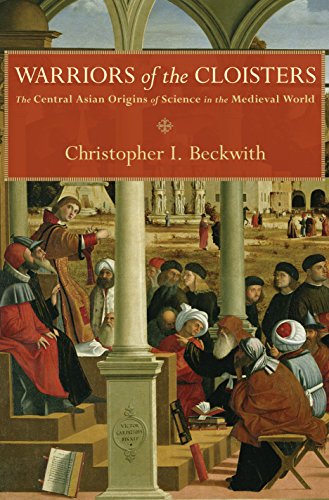
How science in medieval Europe originated in Buddhist AsiaWarriors of the Cloisters tells how key cultural innovations from Central Asia revolutionized medieval Europe and gave rise to the culture of science in the West. Medieval scholars rarely performed scientific experiments, but instead contested issues in natural science, philosophy, and theology using the recursive argument method. This highly distinctive and unusual method of disputation was a core feature of medieval science, the predecessor of modern science. We know that the foundations of science were imported to Western Europe from the Islamic world, but until now the origins of such key elements of Islamic culture have been a mystery.In this provocative book, Christopher I. Beckwith traces how the recursive argument method was first developed by Buddhist scholars and was spread by them throughout ancient Central Asia. He shows how the method was adopted by Islamic Central Asian natural philosophers―most importantly by Avicenna, one of the most brilliant of all medieval thinkers―and transmitted to the West when Avicenna’s works were translated into Latin in Spain in the twelfth century by the Jewish philosopher Ibn Da’ud and others. During the same period the institution of the college was also borrowed from the Islamic world. The college was where most of the disputations were held, and became the most important component of medieval Europe’s newly formed universities. As Beckwith demonstrates, the Islamic college also originated in Buddhist Central Asia.Using in-depth analysis of ancient Buddhist, Classical Arabic, and Medieval Latin writings, Warriors of the Cloisters transforms our understanding of the origins of medieval scientific culture.
User’s Reviews
Editorial Reviews: Review “[W]arriors of the Cloisters convincingly establishes the Central Asian origins of both the scholastic method and the university.” ― Choice”To follow Beckwith is an enjoyable journey through many countries, civilizations, cultures and religions. This book is well worth reading for those who are interested in the spread of ideas and the interweaving of cultures, ideas and beliefs.”—John Bowman, Middle Way”[T]his is a major work of great significance.”—Jeremy Black, European Review of History Review “Building on a broad array of sources and studies, Beckwith highlights one of the early information circuits that crossed the Old World. Once again, Central Asia serves as the pivot of not only the political and military history of Eurasia, but of its intellectual development as well. Beckwith’s erudite and wide-ranging study traces the complex paths via which these ideas and institutions spread, giving us a deeper understanding of the interconnections of Eurasian civilization and the underpinnings of modern science and thought.”―Peter B. Golden, Rutgers University”The insights contained in this book could not have come from anyone else but the inquisitive and resourceful Beckwith. Warriors of the Cloisters draws on research into an extraordinarily broad range of subjects and is certain to elicit debate.”―S. Frederick Starr, Johns Hopkins University”An outstanding and original contribution. Beckwith’s interdisciplinary skills and linguistic versatility support a crucial and critical evaluation that challenges orthodox interpretations of the scholastic method as a solely European invention. Warriors of the Cloisters is likely to fuel scholarly debates and inspire new avenues of comparative research in Eurasian studies.”―Georgios T. Halkias, Ruhr University From the Inside Flap “Building on a broad array of sources and studies, Beckwith highlights one of the early information circuits that crossed the Old World. Once again, Central Asia serves as the pivot of not only the political and military history of Eurasia, but of its intellectual development as well. Beckwith’s erudite and wide-ranging study traces the complex paths via which these ideas and institutions spread, giving us a deeper understanding of the interconnections of Eurasian civilization and the underpinnings of modern science and thought.”–Peter B. Golden, Rutgers University”The insights contained in this book could not have come from anyone else but the inquisitive and resourceful Beckwith.Warriors of the Cloisters draws on research into an extraordinarily broad range of subjects and is certain to elicit debate.”–S. Frederick Starr, Johns Hopkins University”An outstanding and original contribution. Beckwith’s interdisciplinary skills and linguistic versatility support a crucial and critical evaluation that challenges orthodox interpretations of the scholastic method as a solely European invention.Warriors of the Cloisters is likely to fuel scholarly debates and inspire new avenues of comparative research in Eurasian studies.”–Georgios T. Halkias, Ruhr University From the Back Cover “Building on a broad array of sources and studies, Beckwith highlights one of the early information circuits that crossed the Old World. Once again, Central Asia serves as the pivot of not only the political and military history of Eurasia, but of its intellectual development as well. Beckwith’s erudite and wide-ranging study traces the complex paths via which these ideas and institutions spread, giving us a deeper understanding of the interconnections of Eurasian civilization and the underpinnings of modern science and thought.”–Peter B. Golden, Rutgers University”The insights contained in this book could not have come from anyone else but the inquisitive and resourceful Beckwith. Warriors of the Cloisters draws on research into an extraordinarily broad range of subjects and is certain to elicit debate.”–S. Frederick Starr, Johns Hopkins University”An outstanding and original contribution. Beckwith’s interdisciplinary skills and linguistic versatility support a crucial and critical evaluation that challenges orthodox interpretations of the scholastic method as a solely European invention. Warriors of the Cloisters is likely to fuel scholarly debates and inspire new avenues of comparative research in Eurasian studies.”–Georgios T. Halkias, Ruhr University About the Author Christopher I. Beckwith is Distinguished Professor of Central Eurasian studies at Indiana University, Bloomington. His historical books include Empires of the Silk Road: A History of Central Eurasia from the Bronze Age to the Present, The Tibetan Empire in Central Asia: A History of the Struggle for Great Power among Tibetans, Turks, Arabs, and Chinese during the Early Middle Ages, and Greek Buddha (all Princeton). Read more
Reviews from Amazon users which were colected at the time this book was published on the website:
⭐Many scholars of Asia must have wondered, over the years, why so many leaders of early medieval thought and science came from Central Asia–specifically, the area from what is now northeast Iran to far west China. That area, especially from around 600 to 1100 CE, produced dozens of brilliant individuals, as shown recently by Frederick Starr in a major work, LOST ENLIGHTENMENT. For a while Central Asia was the world leader in intellectual pursuits and progress.From Christopher Beckwith’s work, we can see that this explosion of innovation also had a major role in launching science in Europe. Basically, early Buddhists in Central Asia invented the vihara, a school for training religious scholars. This was adopted and adapted by the Muslims, becoming what in Arabic was called the madrasa. It spread to Europe in the 1100s, becoming the college–and fusing with existing guilds of intellectuals to become the university. Meanwhile, the Buddhists had also invented the recursive-argument technique of debating and demonstrating points. This is a technical matter, but suffice it to say that it lies behind modern scientific exposition of ideas and, also, certain common debating practices.These two innovations, combined with the explosion of translations from Greek and Arabic that appeared at that time, drove a spectacular change in European thought: from fairly mindless theology to philosophy, science, and other innovative and intensive intellectual modes. Beckwith compares it with the effect of western thought and customs on Japan in the Meiji era. One result was a culture based on science and scientific progress. I would hold, cautiously, to a traditional view that this did not really happen till the “scientific revolution” of the 16th century, but I agree (following Gaukroger, an author oddly missed by Beckwith) that that “revolution’ was really just part of a fairly smooth upsweep from the 12th century.So far, so good. (There will no doubt be Euro-centrists who challenge the details, but Beckwith blows them out of the water.) Beckwith gets onto shakier ground in saying that nobody else had true science, or at least a scientific culture. I wish he had defined his terms more rigorously. I think he means what my sometime colleague Randall Collins calls “rapid discovery science,” a useful term for the self-conscious attempt to find and prove everything by using rigorous evidential and logical methods. Science, in the normal sense of the term, is wider–I would say universal. Certainly the nonwestern societies I know best–China and the Maya–had it long before 12th century Europe. Maya math and astronomy was not far behind those Central Asians at the same time period. Beckwith argues that if people don’t have a word for science, they don’t have the thing–which is a bit too much like arguing that if people lump dogs and wolves under one term they can’t have dogs. The Chinese and Maya certainly had words for evidence-based types of knowledge, and phrases for scientific ways of knowing.Beckwith also includes an odd passage to the effect that “Modernism” is against science and has also given us two world wars and the breakdown of the arts. I really have little idea what is meant here. Certainly not “modernism” by any usual or accepted definition. The package in question is possibly the Hegelian idealist tradition as expressed in fascism, extreme-left communism, and postmodernism–a motley crew but united by Hegelian origin and a tendency (especially in fascism and postmodernism) to cleave to Nietzsche and Heidegger. But I really don’t understand the passage.I strongly support Beckwith’s overall agenda, of showing how enormously important the transmission of ideas has been in history, and how important Central Asia has been in it all. China benefited enormously in philosophy and medicine; vast medical tomes were translated or summarized in Chinese, and countless new remedies came from the western and Indian worlds via Central Asia.Beckwith and Starr agree that the rise of intolerant, narrow-minded Islam, as exemplified by al-Ghazzali, ended the glory days of Central Asia. Certainly that was a part of it, but the decline of the Silk Road after the fall of Tang was a part of it too, and so were climatic fluctuations that stressed agriculture and trade, and so were marauding nomad warriors.More research is sorely needed on all these matters. Beckwith found himself constantly limited by lack of any modern editions, let alone critical ones, of many of the works. I can only say “Amen.” Lacking Beckwith’s linguistic abilities, I am much more dependent on translations and critical editions. Scholars need to get to work….
⭐I have read previous books by this author, including lost and lighten meant which I thought was a much better book. The author in my opinion, is engaging in biased scholarship , Presumably based on his own political or personal views.In this book, for example, he makes the argument that none of the luminaries described in the book are “Persian ” and mentions that they are not “ethnolinguisticly” Persian. In the case of Razi, Who was from the city of Ray, which is currently incorporated into greater Tehran , he mentions that this city was not within Persia. This is all very interesting to Iranians and the citizens of the what Marshall Hodgson described as the “Persianate” world. The Persian language as it has been spoken over the last thousand years, which is incidentally the language spoken by many of the luminaries he is describing, has its roots firmly in the area (Khorasani) that the author is desperately trying to carve out as a world separate from the “Persian” World that he has created in his own mind. The greatest poets of this particular language such as Rudaki, Ferdowsi and Rumi are from this “Central Asia” that the Author is trying to so desperately separate from the rest of the Iranian cultural Sphere.Ferdowsi for example is considered by all Iranians (the people of modern day Iran, the Kurdish regions, and many people in the Central Asian republics) as the person who kept this culture and language alive in the face of the Arab onslaught. I think it would surprise and perplex (and probably enrage) Ferdowsi significantly if he were to read this authors book, which wants to separate him from the Iran whose culture and history he celebrated in what is the longest epic poem in existence. In the interest of scholarship and honesty, the author needs to explain his own definition of Persian which is apparently different from that of all prior historians including the Greeks.
⭐It is downright astonishing, especially in our times of specialization, how much Chris Beckwith knows about history, linguistics, geography. Moreover his knowledge comes from an unusual angle, neither Western nor the usual Oriental perspective. Beckwith captures the whole of Eurasia, from China and India to North Africa and the westernmost parts of Europe, all pivoting on Central Asia, the internecine zone of contact between several world-economies, empires, and civilizations. The style of argument is calm, confident, and impressively erudite. Several pictures, which hitherto existed separately in our heads, get reconnected to produce a surprisingly new understanding of the whole and the ways our world became modern. The ‘stans’ of Central Asia as the cradle of modernity? Think again after reading this book.
⭐A turgid dissertation in ancient central Asian philology and argumentation. Impressive in its scholarship, but probably most interesting to academics in a fairly arcane discipline.
Keywords
Free Download Warriors of the Cloisters: The Central Asian Origins of Science in the Medieval World in PDF format
Warriors of the Cloisters: The Central Asian Origins of Science in the Medieval World PDF Free Download
Download Warriors of the Cloisters: The Central Asian Origins of Science in the Medieval World 2012 PDF Free
Warriors of the Cloisters: The Central Asian Origins of Science in the Medieval World 2012 PDF Free Download
Download Warriors of the Cloisters: The Central Asian Origins of Science in the Medieval World PDF
Free Download Ebook Warriors of the Cloisters: The Central Asian Origins of Science in the Medieval World