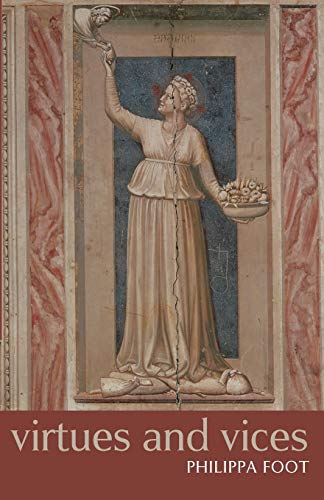
Ebook Info
- Published: 2003
- Number of pages: 232 pages
- Format: PDF
- File Size: 1.08 MB
- Authors: Philippa Foot
Description
Foot stands out among contemporary ethical theorists because of her conviction that virtues and vices are more central ethical notions than rights, duties, justice, or consequences–the primary focus of most other contemporary moral theorists….[These] essays embody to some extent her commitment to an ethics of virtue. Foot’s style is straightforward and readable, her arguments subtle…–Choice
User’s Reviews
Editorial Reviews: Review “Foot stands out among contemporary ethical theorists because of her conviction that virtues and vices are more central ethical notions than rights, duties, justice, or consequences–the primary focus of most other contemporary moral theorists. This volume brings together a dozen essays published between 1957 and 1977, and includes two new ones as well. In the first, Foot argues explicitly for an ethic of virtue, and in the next five discusses abortion, euthanasia, free will/determination, and the ethics of Hume and Nietzsche. The final eight essays chart her growing disenchantment with emotivism and prescriptivism and t heir account of moral arguments. All the essays embody to some extent her commitment to an ethics of virtue. Foot’s style is straightforward and readable, her arguments subtle, ingenious, and some of them important.”–Choice About the Author Philippa Foot is Griffin Professor of Philosophy Emeritus at the University of California, Los Angeles, and an Honorary Fellow of Somerville College, Oxford.
Reviews from Amazon users which were colected at the time this book was published on the website:
⭐This collection of essays is a result of Foot’s initial development of virtue ethics in the 70s at a time when virtue theory was much neglected in analytic moral philosophy. Foot revisited the traditional virtue-based moral theory of Aristotle and Aquinas according to which the moral virtues consist in courage, temperance, and, wisdom that are beneficial dispositions a person who acts morally should possess. Foot suggests that virtues are “corrective” passions that guide a person’s action. But she further suggests that a person may possess certain virtues without acting in a way that makes his action virtuous. Examples are temperance may not operate as temperance in a timid and hard to please person, and, courage may not operate as courage in a person who habitually takes risk to do bad things for personal gain. Possession of virtuous passions/dispositions can in itself be neutral in moral worth. This notion makes how virtues operate in a person’s actions to be nuanced and complicated.Contained in this collection of essays are position papers she took against emotivism and prescriptivism. In “Moral Arguments”, she argued there is no such evaluative element that could capture the ‘whole’ meaning of moral terms such as “right” and “wrong”. Moral terms have determinate meanings to support moral arguments. But she thinks it is not easy to capture the whole moral code in any particular moral view. Yet it is not anything goes. In “Moral Beliefs” she analysed the relationship between evaluative elements and descriptive elements in moral statements. The logical gaps between factual premises in descriptive elements and evaluative conclusion is small if there is a common understanding of how certain effects follow given facts, though she acknowledged that an evaluation is something going “beyond” acceptance of certain facts. No one needs to accept an apparent conclusion just because one accepts certain facts. Here, it seems she accepts the fact/value distinction.In “Goodness and Choice”, she treated the concept of “good” in terms of functionality of that which to be called “good”, such as a good knife’s goodness being based on the knife functioning as a knife. This essay provides a good discussion of various considerations of good making properties in an era before the concept of supervenience.Also featured in this collection of essay is The Problem of Abortion and the Doctrine of the Double Effect. This essay is one of the seminal essays of the trolley car dilemma. She provided many interesting examples to highlight the difference between ‘oblique intention’ and ‘direct intention’ in moral decisions, especially the difference in evaluative assessment with respect to direct action, toleration, and, omission.
⭐By many accounts I’ve read by academic philosophers, Anglo-American ethical philosophy went into a 50 year lull, or muddle, depending on your point of view, after the publication of G.E. Moore’s Principia Ethic in 1904. Moore’s work dominated ethical philosophy largely because of his idea of the “naturalistic fallacy” and his exposure of this fallacy in many leading ethical systems to that point. Many leading philosophers believed that More and his success had made ethical philosophy “boring” (e.g. Mary Warnock) or inconsequently to dealing with the tremendous ethical issues raised during the 20th century. I was interested in Philippa Foot’s writings because she was credited by Warnock among many others with sparking a rejoinder to Moore and at least making ethical philosophical judgment and reasoning interesting again.”Virtue and Vices” is a good representative collection of Foot’s work. It is a collection of her most recent work up to 2002 including ruminations on “virtues and vices”, abortion, euthanasia, freewill and determinis, David Hume and Friedrich Nietzsche as well as a number of her best essays beginning with her celebrated 1958 essay in “Mind” . Because it stops in 2002, “Virtues and Vices” does not cover any of Foot’s later development to the time of her death where she states a more forthright defense of naturalism.Moore himself wrote that his work was supposed to be a foundation for the equally important “science”or study of “casuistry” by which he meant the study of good and evil wherever was found. It’s my belief that Foot and many others who are amount the current leading ethical philosophers are really engaged in casuistry. This may account for the style of writing, not unique to Philippa Foot, of the overprecise and pedantic, almost pettifogging, use of words. Whether it’s called ethical philosophy or casuistry (which might carry pejorative connotations for some) , Foot succeeds in illuminating the discussion of important ethical problems and issues in highly original ways. Anyone who, like me, is looking for a path to get back on track with understanding moral philosophy in the modern world would do well to read and carefully study Foot’s “Virtues and Vices.”
⭐essential reading
⭐great
Keywords
Free Download Virtues and Vices: And Other Essays in Moral Philosophy in PDF format
Virtues and Vices: And Other Essays in Moral Philosophy PDF Free Download
Download Virtues and Vices: And Other Essays in Moral Philosophy 2003 PDF Free
Virtues and Vices: And Other Essays in Moral Philosophy 2003 PDF Free Download
Download Virtues and Vices: And Other Essays in Moral Philosophy PDF
Free Download Ebook Virtues and Vices: And Other Essays in Moral Philosophy