

Ebook Info
- Published: 2009
- Number of pages: 404 pages
- Format: EPUB
- File Size: 0.35 MB
- Authors: Robert M. Pirsig
Description
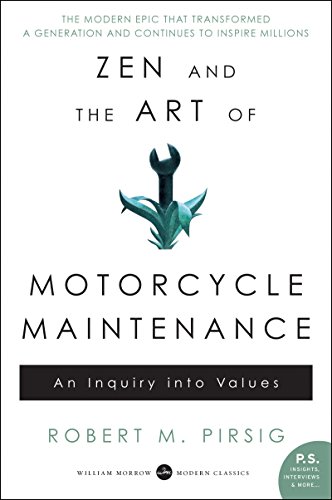
THE CLASSIC BOOK THAT HAS INSPIRED MILLIONSA penetrating examination of how we live and how to live betterFew books transform a generation and then establish themselves as touchstones for the generations that follow. Zen and the Art of Motorcycle Maintenance is one such book. This modern epic of a man’s search for meaning became an instant bestseller on publication in 1974, acclaimed as one of the most exciting books in the history of American letters. It continues to inspire millions. A narration of a summer motorcycle trip undertaken by a father and his son, Zen and the Art of Motorcycle Maintenance becomes a personal and philosophical odyssey into fundamental questions on how to live. The narrator’s relationship with his son leads to a powerful self-reckoning; the craft of motorcycle maintenance leads to an austerely beautiful process for reconciling science, religion, and humanism. Resonant with the confusions of existence, this classic is a touching and transcendent book of life.This new edition contains an interview with Pirsig and letters and documents detailing how this extraordinary book came to be.
User’s Reviews
Reviews from Amazon users which were colected at the time this book was published on the website:
⭐Looking at the reviews here, this book is loved by hundreds and reviled by a small percentage. I wonder what causes so much passion? It’s wonderful that we have, among those who gave the book just one star, so many people who are so far above it intellectually — too familiar with philosophy, too personally enlightened, perhaps — to find any value in it. But I would like to point out to the subset of our best and brightest, those who tell everyone else not to waste their time reading it, that just because you got nothing out of the book doesn’t mean no one else will.One of the complaints I see here is that there isn’t much of the title’s Zen nor much motorcycle maintenance, either — and I note that the author says something about this in his introduction, so it must be true, right? — yet I believe there is plenty of both. If the reader is expecting an introduction to Zen or a How To manual on motorcycle maintenance, those will not be found. It’s not even the author sharing his enjoyment of either of the two fields with his audience. But the themes that run throughout the book explore many of the same ideas the Buddha did, and several concepts important to motorcycle maintenance that will not be found in manuals are discussed throughout the work. But the title really represents the duality that Pirsig puts under his microscope: Zen represents the hippie “go with the flow” attitude that is contrasted to the “slice and dice” schemes of technology, via motorcycle maintenance. And in the end, the title doesn’t say just motorcycle maintenance; it’s the “Art ” that’s critical, because one thing the book is aiming for is to show us that the science of technology is an art — or at least should be an art — and that the two ways of looking at life don’t need to be in opposition, but can be quite naturally blended, to the benefit of all concerned.It might seem like the novel is caught in its time, with language about those who see things as “groovy” vs. “the squares” but the dichotomy between the two has been under discussion in various forms for centuries: romanticism vs. empiricism, passion vs. logic, science vs. religion. The same split is found today underlying two sides of the debate over climate change. If the book is not approached as being literally about Zen and motorcycle maintenance, but as using these as stand-ins for concepts that can be much larger — or even much smaller — there is a lot to be gained here.Another complaint is that the protagonist is not sympathetic, but that’s because this isn’t a novel written from the romantic side, nor, really, the empirical side — it’s not even a novel, though it reads a lot like one — it is a true-enough tale of relationships between two related men, and a father and a son, and a road trip that carries with it time for plenty of slow discussion of philosophy. The book takes its time putting the pieces together, and the author isn’t trying to win our love — if you can approach the book on its own terms rather than with a whole load of expectations about what it should do and how it should do it, you may get something out of it — but to truly enjoy it, you’ve got to go with the flow, you know?I know I get a lot out of it every time I read it. I love road stories, and this one is paced just like a real long-distance trip, with long stretches of time to think things through interspersed with short breaks for taking care of the business of life. That what’s going on in the environment, relationships, and other encounters reflects what’s being thought through in the long stretches is a small bonus. The writing is clean and evocative, enjoyable. For the most part, the carefully constructed introduction to all the elements needed to understand the philosophy is gentle enough to be clear and not overly taxing, at least until the deepest parts, which can be hard to follow (and for good reason). The elements of psychological mystery captivate me each time.I first read ZAMM the year it was released, in the mid-70s, and have read it at least every five years since then, and each time I thoroughly enjoy it. The first time through, I could not follow the philosophy all the way down into the descent into madness it brought on. Five years later — with time for the ideas to be examined through my own life — I got it, even agreed with it. This time, this reading, is the first time I ended up doubting the validity of the greatest philosophical insights the story offers. Ironically, it’s my deepening understanding of Buddhism that changed my mind.There really is a lot of Buddhism in this book, and not specifically Zen, either, but the deepest themes common to all forms of Buddhism. The questions about the wisdom of dividing the world up into a duality of the physical vs. the mental, of seeing ourselves as somehow separate from everything else, these were explored by the Buddha, too, though the framework he used to discuss these ideas was — obviously — nothing to do with motorcycles. In Dependent Arising he, too, considers how it comes to be that we split the world in two. “Name and form” he calls this split, and later thinkers have described what he was talking about as the same subject-object division that Pirsig is mulling over in ZAMM. The Buddha, though, says that it is “desire for existence” — not quality — that, to borrow Pirsig’s phrase, “is the generator of everything we know”. I tend to agree with the Buddha because I can see in our lives, and through our sciences, what that desire for existence is and why it drives us to divide the world up the way we do, and exactly how it leads us into trouble. I can’t say the same for Pirsig’s metaphysics, but that doesn’t stop me from deep enjoyment of the book. I hope to have another half-dozen five-yearly reads, if I’m lucky, and — who knows — maybe I will come around again to see it the way he does.
⭐There are only a handful of books that have really changed the way I’ve looked at things; Jerzy Kosinski’s The Painted Bird, Victor Frankl’s Man’s Search for Meaning, Julian Jayne’s The Origin of Consciousness in the Breakdown of the Bi-Cameral Mind, Ludwig von Mises’ Human Action and Robert M. Pirsig’s Zen and the Art of Motorcycle Maintenance (ZAMM). Pirsig’s book may be the most profound because it not only challenges, but re-labels our entire thought process, challenging many of our most deeply held values. In fact, it’s subtitled, (An Inquiry Into Values).Proof that I’m not alone in assessing the impact of ZAMM is the fact that it has remained in print for nearly three decades since it was first published in 1974. That’s quite an achievement for a book with such a clunky title – a book whose first publisher warned Pirsig not to expect “much more” than the $5,000 advance because, “works of this kind rarely sell in volume” and whose author readily states up front that it “has little to do with the study of Zen and isn’t all that accurate when it comes to motorcycle maintenance either.”On the surface, ZAMM is a very simple story about the narrator’s cross-country trip on motorcycle with his emotionally troubled son, Chris and their technologically challenged neighbors, John and Sylvia Sutherland. Pirsig wraps a brilliant philosophical analysis of values, in a road story that pits Phaedrus (the narrator’s former self) against his current, post-electroshock persona, his son and the techno-phobic Sutherland’s.The story unfolds as a series of talks or Chautauquas, in which the narrator explores such topics as “Classical (emphasis on underlying function) Vs Romantic (emphasis on external form)” styles of thinking, “defining quality” and “insanity as a rejection of the accepted mythos” (an idea previously explored by Thomas Szass).Ultimately, Pirsig does nothing less than re-focus the nature and definition of QUALITY. What is it? How do we define the “present” when everything we’re conscious of has already happened, been processed and is already a part of the past?Phaedrus looks at quality and notes, “we all know it when we see it, but how is it truly defined? What makes one thing of greater or less “quality” then another?” He comes close to quantifying it in his “Church of Reason Lecture,” which starts on page 142 of the original paperback release.Pirsig breaks the world down into two outlooks, Classic (which focuses on the underlying function) and Romantic (which focuses on the outer-lying form). Aesthetics (the study of beauty) is form based or Romantic thinking, while mechanics (the study of how things work) is function based or Classical thinking. He uses this to explain why different people see the same world in very different ways. In this journey he shows the difference between the two as the difference between the narrator’s Classical outlook and that of the Sutherland’s Romantic one.John and Sylvia both enjoy the look and feel of riding a motorcycle, but despise the mechanical chores of keeping it functioning at top proficiency. John is proud of his shiny, new and very expensive BMW motorcycle, but can’t get into the daily maintenance of it. Phaedrus, on the other hand, is primarily attracted to and focused on the underlying form of the motorcycle. He is fascinated with how it works and what causes it to break down. Phaedrus is interested in the mechanics of the bike because he wants to minimize its weaknesses and maximize its effectiveness. The Sutherland’s just want to ride, and to avoid at all costs the mechanics of the thing because that’s what they’re on vacation for – to get away from the mechanistic world.This Classic/Romantic split is important today because it explains all of our contemporary socio-political schisms so well. Emotional thinking is always Romantic, while pragmatic or logical thinking is always Classical. Both sides see only one true way of looking at things and both overlook an important part of the puzzle of life.It’s why so many Leftists wear the “bleeding heart liberal” tag as a badge of honor. It feeds their emotionalism. Anything that sounds compassionate, feels good or “helps people,” is, to their form based thinking, “good,” and people who espouse self-reliance and individual responsibility are, in their view, “mean-spirited, Social Darwinists and well…evil” On the other hand, that’s why economic Libertarians and social conservatives see “do-gooder liberals” as “grossly misguided dupes who care nothing for helping people help themselves and as well…evil.”It’s why, Romantic thinkers rarely use facts. They support their positions on what “feels right,” or “fair.” It’s also why, when emotional Leftists are confronted with facts they don’t like, they interpret the data as “angry” or “argumentative.” This also explains why Classical thinking Libertarians and Romantic thinking Leftists don’t communicate. Classicists deal in pragmatics and facts, while Romantics deal in feelings and appearances.What Pirsig does, is synthesize both Classical and Romantic components into a sort of “unified field theory” of living. He offers a vision of a complete whole – a fusion of logic and emotion, form and function. An ideal whole that we’re still very far from. An ideal that cost his narrator, Phaedrus, dearly.Upon reaching Montana, the Sutherland’s split and head south, while the narrator and his son head on toward Bozeman, the College town in which the narrator’s former self (Phaedrus) taught. As they get closer to Bozeman, the pull of the narrator’s former self (Phaedrus) grows stronger and he begins reliving some of the philosophical questions that had brought Phaedrus to the brink of emotional breakdown.The entire book becomes a journey of self-discovery in which the reader comes along for a ride. As the narrator gets in touch with the questions and pursuits of his former life, he realizes that, in order to connect with his son, Chris, he must first confront his former self (Phaedrus). Read it for yourself, it’s truly a modern day masterpiece.
⭐I liked the parts of the relationship between father and son.The China quad were hard to follow and took quite a bit of concentration.I was just making sense of things at the very end.
⭐It’s one of those ubiquitous books that’s kept turning up on library shelves, charity shop shelves and bookshop shelves throughout my life and yet i’ve always walked away from it, until now.I’ve always had quite a deep interest in Zen and it always seemed to me that putting it with motorcycle maintenance just wasn’t something i wanted to know about. But now i have a motorbike that needs some maintenance and this book turned up in Kindle daily deals for 99p i thought the time was right.But oh, how wrong i’ve been all these years. It’s not a book about Zen or how to fix a motorbike while practising Zen, it’s a wholly different thing altogether.In fact, it’s a road trip book where our narrator takes his son on a road trip on an old motorbike across the USA. But it’s a road trip with a difference.At it’s heart it’s a book about insanity, the condition of society and its relationship to technology, and a fair bit of Greek philosophy as well; and it’s all broken up with the story of the road trip. And it’s simply, awesome.With hindsight i’m happy that i’ve never read it until now as i’m much older and it really blended nicely with my own life experiences: having dropped out of a Philosophy degree course for much the same reasons and now many years later i can look back and see things more clearly.And the ending in the ‘Afterword’ is what truly completes this book. It really is a masterpiece of writing.
⭐This is a challenging book to read and I admit it took a while to ‘get to grips with it’.I feel; personally speaking, that this is a book I will need to re-read to fully understand all that it offers, but I can understand the criticism offered by others who find it puzzling, banal or just self-indulgence by the author.The author was clearly very intelligent and well versed in Classical literatureHaving completed the book, I found this to be one of, [if not the hardest book I have ever read]. The author seemingly was dealing with his own intellectual struggles with the duality of life and this is the context of the book, set within a motorcycle journey that he took previously and which he now repeats with his son and a couple of friends.It is my take, that it was written to illustrate both the perspectives of himself now when ‘recovered’; and also his recollections of earlier perspectives of his mind whilst he was facing these challenges. We would label these mental health challenges, [I think he records it as catatonic schizophrenia], but I like the alternative supposition posed by the author when he suggests a Zen perspective for the dichotomous struggles of his mind/personality.He uses motorcycle maintenance as a metaphor for some of the aspects of our man-made constructs of human life and learning.I have learnt from reading this book and would like to see it made into a film, if someone intuitive enough had the capacity to properly demonstrate the meanings and the lessons that Mr Pirsig was trying to tell us about.
⭐In fact its time has never gone away. This ingenious book gets to the heart of what has ailed Western, and now global, culture for hundreds of years, while telling a compelling story that combines a road trip with the slow revelation of a journey through mental collapse. Expect to be challenged to think hard during philosophical passages, as well as delighted by the parallel stories of the narrator’s road trip, his relationship with his son, who rides with him, and his re-creation of his previous self. In today’s world where we are increasingly seeing the catastrophic results of putting ‘reason’ and apparent objectivity before true value-based judgements in our relationship with nature, this book deserves to be read by everyone who has a mind and cares about how they use it.
⭐If there is to be anything to be taken away from reading this book, its that an individual can spend a large part of their life on something which is possibly delusional.It seems that Persig took the English word ‘quality’ and tried to imbue it with more meaning that it actually has, to come up with a general theory of reality.Most people would easily be able to define ‘quality’ as the degree to which an object or function meets expectations, however, Persig felt he needed to reverse engineer it with a mishmash of philosophy. I suspect he arrived at his ‘enlightenment’ to satisfy his large ego (Zen?) by cherry picking logic and references to make it seem that he was standing shoulder to shoulder and possibly even succeeding Plato, Kant and other greats.Whilst I had many questions about his deductions there is one glaring error in his logic which needs to be called out since it does call into question his logical intelligence. He attempts to prove the number zero exists by contradiction, saying that “digital computers, which function exclusively in terms of ones and zeros, should be limited to just ones” (if zero didn’t exist) and thus it would be absurd if zero didn’t exist. What he doesn’t realise is that the ones and zeros in binary could be represented by any symbols – the most obvious being ‘on’ and ‘off’, or ‘open’ and ‘closed’.Despite these criticisms, I think the book does have a good format especially regarding the motorcycle trip and maintenance. The references in isolation are interesting and have inspired me to read more philosophy and some of the ideas are thought provoking (but its not clear whether they are original) e.g. we never experience the present via senses because of the time it takes us to perceive light, sound etc.I give it two stars because I don’t believe people should put the effort into reading this – go with something more robust, either way its going to be a hard read.
⭐One can see why this book was a hit when published in the 1970s – coming after the Beatles met maharishi and transcendental meditation. This book an exploration of what man and machine (and what more male symbolic than a motorbike) is all about.Not only dated (philosophical thought, even SF thinking advanced in last 50 years), Pirsig’s painting with words becomes more and more abtsract as the chapters pass. They say all art is to get a reaction. For me it was not only finding some of his brush strokes (thinking) disagreeable, but also, mainly eye/mind glazing boredom/bafflement. Book discarded under half way through.
Keywords
Free Download Zen and the Art of Motorcycle Maintenance: An Inquiry Into Values in EPUB format
Zen and the Art of Motorcycle Maintenance: An Inquiry Into Values EPUB Free Download
Download Zen and the Art of Motorcycle Maintenance: An Inquiry Into Values 2009 EPUB Free
Zen and the Art of Motorcycle Maintenance: An Inquiry Into Values 2009 EPUB Free Download
Download Zen and the Art of Motorcycle Maintenance: An Inquiry Into Values EPUB
Free Download Ebook Zen and the Art of Motorcycle Maintenance: An Inquiry Into Values