Ebook Info
- Published: 2016
- Number of pages: 478 pages
- Format: PDF
- File Size: 2.33 MB
- Authors: Roberto Mangabeira Unger
Description
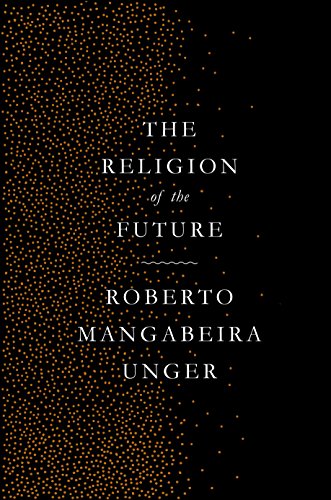
A new philosophy of religion for a secular worldHow can we live in such a way that we die only once? How can we organize a society that gives us a better chance to be fully alive? How can we reinvent religion so that it liberates us instead of consoling us? These questions stand at the center of Roberto Mangabeira Unger’s The Religion of the Future: an argument for both spiritual and political revolution. It proposes the content of a religion that can survive without faith in a transcendent God or in life after death. According to this religion—the religion of the future—human beings can be more human by becoming more godlike, not just later, in another life or another time, but right now, on Earth and in their own lives. They can become more godlike without denying the irreparable flaws in the human condition: our mortality, groundlessness, and insatiability.
User’s Reviews
Reviews from Amazon users which were colected at the time this book was published on the website:
⭐An amazing book that tackles the incoherences and inconsistencies of religion head-on. Unger is a professor of law who surgically, rigorously, and deeply considers why religion matters. This is not an easy read. He is a master of language, but is dense, deep and philosophical. His assessments often contain brutal truth about the human experience. His encyclopedic knowledge of all the world’s religions informs his work.All religions tend to be focused on history, or are fundamentally backward looking. He asks how religion should evolve. I am in a small reading group with a Rabbi, a muslim, Christians, a historian, a prominent scientist, etc. This book is challenging all of them in a satisfying way. As an atheist, I find reading it inspiring and spiritual. It puts me in a hopeful mood. Now, that’s an accomplishment!
⭐I am happy, though, that I have read Ungers part of “The singular Universe and the reality of time” before I began reading this book. The line of thoughts in this book seems to be a natural extension. I am not a native English speaker, and – for me – it took some time to understand, which I believe I do, his way of thinking. the book is very enjoyable. “understand” yourself
⭐I had to read this book twice to properly absorb it. This is a carefully written work of philosophy. I also believe it is a profound and important book. Yet looking it up on Amazon for reviews is initially surprising: as of this writing, there are only 4 reviews for the book, and there have only been 4 reviews from before my first reading of the book, which ended 3 months ago on July 10. (My second reading ended today, October 10.)I believe I understand the reasons for this lack of Amazon contributor attention. You have to be educated in philosophy if you want to understand large stretches of this book. It would be a monumental task for someone without an academic background in philosophy to read and comprehend the whole of this book. But the devil is in the details. You get into the details and you’re receiving instruction on how to live from a teacher, if not a prophet.But this book requires matching wits with Unger, a very educated and deep thinking man who is unrestrained about using all of his intellectual training in expressing his monumental thoughts in this book. It requires so much concentration and background in philosophy and science that most readers probably rush through the book, comprehending very little and not realizing how profound and prophetically significant for the times this book is.I’m sure Unger hopes there’s a sympathetic readership somewhere out there. But he’s not going to let any notion of it color what he wants to say or how he wants to say it. I don’t think Unger has any particular category of readers in mind. Its readership will have to find itself. He’s not letting the way he wants to write be influenced by his readers’ views. He’s just doing what he wants to be doing.So most people who’ve run their eyes over the words in the book don’t bother reviewing it on Amazon. It just doesn’t interest them. They probably daydreamed through most of it.I would guess that philosophers who do understand the book usually don’t consult with Amazon reviewers or contribute to Amazon reviews, whether or not they appreciate the book. They restrain from this activity out of professional courtesy to their peers. (The most accessible source for the average individual of reviews of books, movies, operas, etc. from scholars in the field would be Wikipedia, which contains a rather lengthy scholarly summary of Unger’s life. Judging from this biography and hints in The Religion of the Future, Unger was raised a Catholic. He’s from Brazil., which gives credence to this speculation.)But none of that is important. What’s important first of all is Unger’s ability to communicate to the native English language reader the fullness of his ideas in a formally written style that influential readers would understand and respect (especially college English professors). Unger has obviously thought a lot about the expressiveness of language. The writing style of Unger indicates an academically studied English language. He must have actually studied English academically, because English is a second language for Unger and he wanted to learn to write professionally in English as correctly and as academically respectable as possible, with unabashed scholarship visible throughout the book as an additional stamp on his right to be writing such a book.Unger has a precise and academic understanding of every word he uses and I’m sure off the top of his head can give you a precise definition of every word as well. So he writes as clearly and precisely as possible, in language so profound that any fool could understand Unger’s every sentence that isn’t discussing technical philosophical matters. The fool need only think about the sentence for at least a half an hour, trying to comprehend the mind-blowing meaning in the sentence.What’s important second of all is trying to understand where all Unger’s ideas came from in the first place, and when they emerged. The most compelling explanation for the profundity of this book is based on his past years of explaining a variety of issues in life in fine detail in his many published books. During these years of contemplation, he achieved an unusual degree of insight above and beyond the conflicting and compromising forces in existing social structure, an insight that transcends the presuppositions of these conflicting and compromising forces and views them objectively. His perception is unbiased and deep. He stands above the common disputes and differences in public thought. Notice also that Unger’s perception is godlike: it has the properties of the perception of the True God.Christianity got blocked in its struggle with the world. A religion of the future would solve the problems in the struggle with the world that Christianity (and Judaism and Islam) could not. Unger’s perspective is cosmic and prophetic. But I wonder if his prose could not be rearranged a little so that it was easier to comprehend, not postpone the punch line so much? It’s not so much that he is postponing for dramatic effect, but that he’s just giving us his discursive train of deep thought. He doesn’t have to sacrifice more easily assimilable prose merely to avoid false drama. When it’s called for, Unger has moments of powerful drama, drama that practically leaves you gasping with wonder and delight.All of these explorations by Unger, guided by his perception, culminated in the writing of The Religion of Future. It took him this long to “put it all together” (mostly): a lifetime of thinking and dancing around the foundations of the religion of the future.
⭐I’m not well-read in theology, philosophy, or politics, so I can’t make comparisons; I speak only from my own experience. Unger’s writing is entirely accessible and wholly convincing. His work is not for academics and scholars, it’s for everyone. He repeats and reminds his main points frequently, a good way for simpler minds like my own to not lose the larger ideas amongst the necessary detail. I was looking for a convincing answer on how best to live my life and in this book I found it.
⭐It appears that the author is writing in an attempt to impress academics. His sentences are filled with jargon and are almost unintelligible. I have a graduate level degree and, at best, can decifer only the gist of what he is trying to say. It is unfortunate because I think he may have something worthwhile to say.
⭐RMU’s impeccable logic, deep insight and beautiful language make this book not only a great read but also a continuous source of self-reflection and analysis in an effort to understand oneself and humanity. Let’s be grateful that we can benefit from the wisdom of a great mind!
Keywords
Free Download The Religion of the Future in PDF format
The Religion of the Future PDF Free Download
Download The Religion of the Future 2016 PDF Free
The Religion of the Future 2016 PDF Free Download
Download The Religion of the Future PDF
Free Download Ebook The Religion of the Future